Best Business Idea Analysis Tools for Entrepreneurs in 2026
In 2026, the failure to use purpose-built analysis tools before committing to a startup concept is not an innocuous omission — it is a strategic handicap. The market has never been more competitive, the cost of building a product has never been lower, and consequently the volume of undercapitalized, poorly validated products competing for the same narrow customer segments has never been higher. Founders who use the correct analytical stack before writing code arrive at their first customer acquisition test with a structurally vetted concept, a pre-defined ICP profile, and a unit economics model that has already passed a basic viability threshold. Founders who skip this phase arrive with optimism and a beautiful logo.

- Category 1 — Dedicated AI Analysis Apps: Structural audit and framework-driven validation.
- Category 2 — Search Demand Validators: Proving organic market pull before building.
- Category 3 — Customer Survey & Interview Tools: Quantifying pain severity and willingness to pay.
- Category 4 — No-Code Prototype Platforms: Testing UX assumptions without engineering costs.
- Category 5 — Painted Door / Demand Test Platforms: Proving purchase intent with real money.
The Optimal Tool Usage Sequence
Before listing specific tools, the most important decision is which category to use first. Using tools out of sequence produces misleading results: running a beautiful Google Ads demand test for an idea that has a fatal unit economics flaw will produce accurate conversion rate data for a concept that is structurally unviable.
Category 1: Dedicated AI Idea Analysis Apps
This is the most important category and the one most commonly skipped. A dedicated Idea Analysis app forces your concept through a standardized venture evaluation framework — Pain Severity, TAM calculation, competitive moat assessment, unit economics viability — and generates an adversarial, categorical risk assessment regardless of how compelling your concept sounds.
The critical distinction from generic AI tools like ChatGPT: analysis apps are structurally optimized for risk identification, not user satisfaction. They will tell you your TAM is insufficient or your unit economics are inverted. ChatGPT will agree with almost anything you pitch it. Use analysis apps for structural validation; use ChatGPT only in Phase 3 (Generate), after validation is complete.
Category 2: Search Demand Validators
Search demand data is the closest proxy available to measuring organic market pull before a product exists. When thousands of people are actively typing queries into Google about a problem you propose to solve, that behavioral signal constitutes strong evidence of pre-existing demand — free of your own optimism bias.
| Tool | Primary Use | Cost | Best For |
|---|---|---|---|
| Google Trends | Macro search trend direction over time | Free | Verifying the market is growing, not dying |
| Google Keyword Planner | Monthly search volume for specific queries | Free (Google Ads account) | Identifying high-volume, high-intent search clusters |
| Ahrefs | Search volume + competitor content analysis | $99-399/mo | Competitor keyword gap and backlink analysis |
| SEMrush | Paid search competitive intelligence | $129-449/mo | Identifying PPC competitor ad spend and copy strategies |
Category 3: Customer Survey & Interview Tools
Quantitative search data proves that people search for solutions to a problem. Customer interview and survey tools prove how severely people experience the problem, what they currently use to cope with it, and how much they would realistically pay for a dramatically better solution. These two data sources are complementary and both are necessary.
- Typeform — The highest-converting survey tool aesthetically. Use it to run an 8-question pain validation survey distributed via LinkedIn or Reddit targeting your exact ICP. Measure the percentage of respondents who indicate the problem is "very significant" and priced at above your target price point. Free tier: 10 responses/month.
- Calendly + Zoom — Book 30-minute customer discovery calls. Record them (with permission). Analyze the language customers use to describe the pain — this language becomes your landing page copy, which dramatically increases Painted Door conversion rates.
- Loom — Record a 90-second product demo using a Figma prototype and share it with 20 ICP-matched LinkedIn contacts. Ask for specific feedback on the proposed solution's core mechanism. Free to create and share unlimited videos.
Category 4: No-Code Prototype Platforms
Before engineering anything, validate that the UX flow your product requires creates the expected user behavior. No-code prototypes built in Figma or Maze allow you to observe real users interacting with your proposed interface — identifying friction points, confused navigation, and failed affordances — before committing to any production engineering.
- Figma — The industry standard for UI design and interactive prototyping. Build a fully clickable prototype of your core product flow in 4-8 hours. Share via link with 5-10 target users and observe whether they complete the primary action without guidance. Identifies critical UX failures before code is written. Free tier is sufficient for prototyping.
- Maze — Automated usability testing with quantitative metrics. Import your Figma prototype, define the target task, and distribute to users. Maze automatically calculates task completion rate, time-on-task, and misclick rate — providing statistical confidence in UX decisions. $99/mo for full testing capability.
Category 5: Painted Door / Demand Test Platforms
The final validation category generates the most reliable demand signal of all: real people attempting to exchange real money for your proposed solution before it exists. Build a landing page, describe your product, add a real conversion mechanism, and drive targeted traffic.
- Carrd — The fastest way to build a single-page Painted Door test. $19/year for the Pro plan. Build your landing page in 2-3 hours with a clean, professional design. Connect to Stripe or Typeform for the conversion event. Optimal for founders without design background.
- Webflow — More design control and CMS flexibility than Carrd for more complex proposition pages. $16-23/month. Best when you need multi-section storytelling or a blog-style content structure alongside the conversion element.
- Google Ads / Meta Ads — Drive 300-500 qualified visitors to your Painted Door page with $80-120 of carefully targeted advertising. Google Search Ads (targeting your high-intent keyword clusters from Phase 2) are ideal for solution-aware audiences. Meta Ads are better for problem-aware audiences who do not yet know your category exists.
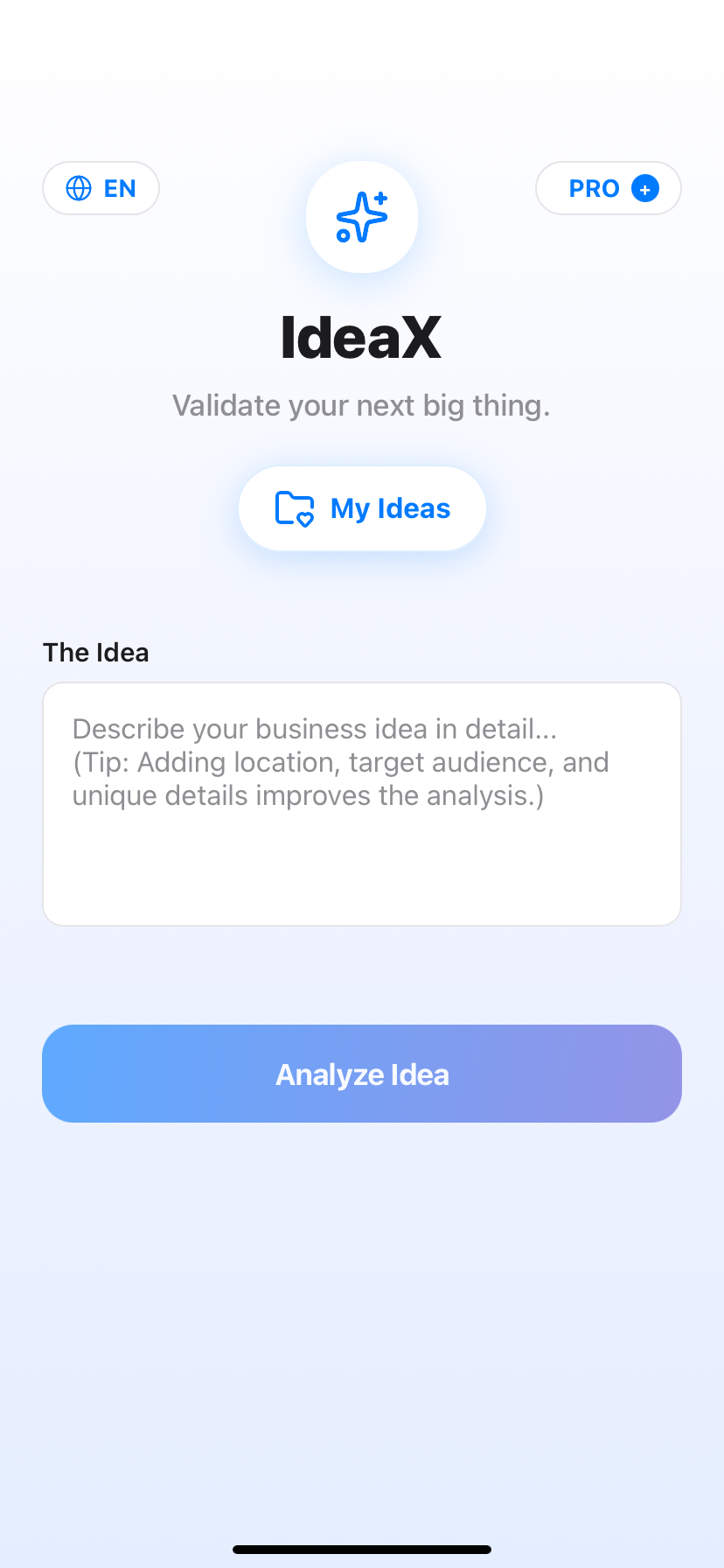
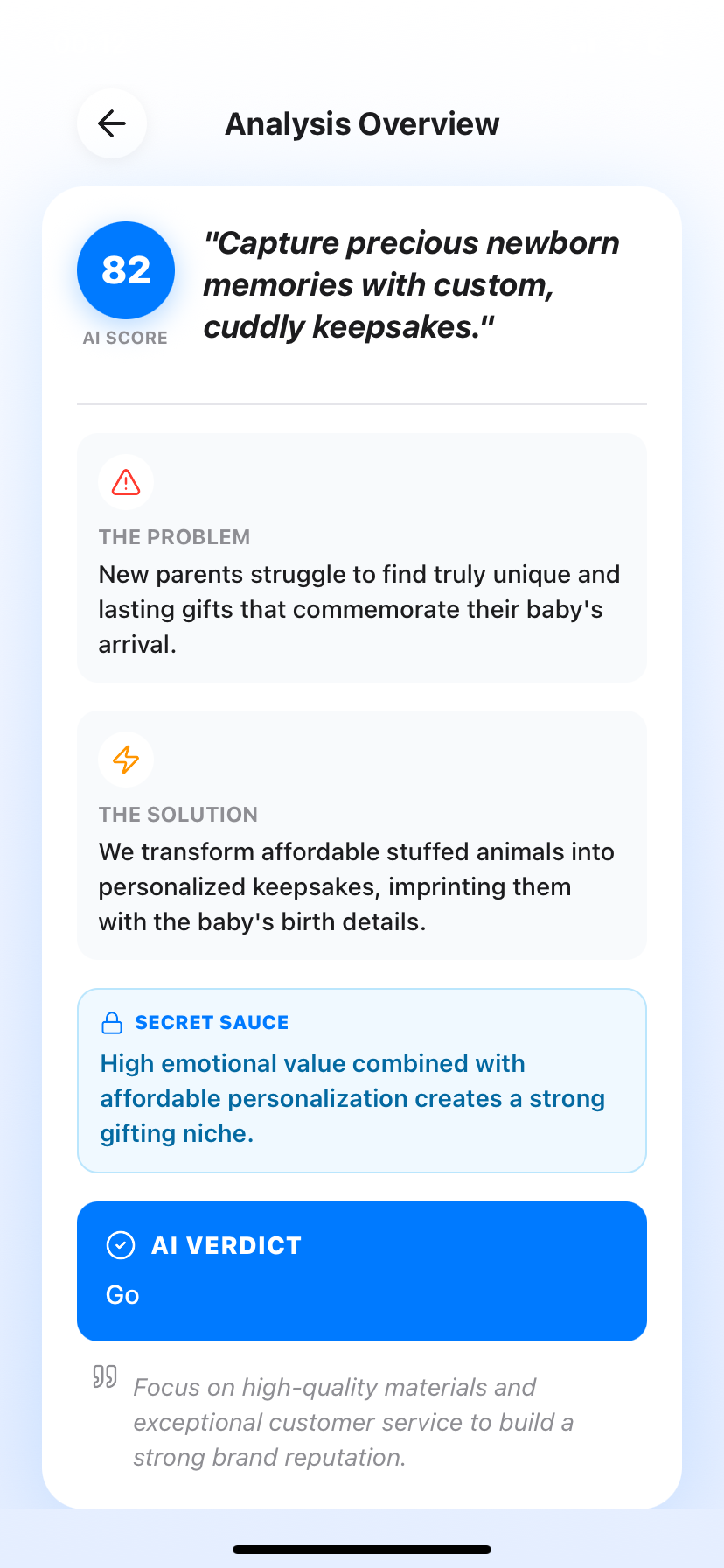
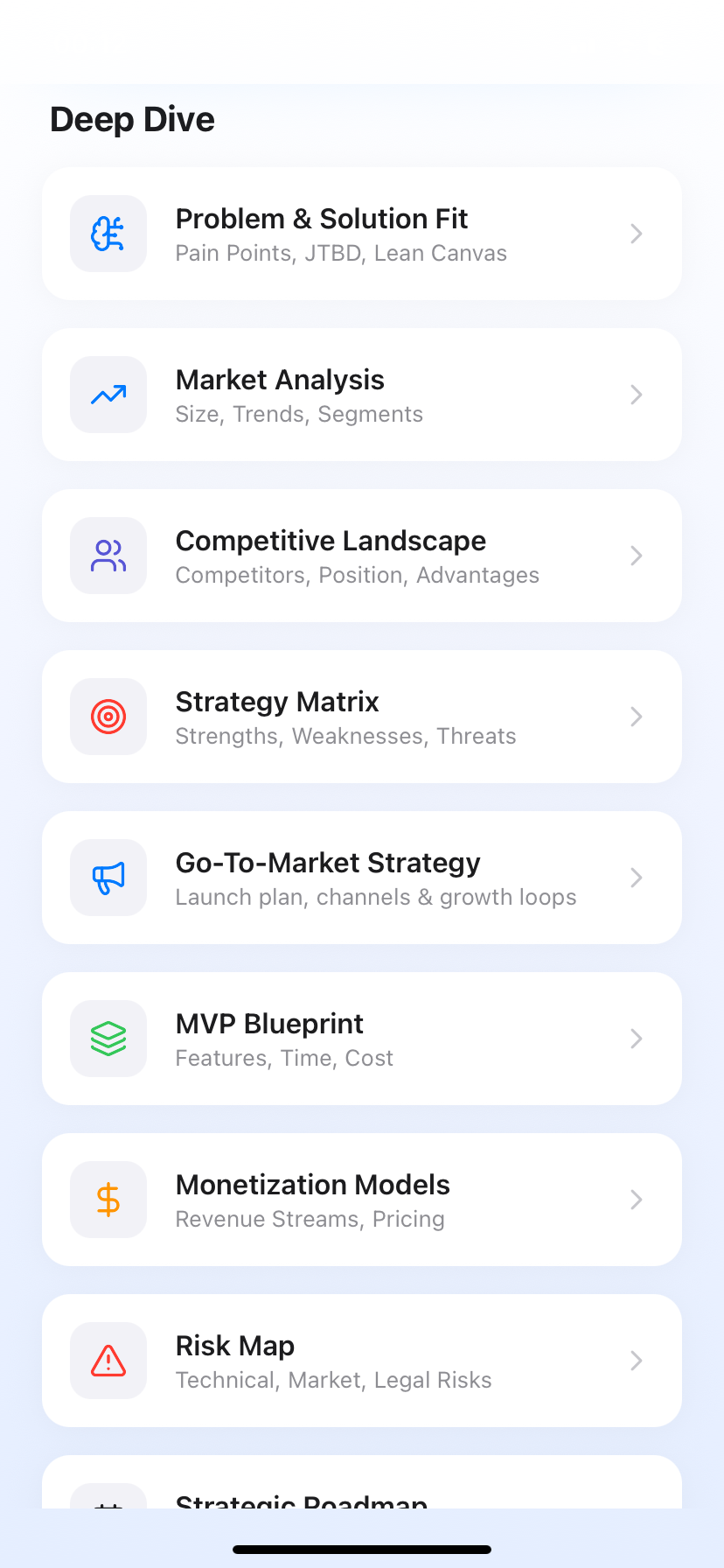

IdeaX: Business Idea Analysis
The apex tool for startup structural validation.
Start with the structural audit. Then use the rest.
Before you open Ahrefs or build a Carrd page, run the structural audit that determines whether your concept is worth validating at all. IdeaX is Phase 1 in the optimal 5-phase validation stack: submit your raw concept and the AI generates a complete Pain Severity rating, TAM estimate, competitive moat score, and unit economics viability assessment in under 10 minutes. Build your entire validation campaign on a structurally sound foundation — not on optimism.
Frequently Asked Questions (FAQ)
What is a business idea analysis tool?
A specialized platform that applies structured venture evaluation frameworks to measure feasibility, market demand, competitive landscape, and unit economics viability before development begins. Unlike generic AI or manual research, purpose-built analysis tools surface the structural risks most likely to cause a startup to fail — before you invest time or capital.
Are SEO keyword tools good for idea validation?
Yes — for a specific, limited purpose. Ahrefs and SEMrush measure existing search demand: how many people type queries related to your proposed solution into Google. High-volume, high-intent queries indicate organic market pull. However, they do not validate willingness to pay, unit economics, or competitive differentiation — which require additional tools.
Can I validate my startup idea using only free tools?
Yes. Free stack: Google Trends (macro demand trends), Google Keyword Planner (search volume), Carrd free tier (landing page), Typeform free tier (survey), Reddit/LinkedIn (forum signal test). Only non-free element recommended: $50-100 of targeted ads for a Painted Door test with qualified strangers.
What tool should I use first?
A dedicated Idea Analysis app (Phase 1). Run the structural audit before spending time on market research or validation experiments. This prevents you from designing a perfectly instrumented validation experiment for a concept with a fatal structural flaw that was detectable in 10 minutes. Structural audit → Search demand → Customer interviews → Prototype → Painted Door.
What is the difference between Ahrefs and SEMrush for idea validation?
Both measure similar data. Ahrefs is preferred for competitor backlink analysis and content gap research. SEMrush is preferred for paid search competitive intelligence and display advertising landscape data. For early-stage validation, either is sufficient — both offer limited free trial access for initial research.