
How to Know If Your Business Idea Has Too Much Competition
The moment a first-time founder discovers a competitor, they make one of two critical errors: either they panic and abandon an excellent idea that the market has already validated with real paying customers, or they dismiss the competitive threat entirely and proceed into a commoditized Red Ocean where even well-funded incumbents are barely surviving on 2% margins. Neither reaction is rational. The correct response to discovering competition is structured analysis: using a reproducible 5-signal framework to determine with precision whether the competitive density you have found represents a death sentence, a strategic opportunity, or the single most valuable proof of market demand available.

- Signal 1 — The Zero-Competition Red Flag: Why no competitors is a crisis, not an opportunity.
- Signal 2 — The Red Ocean Diagnostic: 5 indicators that a market is too commoditized to enter.
- Signal 3 — The Vulnerable Giant Test: How to read Trustpilot scores as a market opportunity signal.
- Signal 4 — The Micro-Niche Unbundling Strategy: How to win a crowded market by shrinking your TAM.
- Signal 5 — The Differentiation Gap Analysis: Finding the white space that incumbents leave exposed.
Signal 1: The Zero-Competition Red Flag
When you search for your startup idea on Google and find zero competitors, your first instinct is typically elation: "I discovered an untapped market." The correct response is alarm. If no one has built a business around this problem in a world where billions of people have internet access and the cost of software development has never been lower, one of three things is almost certainly true:
- The problem is not commercially painful enough. People experience it but not severely enough to pay to solve it. They tolerate the problem rather than demand a solution.
- The potential market is too small. The problem is real and painful, but affects a market too niche to support a standalone business. Previous builders assessed this and concluded the TAM doesn't justify development costs.
- Others have tried and failed. Conduct careful research: search for dead products, discontinued apps, or shuttered companies in the category. If 3 well-funded products pivoted away from this market in the last 5 years, the failure signal is the strongest competition signal available.
Competition is the most reliable proxy for "willingness to pay" that exists. When you find 8 competitors in your category, your reaction should be relief — the market has been validated with real customer revenue. Your job is not to invent a market; it is to capture an underserved segment of one.
Signal 2: The Red Ocean Diagnostic
Not all competitive markets are equal. A market with 40 competitors all fighting for the same undifferentiated customer with essentially identical products at declining prices is a Red Ocean — named for the blood of companies fighting a commoditization war. Entry without structural advantages leads to immediate price competition.
| Indicator | Red Ocean Signal 🔴 | Blue Ocean Signal 🟢 |
|---|---|---|
| Feature sets | All competitors look identical | Significant feature and positioning divergence |
| Price trend | Category ASP declining YoY | Price bands are wide and expanding |
| Customer reviews | All competitors rated 3.5-4.0 (mediocre) | Clear 4.8+ leader or strong 1-star complaints |
| Growth rates | Market growing < 5% CAGR | Category growing > 15% CAGR |
| Gross margins | Category margins below 40% | Category margins above 60% for software |
If the competitive landscape exhibits 3 or more Red Ocean indicators, you need either a structural technological breakthrough (not just a UX refresh) to survive, or a Micro-Niche Unbundling strategy to exit the Red Ocean entirely.
Signal 3: The Vulnerable Giant Test
A market populated by large, well-funded incumbents is often the best available opportunity — not a barrier to entry. Giants accumulate market share over years or decades, during which they accrue technical debt, institutional inertia, bloated product roadmaps, and customer bases whose specific needs the product long ago stopped serving precisely.
The Vulnerable Giant protocol: open the Trustpilot, G2, or App Store reviews of every major competitor in your category. Categorize every 1-star and 2-star review by theme. If 30%+ of negative reviews cluster around the same 2-3 complaints ("too expensive for small teams," "terrible customer support," "not built for [specific use case]"), you have identified an exploitable gap. You are not building against the giant — you are building for the segment the giant has structurally abandoned.
Signal 4: The Micro-Niche Unbundling Strategy
The most powerful competitive positioning strategy for a funded startup entering a crowded market: shrink your Total Addressable Market until you are the most relevant product for a specific segment, rather than the most generic product for everyone.
Signal 5: The Differentiation Gap Analysis
The Differentiation Gap is the specific dimension of value where every competitor in a market performs poorly for a specific customer segment. Identifying this gap requires a systematic competitive matrix, not intuition.
Build a spreadsheet with competitors as columns and positioning dimensions as rows (price tier, primary use case, customer size target, integrations, support model, onboarding complexity, mobile-first vs desktop, etc.). Mark each cell. The rows where all competitors have the same answer for a specific customer segment represent your Differentiation Opportunity. When Salesforce, HubSpot, and Pipedrive all share the same weakness for freelance consultants (too complex, too expensive, no lightweight pipeline view), a product specifically designed for freelancers has a genuine differentiation claim that is neither generic nor easily copied.

IdeaX: Business Idea Analysis
Map the battlefield before you enter it.
Let AI run the 5-signal audit instantly.
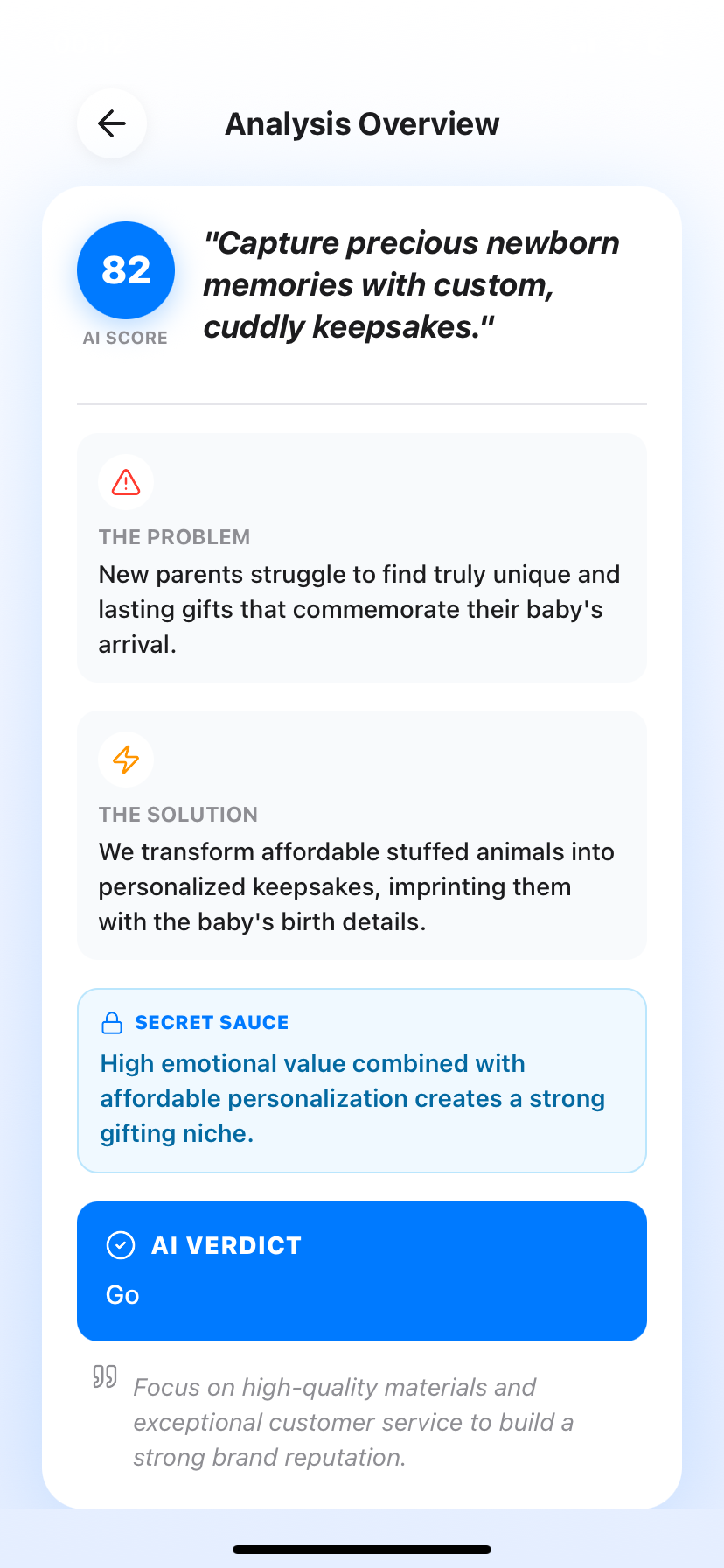
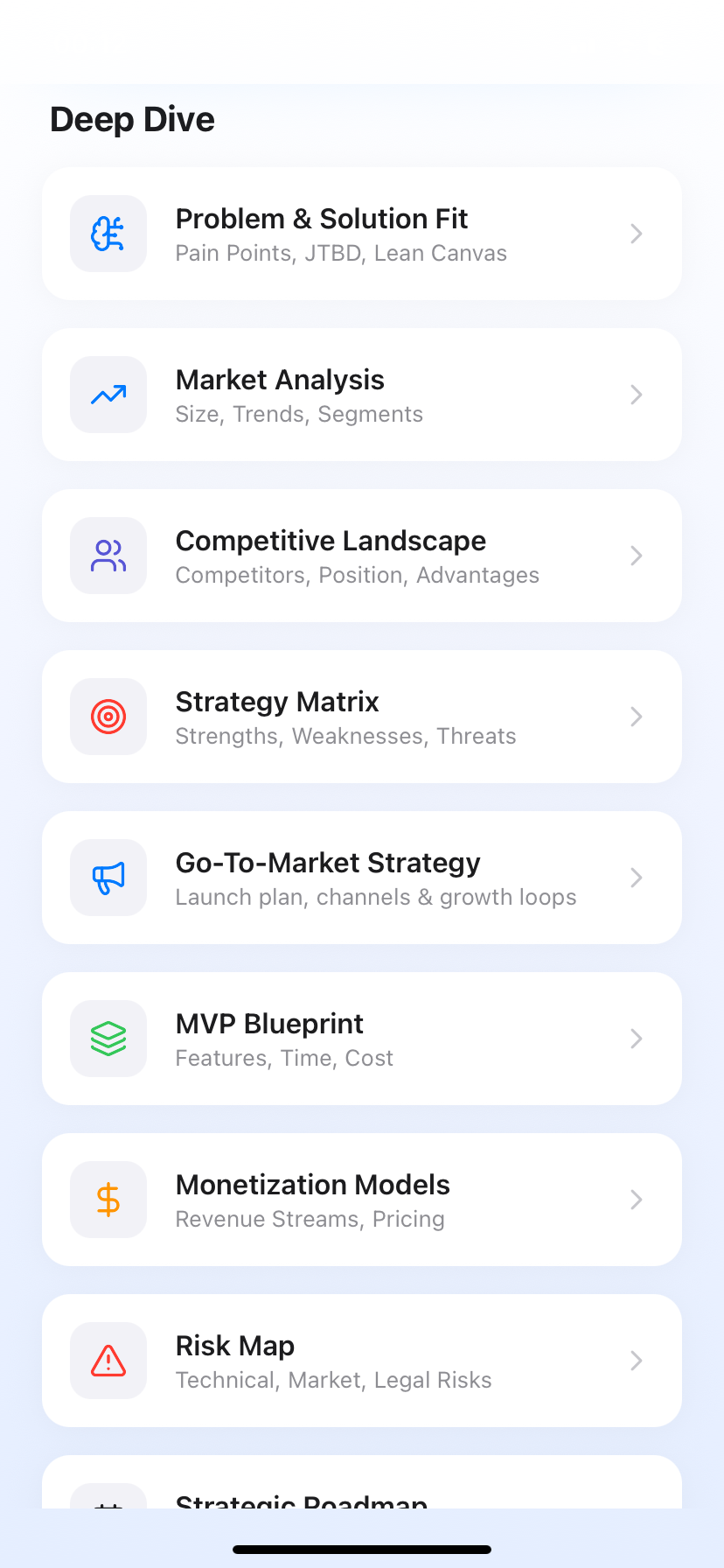
Running a full 5-signal competition audit manually takes 10-15 hours of competitor research, review mining, and matrix construction. IdeaX automates the entire process: submit your concept and the AI immediately evaluates your competitive density, identifies Vulnerable Giant signals within your market, recommends the highest-probability Micro-Niche positioning, and flags your most defensible Differentiation Gap. In 10 minutes, you get a complete competitive strategic map — and know exactly whether to fight, niche down, or walk away.
Frequently Asked Questions (FAQ)
Is it bad if my business idea has no competition?
Almost always yes. Zero competition signals either a problem not painful enough to pay to fix, a market too small to be commercially viable, or a category where previous attempts failed. Competition proves willingness to pay. When you find multiple competitors, react with relief — the market is validated. Your job is to capture an underserved segment, not invent demand.
What is a Red Ocean and when is it too crowded to enter?
A Red Ocean is a market where all competitors have commoditized the core product and compete on price with razor-thin margins. Entry red flags: identical feature sets across all competitors, declining category ASP year-over-year, all competitors rated 3.5-4.0 (mediocre), market growing less than 5% CAGR. You need a structural technological breakthrough — not just a UX refresh — to survive a true Red Ocean.
How do I compete against a well-funded giant?
Don't compete directly — unbundle. Serve a hyper-specific segment the giant considers too small to prioritize. In a $2B market, 0.1% is a $2M business. You can deliver 10x more relevant value to a narrow segment than a generalist can. When the giant eventually notices your niche, you'll have community, word-of-mouth, and switching costs that make displacement expensive.
What is the Vulnerable Giant opportunity?
A large incumbent with high market share but severe customer dissatisfaction — Trustpilot below 3.5, G2 reviews citing 'clunky interface' or 'terrible support'. They're vulnerable because they built for a different era, have legacy code, and can't fix UX without alienating their existing base. Their unhappy customers are your most accessible early adopter pool.
How do I perform a Differentiation Gap analysis?
Build a competitor matrix with positioning dimensions as rows. Mark each cell. Identify the rows where all competitors fail for the same customer segment (evidenced by consistent 1-star review themes). The gap where multiple incumbents all perform poorly for the same segment is your Differentiation Opportunity — and your entry point to avoid the Red Ocean entirely.