
Business Plan vs Business Model Canvas: Complete Comparison
Every year, hundreds of thousands of first-time founders make the same expensive mistake: they spend weeks or months writing a 40-page Traditional Business Plan before they talk to a single customer, before they write a single line of code, and before they have a single data point about whether any human being on earth actually wants what they propose to build. The Traditional Business Plan was invented in a pre-internet, pre-iteration era when "building the business" required millions of dollars of physical asset investment before any revenue could be generated. In 2026, that document format is appropriate for approximately 5% of new business ventures. The other 95% need a Business Model Canvas — or better yet, its startup-optimized derivative, the Lean Canvas.

- The fundamental structural difference between the two formats.
- The 9 Business Model Canvas building blocks and what each represents.
- The 5 specific contexts where a Traditional Business Plan is the correct tool.
- Why VCs don't read 40-page plans — and what they actually evaluate.
- The difference between the BMC and the Lean Canvas for early-stage founders.
Structural Comparison: What Each Document Actually Does
| Dimension | Traditional Business Plan | Business Model Canvas |
|---|---|---|
| Length | 20-50 pages of formatted text | 1 page, 9 boxes |
| Time orientation | Static 5-year projection | Living hypothesis map, updated weekly |
| Core assumption | Strategy is known upfront and correct | Strategy is a hypothesis to be tested |
| Intended audience | Bank underwriters, SBA loan officers | Founders, co-founders, early team |
| Update frequency | Rarely — re-writing is expensive | Sprint-by-sprint as evidence accumulates |
| Financial projections | Detailed 5-year P&L with no validation basis | Revenue Stream hypotheses to validate |
The 9 Building Blocks of the Business Model Canvas
The Business Model Canvas, developed by Alexander Osterwalder in 2005, organizes every element of a business into 9 mutually interdependent building blocks on a single visual page. Each block contains one or several brief hypotheses — not declarations of certainty, but bets about how the business will work.
5 Contexts Where a Traditional Business Plan Is Actually Required
The Business Plan is not obsolete — it is simply misapplied by the vast majority of founders who use it. There are 5 specific contexts where the Traditional Business Plan remains the appropriate tool:
- SBA Loan Applications. The Small Business Administration and similar government lending programs explicitly require a formal business plan as a condition of the application, with prescribed sections for executive summary, market analysis, organizational structure, and financial projections.
- Traditional Commercial Bank Lending. Banks providing commercial real estate loans, equipment financing, or expansion credit lines for established businesses require detailed financial history and forward projections in a standardized document format.
- Government Grant Applications. Many government innovation grants, particularly in the EU and Australia, require formal business plans as part of the submission process.
- Strategic Acquisition Documentation. When selling a business or acquiring one, formal business plans are part of the Due Diligence documentation package for serious buyers.
- Franchise Applications. Many franchise agreements require prospective franchisees to submit a formal business plan demonstrating financial readiness and understanding of the operational model.
Why VCs Don't Read Business Plans — and What They Evaluate Instead
The modern venture capital evaluation process is designed around a fundamental truth that the Traditional Business Plan ignores: at the pre-seed or seed stage, no static document can accurately predict whether a startup will succeed, because the startup's business model does not yet exist in tested form. VCs know this. They are not evaluating whether your 5-year revenue projection is accurate — they know it isn't. They are evaluating whether the founder has the judgment, domain expertise, and execution capacity to survive the inevitable invalidation of their initial assumptions and adapt quickly enough to find a viable model before runway expires.
What actually matters in a VC evaluation: clear articulation of a large, real problem; credible evidence of early traction (even 10 paying users); founder-market fit evidence; a specific, credible differentiation hypothesis; and a unit economics model that indicates the business can achieve 3:1+ LTV:CAC at realistic acquisition cost. None of this requires 40 pages. All of it requires real customer evidence.
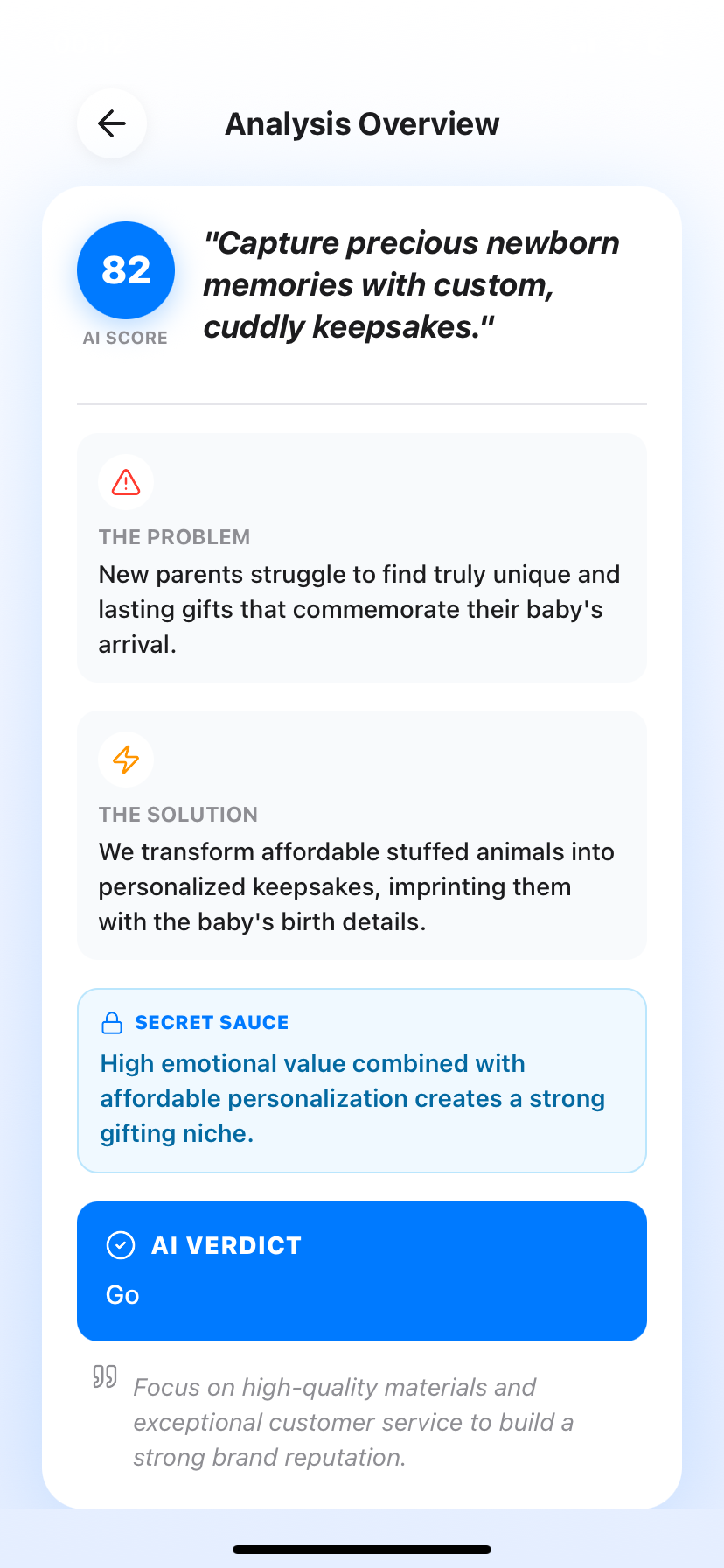
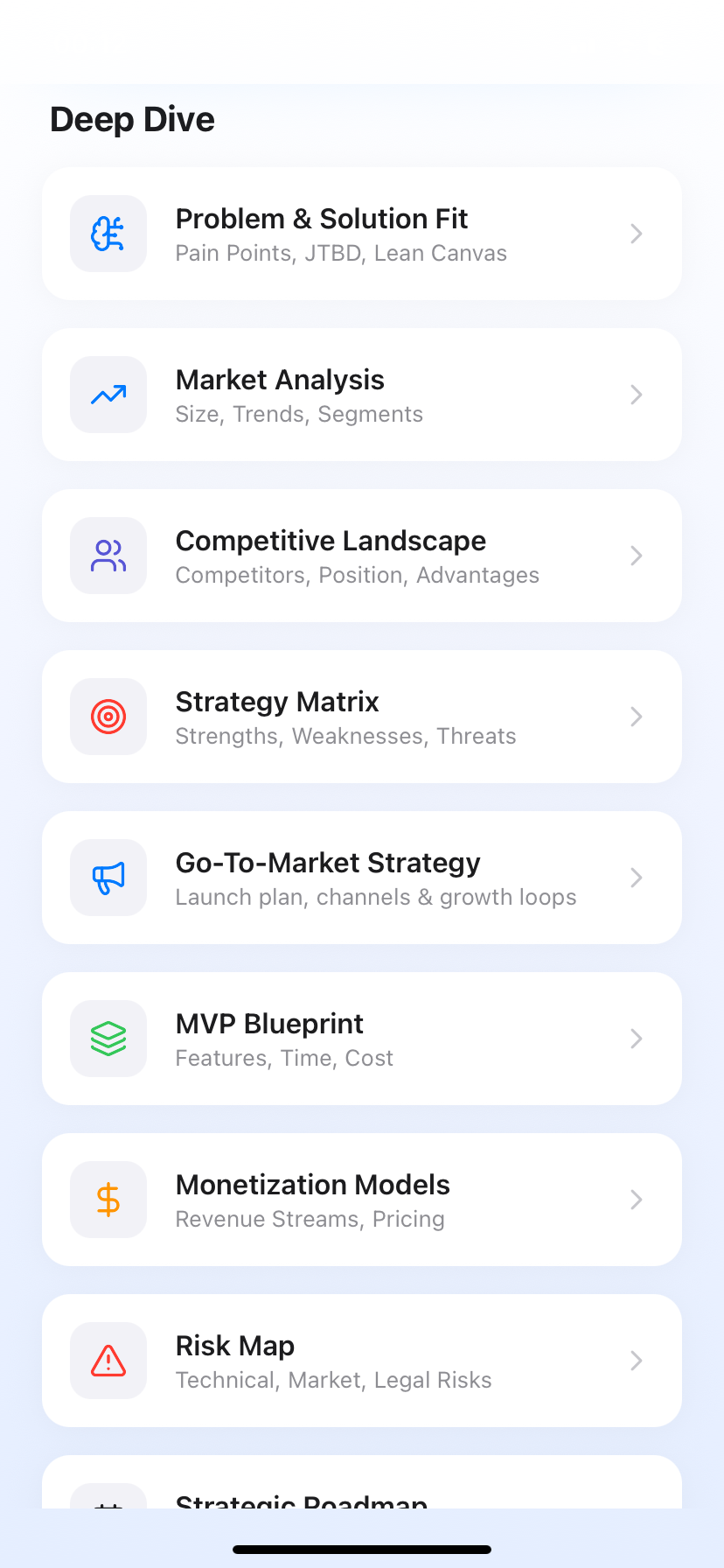

IdeaX: Business Idea Analysis
Auto-generate your Canvas. Skip the PDF.
Build an agile hypothesis map. Not a static novel.
Filling out a Business Model Canvas or Lean Canvas manually requires 3-5 hours of structured thinking and domain research. IdeaX generates a complete, hypothesis-level business model map in under 10 minutes: Customer Segments defined with behavioral specificity, Revenue Stream options ranked by viability for your category, Key Activities mapped to your proposed value mechanism, and an Unfair Advantage assessment that identifies whether your strategic moat is genuinely defensible. Start with your Canvas. Validate it. Then write any document your lending institution requires.
Frequently Asked Questions (FAQ)
What is the primary structural difference?
A Traditional Business Plan is a 20-50 page static document arguing that a fixed strategy is correct, primarily for bank underwriters. The Business Model Canvas is a 1-page living hypothesis map with 9 interconnected building blocks, designed for iterative testing in high-uncertainty startup environments. The Plan assumes knowing the answer upfront. The Canvas accepts that the initial assumptions are probably wrong.
Do venture capitalists read 40-page business plans?
Almost never. VCs evaluate traction evidence (paying customers, growth rate, retention), founder-market fit, and unit economics viability — communicated via a 10-slide pitch deck. A 40-page plan signals the founder spent significant time on documentation rather than customer discovery and early execution, which is a negative signal.
When is a formal Business Plan actually necessary?
In five specific contexts: SBA loan applications, traditional commercial bank lending (equipment, real estate), government grant applications with prescribed formats, strategic acquisition documentation, and franchise applications. For all other contexts — VC, angel, accelerator, product development — a Canvas-based approach is superior.
What are the 9 Business Model Canvas building blocks?
Customer Segments, Value Propositions, Channels, Customer Relationships, Revenue Streams, Key Resources, Key Activities, Key Partnerships, and Cost Structure. Each block is filled with testable hypotheses, not permanent declarations — making the Canvas a living document updated as market evidence accumulates.
What is the difference between BMC and Lean Canvas?
The Lean Canvas (Ash Maurya, 2010) is a startup-specific derivative of the BMC. It replaces Key Resources and Key Activities with Problem (top 3 customer problems) and Solution (minimum feature set), and adds Key Metrics and Unfair Advantage. For pre-revenue startups, the Lean Canvas is more useful because it explicitly surfaces the riskiest assumptions to test first.