
How to Improve a Weak Business Idea
The first iteration of almost every major multi-billion dollar startup was fundamentally, objectively weak. Slack was a failing video game company. Shopify was founded as a mechanism to sell snowboards online. YouTube was originally a video dating site. You are absolutely allowed to start with a weak idea — as long as you mechanically understand how to surgically iterate and pivot into a strong one before you exhaust your capital runway.

- Lever 1 — The Audience Shift: B2C → B2B upgrade for instant pricing power.
- Lever 2 — The Pricing Shock: Repositioning from "cheap" to "premium".
- Lever 3 — Productizing a Service to escape the 1-to-1 labor trap.
- Lever 4 — The Distribution Channel Pivot: Stop hoping, start engineering.
- Lever 5 — The Niche Depth Drill: Radical specificity to command premium pricing.
The Lever Model: A Business Is a Configurable Machine
When founders discover their idea has fatal structural flaws, they almost always trigger a massively destructive full reset — throwing away months of accumulated learning, brand recognition, and precious engineering investment. This is highly inefficient and often entirely avoidable.
Instead, you must reframe a business model as a functional machine with a limited set of physical adjustment levers. A weak idea is not a condemned building; it is simply a misconfigured machine. By strategically pulling just one lever at a time — adjusting the target audience profile, the pricing architecture, the delivery mechanism, or the distribution channel — you can fundamentally alter the economics and market resonance of the same core product without starting from zero.
The critical discipline is: always change only one variable per experiment to isolate causality. If you change your pricing tier AND your target audience simultaneously, you will never know which variable actually drove the resulting improvement.
Lever 1: The Audience Shift (B2C → B2B Upgrade)
The most common underlying cause of a weak idea is a structurally flawed target audience. Consumer audiences (B2C) are highly emotional, notoriously price-sensitive, and extremely expensive to acquire at scale through paid advertising. Business audiences (B2B), by contrast, make purchasing decisions based on pure ROI calculations and can sustain dramatically higher monthly price points.
The Real-World Audience Pivot Example
Suppose you built an elegant AI-powered scheduling and time-blocking application targeted at college students. After six months, you have acquired exactly 200 users but converted only 12 to a $4.99/month premium tier. Your monthly revenue is $60 and your server costs are $85. You are demonstrably bleeding money.
The core problem is not the software; it is the audience. Students as a demographic simply refuse to pay for productivity software. Do not scrap the codebase. Pull the audience lever. Point the exact same feature set at a different market segment: Corporate Law Firms or Senior Executive Assistants at Fortune 500 companies. Professionals in these industries bill at $400-$800 per hour. A software tool that recaptures even 45 minutes of their week is worth $150-200/month. You have just transformed a failing $5 consumer app into a premium $199/month B2B enterprise tool — without writing a single new line of code.
Lever 2: The Pricing Shock (Race to the Bottom vs. Premium Repositioning)
Many technically sound service businesses remain perpetually weak and unprofitable because they strategically aim for the precise middle of the market — offering a "decent service for a decent price." This approach requires enormous, unsustainable volume to generate a livable income. You are competing against both premium boutiques above you and low-cost offshore freelancers below you. In the long run, the middle always loses.
The Premium Repositioning Strategy
If you run a generic freelance graphic design operation charging $50 per logo, you will inevitably be undercut by Fiverr's $5 logo mills. The optimal strategic move is to radically flip direction and pull the pricing lever sharply upward.
Rebrand the same service as a "Premium Strategic Brand Identity System for Seed-Stage Technology Startups." Reposition your deliverable from "a logo file" to a comprehensive brand asset package including brand strategy documentation, color palette system, typography hierarchy, motion identity guidelines, and pitch deck templates. Price it at $12,000 - $18,000 per engagement.
This premium repositioning requires ten times fewer total clients to hit the same annual revenue target. It allows you to deliver dramatically superior quality work since you have adequate time budget per client. And it immediately fixes your margin vulnerabilities by eliminating volume dependency.
Lever 3: Productizing a Service to Escape the Labor Trap
If the core weakness of your business is that it is entirely dependent on your personal manual labor and therefore fundamentally cannot scale — this is known as "Key-Man Risk" — you must pull the delivery mechanism lever.
From 1-to-1 to 1-to-Many
Consider a talented personal fitness coach who charges $80 per 1-hour session. Her income is mechanically capped at approximately the number of available hours in a working week: a hard ceiling of roughly $80 x 40 hours = $3,200/week maximum theoretical revenue before taxes and overhead. The service model is inherently, structurally unscalable.
The productization strategy: spend one dedicated month filming a comprehensive, structured 90-day strength and nutrition training program. Host it on Kajabi or Teachable as a digital subscription library for $39 per month. Her initial marketing effort — one focused launch campaign to her existing client email list — now potentially serves 500+ simultaneous ongoing subscribers without adding a single additional hour of daily labor.
The fundamental time model has been rearchitected from 1-to-1 (one hour produces one revenue unit) to 1-to-many (one hour of filmed content produces indefinitely scalable revenue in perpetuity).
Lever 4: The Distribution Channel Pivot
Sometimes a business idea is structurally brilliant but is simply being sent to the wrong distribution channel. The identical product can succeed spectacularly on one channel while dying completely on another.
Diagnosing the Distribution Mismatch
If you have a highly technical, complex B2B software product delivering enterprise value but you are attempting to sell it exclusively through Instagram Reels and TikTok content marketing, you have a catastrophic distribution mismatch. Instagram users are scrolling for entertainment; they are not in a decision-making mindset with budget approval authority.
The same product might perform completely differently if you shifted the distribution channel to: cold LinkedIn DM outreach to VP Operations titles, technical SEO content capturing high-intent Google search queries, or attending one in-person industry trade show where qualified decision makers sit in a concentrated room for three days. Pull the distribution lever before concluding the product has no market.
Lever 5: The Niche Depth Drill (Radical Specificity)
"Niching down" is one of the most counter-intuitive but consistently reliable strategies for rescuing a weak generalist business idea. Founders constantly fear that narrowing their potential customer definition will shrink their market size. In practice, the opposite almost universally occurs: the smaller and more specific your claimed niche, the higher the premiums you can charge, the more referrals you generate, and the easier it becomes rank #1 on Google for highly specific search queries.
The Specificity Premium
Consider two accountants. Accountant A advertises: "I do accounting for all types of businesses." Accountant B advertises: "I do accounting exclusively for US-based SaaS founders raising their Series A round." Accountant B charges 3x the hourly rate. They receive overwhelmingly positive organic referrals within the startup community. They rank on the first page of Google for "accountant for SaaS startup." Accountant A competes for the same undifferentiated client pool as thousands of other generalist accountants using price as the only differentiator.
Every weak "generalist idea" can be sharpened into a dominant "specialist idea" by drilling down one layer of specificity into the target audience definition. This is the highest-ROI, zero-cost improvement lever available to any founder.
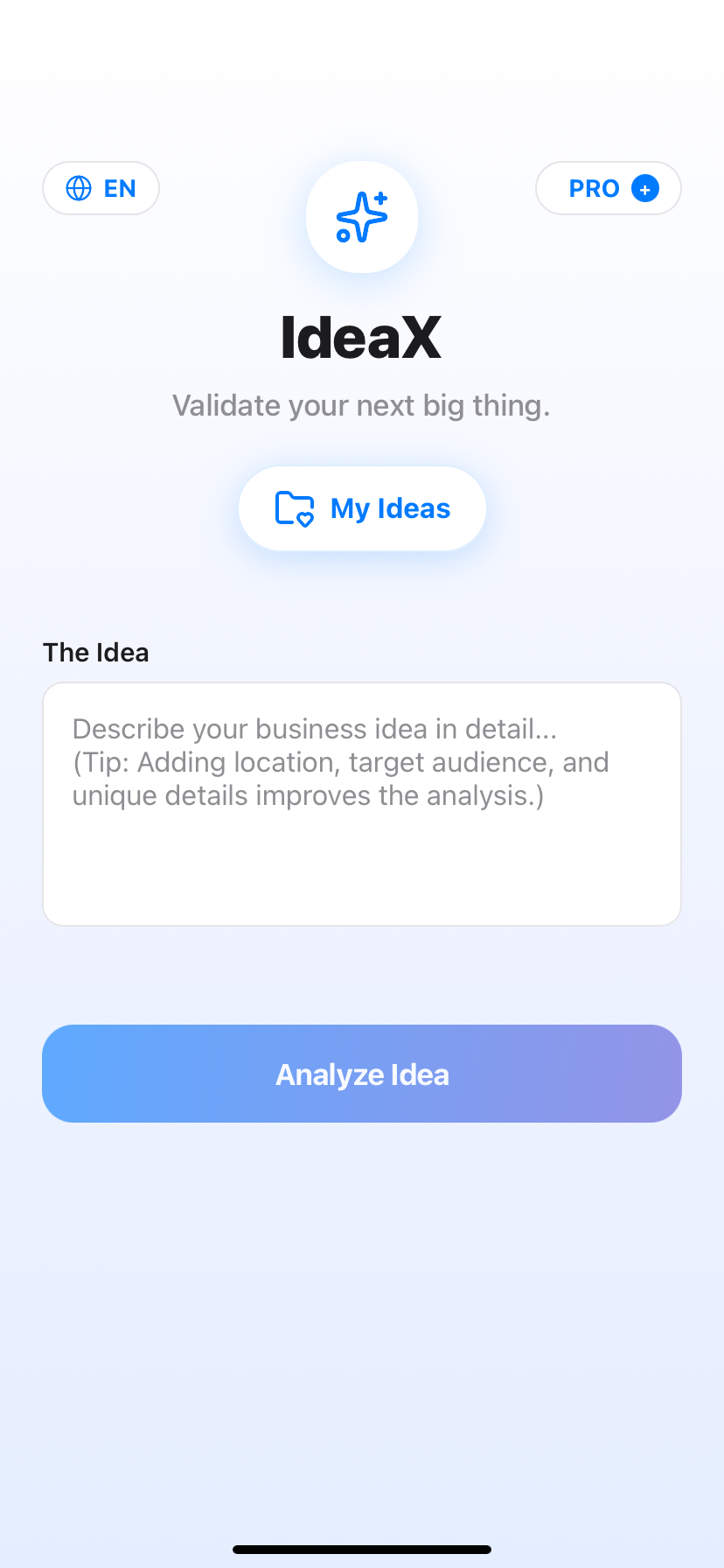
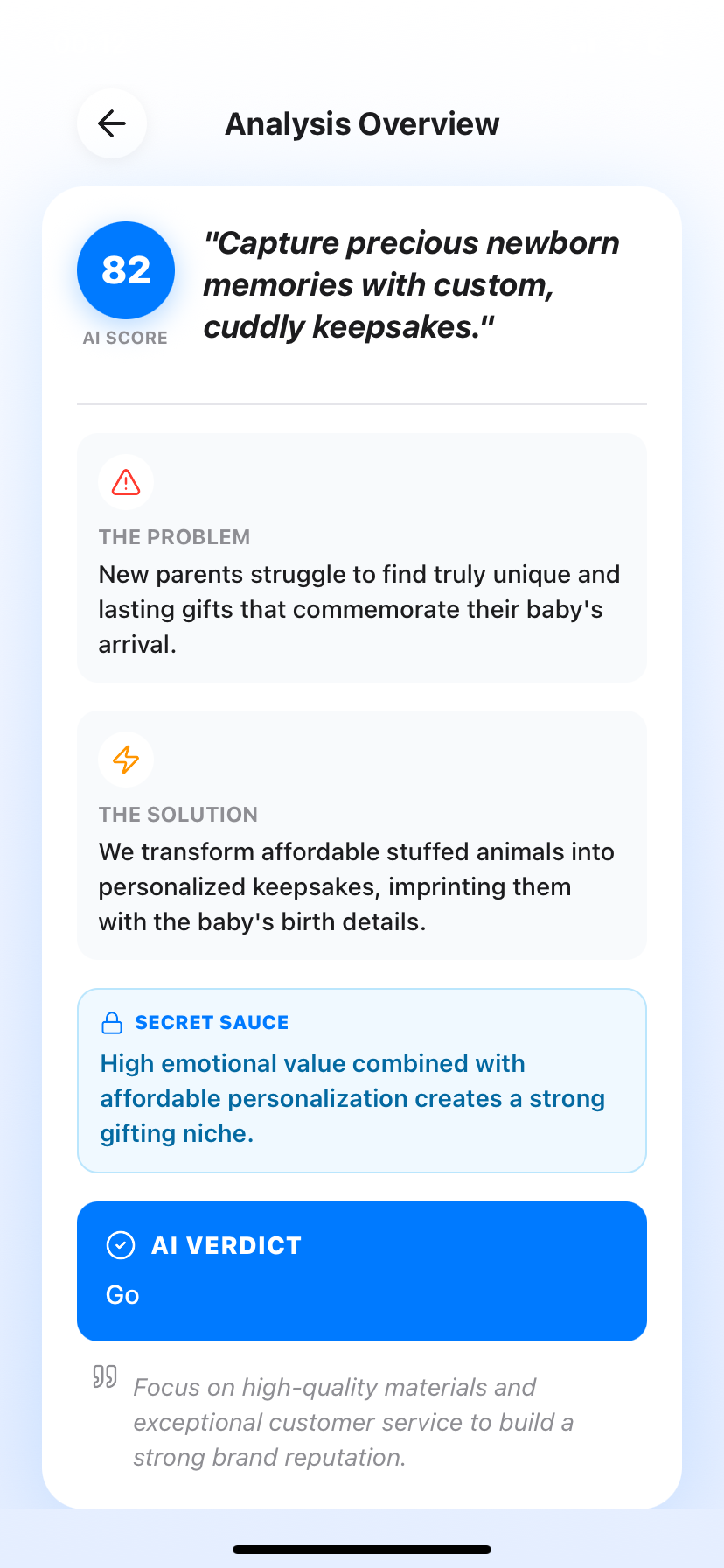
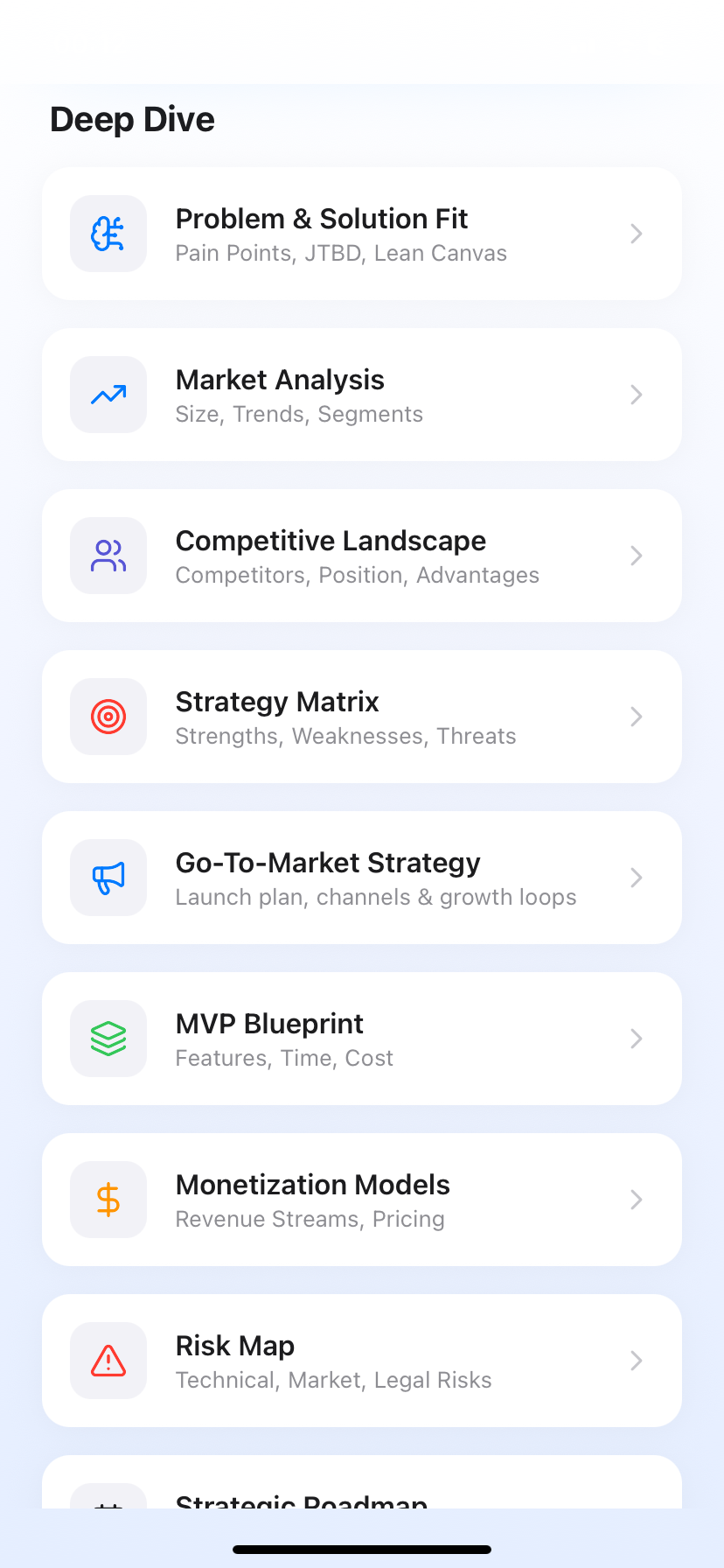

IdeaX: Business Idea Analysis
A structured space for evaluating what to build next.
Don't scrap it. Pivot it scientifically.
A fatal flaw doesn't mean the idea is worthless — it means the current configuration is wrong and needs surgical correction. IdeaX is built specifically to rescue broken concepts. When you input a struggling idea, our AI doesn't only identify why it is currently failing; it actively generates structured "Pivot Pathway" recommendations. It will identify adjacent higher-income target audiences, recommend specific premium pricing repositioning strategies, and suggest alternative distribution channels — giving you a precise, data-backed roadmap to mathematically repair your business model.
Frequently Asked Questions (FAQ)
How do I actually know if my idea is 'weak' vs. just early?
An idea is functionally weak if two distinct signals appear simultaneously: your validation landing page has a sub-1% conversion rate after 500 visits AND direct customer interviews reveal that the problem you solve is not in the top 3 most painful daily frustrations of your target audience. An 'early' idea often has high intent but poor conversion — a 'weak' idea has both low intent and low conversion.
What is a structured pivot vs. a panic pivot?
A structured pivot changes exactly one major variable at a time: either the audience, the pricing model, the distribution channel, or the core feature set. A panic pivot changes everything simultaneously, destroying all prior learnings. Always pull one lever at a time to isolate causality.
Should I completely abandon a weak idea and start fresh?
Not usually. The technical infrastructure, brand identity, and audience insights accumulated during an initial failed attempt are highly valuable sunk assets. Before discarding them, exhaustively test the B2C-to-B2B audience pivot, the pricing lever, and the distribution channel change.
How many pivot attempts before I accept the idea is truly dead?
After testing three distinct, structured pivots across different variables (audience, pricing, and distribution channel) and failing to produce a meaningful improvement in conversion or engagement, the core problem hypothesis is likely fundamentally broken. At that stage, preserving the capital for a different idea is the optimal decision.
Can I improve a business idea with no budget?
Yes. The two most powerful zero-budget improvement tactics are: (1) posting to a highly targeted subreddit and observing the organic engagement signals, and (2) doing 20 direct customer development interviews to understand which specific aspects of the current idea generate genuine interest vs. polite indifference.