
Idea Validation Tool vs Business Consultant: Which Should You Use?
Every year, thousands of early-stage founders make the same expensive decision: they pay $5,000 to $15,000 for a business consultant to "validate" their startup idea, receive a polished 40-page PDF 6 weeks later, and discover one of two outcomes. Either the report confirms what they already believed (exciting, but essentially $12,000 for a confidence boost), or the report identifies the same structural flaws that a dedicated AI validation tool would have surfaced in 10 minutes — at a cost difference of approximately $11,950. This is not an indictment of business consulting as a profession; consultants provide genuine, irreplaceable value in specific contexts. But early-stage startup idea validation is almost never one of those contexts. Understanding exactly when each option produces superior ROI is the decision this guide will make unambiguous.

- The 6-dimension head-to-head comparison: cost, speed, bias risk, depth, iteration speed, and ICP access.
- Why consulting methodology is structurally misaligned with pre-revenue startup validation.
- The 4 specific scenarios where a consultant genuinely outperforms a validation tool.
- The optimal hybrid approach: using both in sequence for maximum ROI.
- The "Consultant Bias Trap" — why paying more doesn't produce more adversarial analysis.
The Structural Misalignment of Consulting for Pre-Revenue Validation
Business consulting as a discipline was developed to analyze businesses that already exist. The consultant's core methodology — collecting operational data, interviewing existing customers, reviewing financial statements, benchmarking against industry peers — requires inputs that only a functioning business generates. A pre-revenue startup idea is, by definition, a hypothesis. It has no operational data, no existing customers to interview, no financial statements to review, and no peer cohort to benchmark against because the specific business model may not yet exist in the market.
This creates a structural methodological problem: when a consultant validates a pre-revenue startup idea, they are applying a data-collection framework to a context that has no data. They compensate by substituting assumptions, industry report extrapolations, and analogous market data — which is exactly what a founder without any analytical training would also do, except the consultant charges $10,000 for the exercise and requires 6 weeks to complete it.
The outputs are also predictably optimistic. Consultants are service providers in a client relationship — their continued engagement and referral business depends on maintaining a positive working relationship with the founder. This creates a systematic incentive to soften risk assessments, hedge on fatal flaws, and deliver a report that validates the founder's enthusiasm rather than one that categorically identifies the concept's structural liabilities. This is the Consultant Bias Trap.
Head-to-Head Comparison: 6 Dimensions
| Dimension | Business Consultant | Idea Validation Tool |
|---|---|---|
| Cost | $3,000–$15,000 per engagement | $0–$50 per month |
| Time to Output | 4–8 weeks | 8–15 minutes |
| Confirmation Bias Risk | High — client relationship incentive to soften findings | None — algorithmic, no client relationship |
| Iteration Speed | Each pivot requires a new engagement + 4-week delay | Re-run analysis on new positioning in minutes |
| Domain Depth | High in specific sectors (healthcare, finance, law) | Broad structural analysis, limited sector-specific depth |
| Network / ICP Access | Can facilitate enterprise introductions via their network | Does not provide direct customer access |
The Consultant Bias Trap — Why Paying More ≠ More Adversarial Analysis
The single most important dynamic founders fail to account for is the systematic incentive structure that governs consultant behavior. Consultants are service providers in an ongoing client relationship. Their business model depends on client satisfaction, repeat engagements, and referrals. Client satisfaction in a consulting context is strongly correlated with the client feeling that their initial instincts were validated and their strategic direction was affirmed.
This creates a well-documented behavioral pattern: consultants naturally soften risk assessments, hedge categorical findings with qualifications ("while this market is competitive, there may be differentiation opportunities worth exploring"), and frame fatal flaws as "areas requiring further investigation" rather than "reasons not to build this." This is not dishonesty — it is a rational response to the incentives of a client-service relationship. But for a founder making a decision that may consume 18 months of their life and $150,000 of their capital, a softened risk assessment is actively dangerous. You need a tool that has no incentive to soften anything.
4 Scenarios Where a Consultant Genuinely Wins
There are four specific contexts where a consultant's institutional knowledge, professional network, and domain expertise produce a quality of output that no validation tool currently replicates:
- Highly Regulated Industry Entry. Healthcare, financial services, legal tech, pharmaceutical, and defense markets have compliance landscapes so intricate that a fatal regulatory error — a HIPAA/SOC2 ceiling you didn't model, an FDA approval pathway that adds 3 years to your timeline, a securities regulation that eliminates your entire revenue model — can cost millions to correct post-launch. A former FDA regulator or a healthcare compliance attorney functioning as a consultant provides genuinely irreplaceable institutional knowledge that no training dataset currently captures at this depth.
- Proprietary Data or Network Access. If a consultant's specific value is their exclusive access to industry data not publicly available (e.g., a former McKinsey partner with proprietary healthcare system procurement data), or direct enterprise-level customer introduction capability (e.g., an ex-CTO who can make a warm introduction to the VP of IT at 20 Fortune 500 companies), the engagement ROI is about the network, not the analysis document.
- Major Capital Allocation Decisions. Acquiring a competitor, entering a new international market, executing a complete product pivot with existing investor capital, or making a strategic hire at the $400K/year level — decisions where the cost of an error vastly exceeds the cost of the engagement. At this scale, the consultant functions as a risk-mitigation mechanism, not a validation tool.
- Investor-Required Third-Party Validation. Some institutional investors or corporate strategic partners require a third-party validation report as a condition of closing a funding round or partnership agreement. In this case, the consultant's brand credibility and signature on the document is the product — not the quality of the analysis. The right consultant for this engagement is the one with the most recognizable name in the investor's reference frame, regardless of methodology.
The Optimal Hybrid Approach
For founders who need both structural validation and sector-specific depth, the optimal approach is sequential, not parallel. Use a validation tool first to produce the structural audit: identify the top 3 structural risks with specificity (not "market competition is intense" but "the LTV:CAC ratio at $89/month pricing and a realistic 3.5% monthly churn requires a CAC below $847, which Facebook Ads benchmarks in this category cannot currently achieve"). Then, armed with a specific, prioritized risk profile, hire a consultant for a narrow, focused engagement to address only the specific risks where their institutional knowledge is genuinely required.
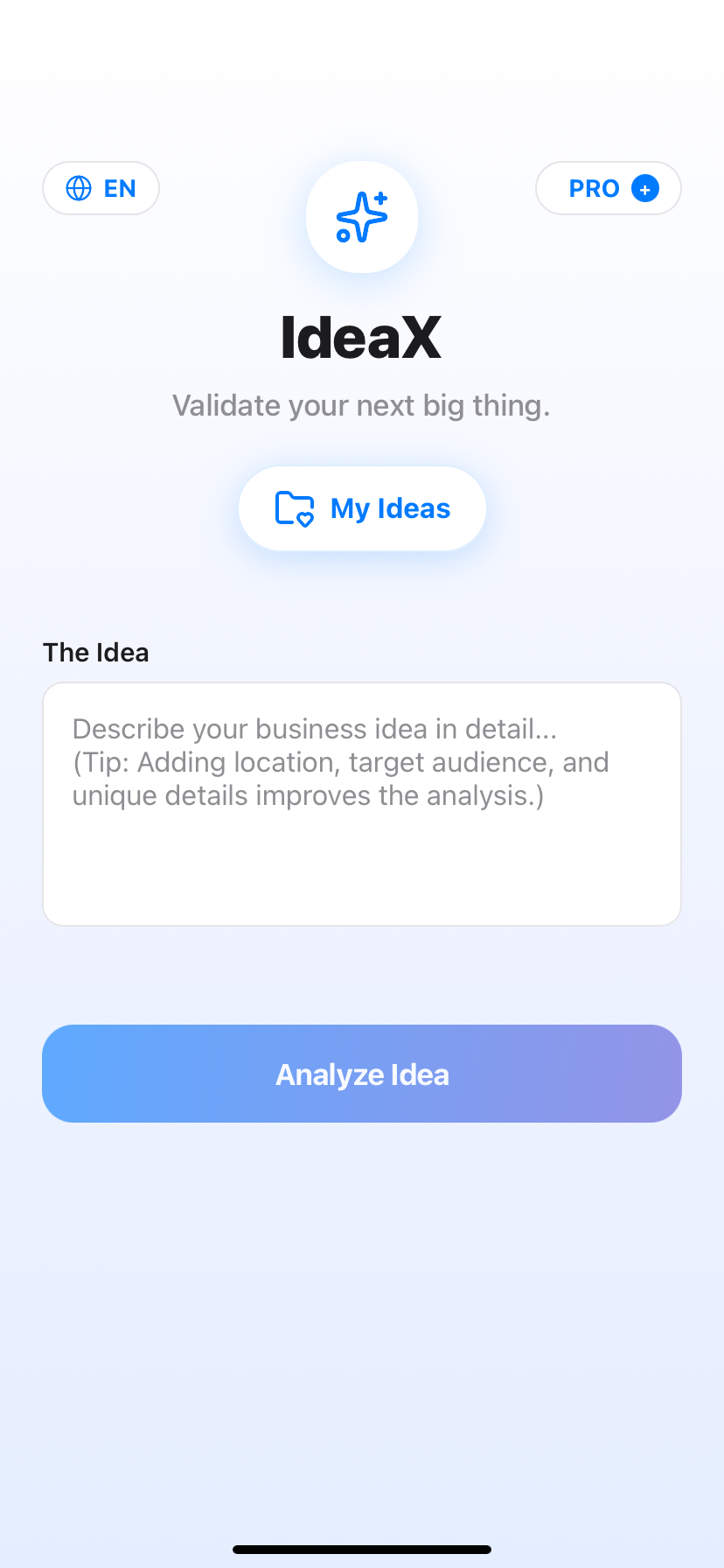
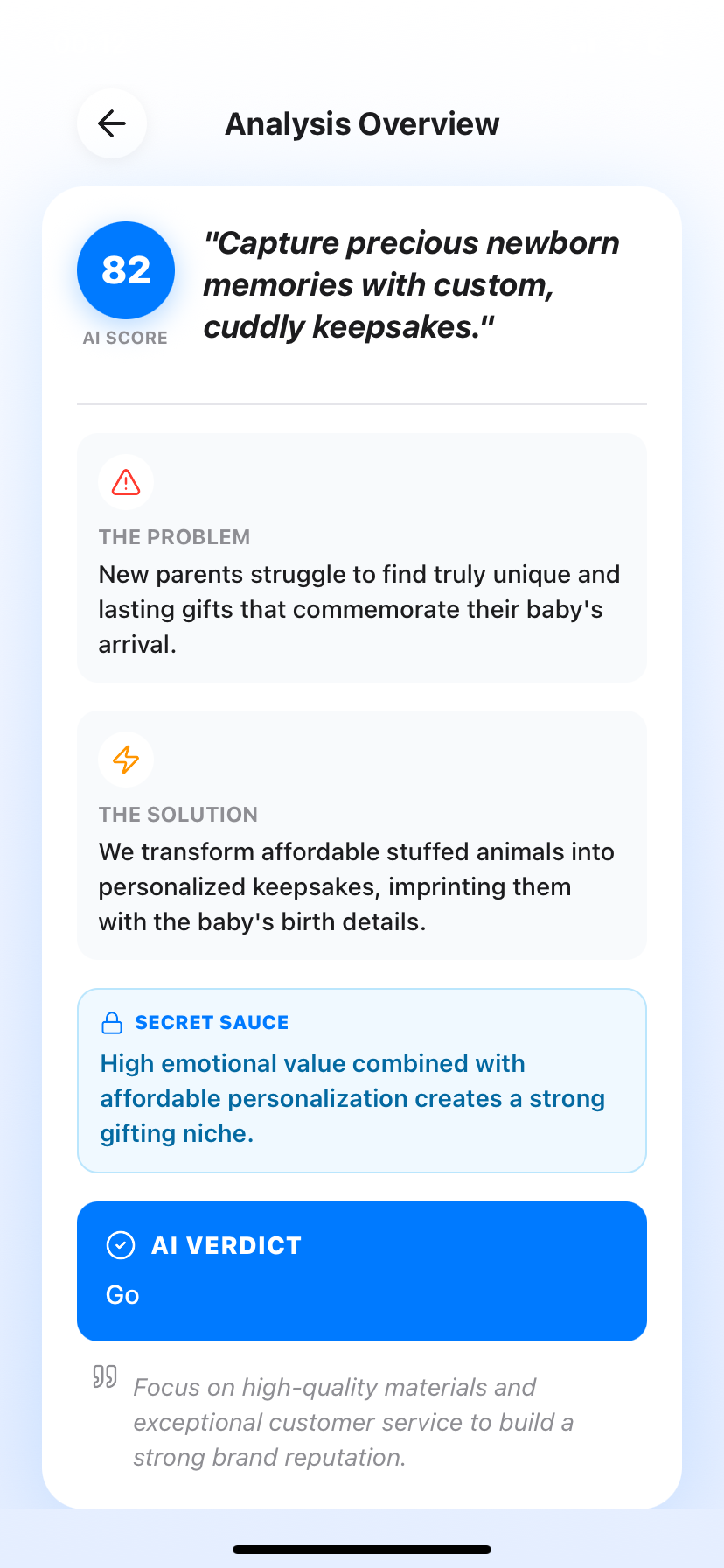
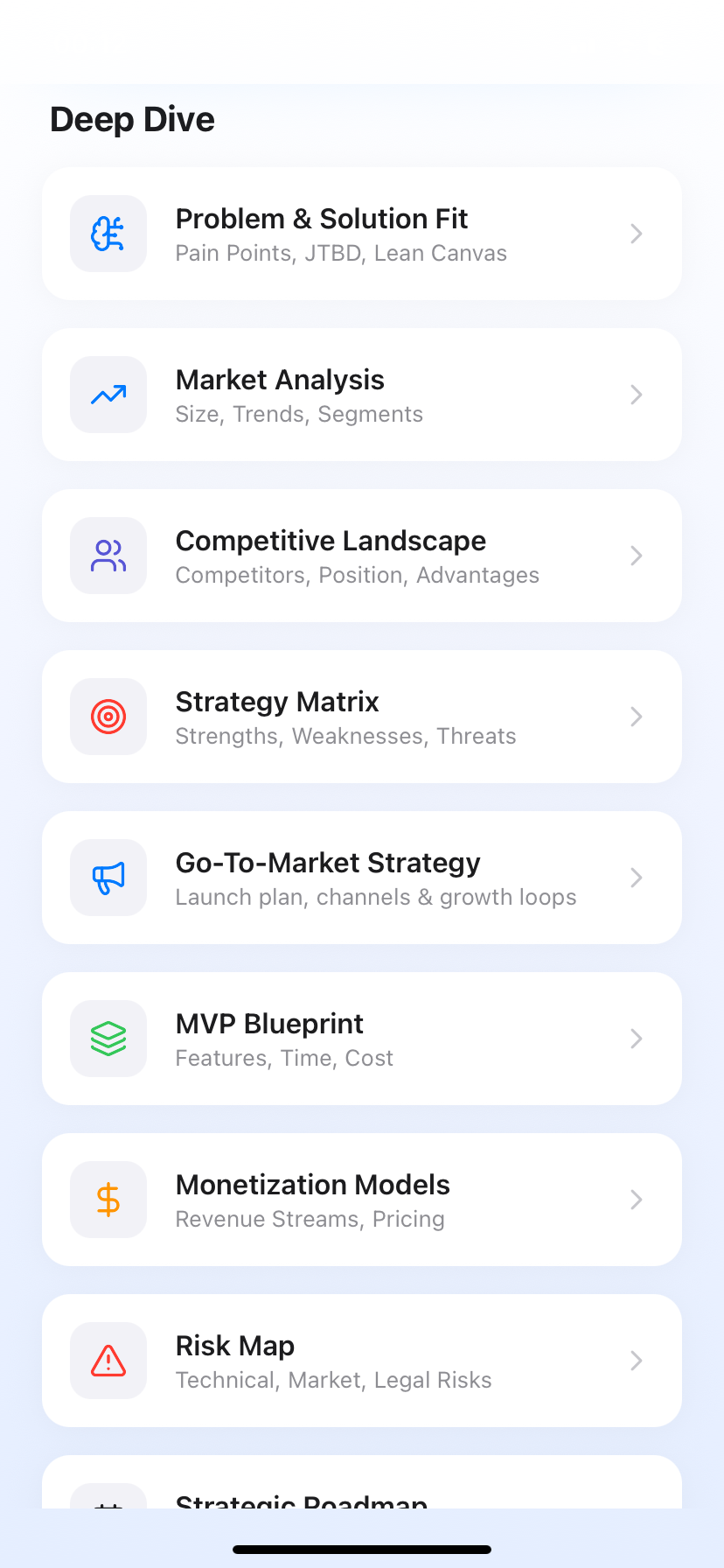

IdeaX: Business Idea Analysis
Phase 1 of the optimal hybrid approach.
Get the adversarial audit. Before spending $12,000.
Before you commit to a consulting engagement — or to execution — run the structural audit that a consultant's polite client-relationship incentives will never produce with the same candor. IdeaX has no client relationship to protect, no referral business to preserve, and no incentive to soften a fatal flaw assessment. Submit your concept and receive a complete adversarial structural audit — Pain Severity rating, TAM estimate, competitive moat score, unit economics viability, and your top 3 prioritized risks — in under 10 minutes. Then, if and only if a specific risk requires institutional expertise you don't have, hire a consultant for that specific question.
Frequently Asked Questions (FAQ)
Should I hire a business consultant to validate my startup idea?
For early-stage startup idea validation specifically, almost never. Consultants are trained to analyze businesses with documented revenue and customer data — a pre-revenue startup idea has neither. Their methodology produces the same structural analysis a validation tool provides in 10 minutes, delivered in 6 weeks at $3,000-$15,000. The exception: a consultant with specific institutional knowledge in a highly regulated industry where a fatal compliance error costs millions.
What does a business consultant actually do during idea validation?
Discovery call (2 hours) → 2-4 weeks of desk research (competitor analysis, industry reports, market sizing) → customer interviews if in scope → 30-50 page report with SWOT, risk identification, and strategic recommendations. The process is thorough but slow, expensive, and methodologically generic — the same framework applied to your AI startup was applied to a bakery concept the previous month.
What is the main advantage of a validation tool over a consultant?
Three: Speed (structural analysis in 10 minutes vs. 4-8 weeks), Cost ($0-50 vs. $3,000-$15,000), and Adversarial Objectivity — the tool has no incentive to soften fatal flaw assessments, protect a client relationship, or cushion a disqualifying finding. It applies the same adversarial framework regardless of your enthusiasm or the concept's narrative appeal.
When is a business consultant the right choice?
4 specific scenarios: (1) Entering a heavily regulated industry (healthcare, finance, legal) where compliance knowledge is genuinely irreplaceable. (2) You need proprietary data or enterprise customer introductions the consultant's specific network provides. (3) A major capital allocation decision where the cost of error vastly exceeds the engagement cost. (4) Investors require a third-party credentialed validation report as a condition of funding.
Can I use both a validation tool and a consultant?
Yes — and this is often optimal for high-stakes decisions. Use the validation tool first to produce a specific risk profile. Then hire a consultant for a narrow engagement to address only those specific risks requiring institutional domain expertise. This converts a $12,000 broad 6-week engagement into a $2,000-4,000 focused 1-week session — dramatically higher ROI from both tools.