
How to Turn a Raw Idea Into a Real Business Plan
The world is tragically abundant with brilliant people staring at the ceiling at 2 AM, imagining vivid multi-billion dollar companies — and catastrophically short of people who actually get out of bed, sit down at a desk, and methodically map the unit economics, distribution strategy, and competitive moat of those big ideas into a rigorous, executable business plan. That gap between dreaming and doing is precisely where most startup potential goes to silently die.

- Step 1 — The Elevator Pitch Constraint: Compress the idea into 2 sentences.
- Step 2 — The Lean Canvas: Map the entire model onto one structured page.
- Step 3 — The Distribution Algorithm: Engineering customer acquisition, not hoping for it.
- Step 4 — Unit Economics Modeling: Calculating CAC, LTV, and the 3:1 ratio.
- Step 5 — The Milestone Roadmap: Replacing vague goals with 30-day sprint commitments.
Why Most Business Plans Are Written at the Wrong Time
There is a common, damaging misconception that a business plan must be formal, lengthy, and written before starting any work. This backward approach creates analysis paralysis and generates a beautifully formatted document that describes a product nobody has ever shown to a real user.
An idea living exclusively in your imagination is volatile, chaotic, and heavily protected by your own unconscious ego. Because it only exists in your mind, you can seamlessly edit, protect, and rationalize it whenever reality threatens to contradict it. To build a real business, you must physically extract the idea from your mind and pin it to a concrete, structured document where its logic can be ruthlessly interrogated by math and market feedback.
You do not need a 50-page leather-bound report. You simply need a ruthless document that answers five fundamental economic questions with specificity and honesty.
Step 1: The Elevator Pitch Constraint
If it takes more than 45 seconds to accurately explain your business idea to an intelligent stranger, your business model has a fundamental structural problem. Complexity at the conceptual level typically signals complexity in the sales cycle — which dramatically increases customer acquisition costs and lengthens the time-to-revenue.
The 2-Sentence Business Model Formula
Force yourself — with absolute ruthlessness — to compress your entire business model into exactly two sentences. Use this formula:
Sentence 1: "We help [highly specific target audience] who struggle with [their most painful, costly problem]."
Sentence 2: "Unlike [the current best alternative], we solve it by [unique mechanism] and charge [pricing model]."
This aggressive constraint forces you to strip away every vague, "nice-to-have" feature and focus entirely on the single most powerful aspect of your core value proposition. If you cannot write those two sentences without fudging the details, you do not yet understand your own business well enough to build it.
Step 2: Fill Out the Lean Canvas
The traditional 50-page business plan format was masterfully designed for businesses that need to borrow large amounts of capital from conservative bank loan officers in the early 1980s. It is spectacularly ill-suited for digital-native startups that need to pivot weekly based on rapid user feedback.
The modern, universally superior alternative for digital founders is the Lean Canvas — a single-page, 9-block visual framework invented by entrepreneur Ash Maurya. Completing it forces you to simultaneously articulate the most important aspects of the business model without hiding behind verbose narrative language.
The 9 Lean Canvas Blocks
1. Problem
Top 3 pains your customer experiences daily.
2. Customer Segments
Exactly who you are building this for.
3. Unique Value
Single, clear, compelling reason they buy.
4. Solution
Top 3 features that address the 3 problems.
5. Channels
Exactly how you will reach your customers.
6. Revenue Streams
How much and how frequently they pay.
7. Cost Structure
Your fixed and variable monthly costs breakdown.
8. Key Metrics
The 2-3 numbers that signal health or death.
9. Unfair Advantage
What cannot be easily copied by a competitor.
Step 3: The Go-To-Market Distribution Algorithm
The single biggest omission in most founder-drafted business plans is a concrete, mechanical distribution strategy. Founders typically devote 80% of the planning document to describing their product features in loving detail, and then write approximately two vague sentences about marketing: "We will post on social media and grow organically."
This is not a distribution strategy. It is a wish. A real distribution strategy is a detailed, mechanical algorithm with specific acquisition funnels and projected conversion rates.
What a Real Distribution Strategy Looks Like
"We will publish a free 'B2B Cold Email Analyzer' micro-SaaS tool to capture organic Google Search traffic for the query 'cold email audit tool'. This free tool will capture approximately 800 email addresses per month from our exact ideal customer profile. We will run a 7-day automated email sequence introducing our flagship paid product with a 14-day trial offer. Based on our expected 8% trial-to-paid conversion rate, this generates approximately 64 new paying customers per month at $49/month, producing $3,136 in new monthly recurring revenue per cohort."
This is a specific, testable, and falsifiable distribution hypothesis. Every number in it can be monitored, measured, and improved. "Posting on social media" cannot.
Step 4: Unit Economics Modeling
A business plan without a financial model is a piece of science fiction. You must prove the fundamental math works before seeking outside capital or quitting your job. This means calculating two numbers and their critically important relationship:
- Customer Acquisition Cost (CAC): The total average marketing spend required to convert one complete stranger into one paying customer.
- Customer Lifetime Value (LTV): The total revenue a single average customer generates across their entire relationship with your product before canceling.
If your planned distribution strategy would cost $100 in Facebook Ads to acquire a subscriber paying $10/month who cancels after two months — your CAC is $100 and your LTV is $20. You are losing $80 on every customer you successfully acquire. The business plan fails the most basic mathematical test before it ever launches. A viable business plan must demonstrate a minimum theoretical 3:1 LTV:CAC ratio across at least one distribution channel.
Step 5: The 30-Day Milestone Architecture
A grand vision without hard deadlines is an expensive hobby. Most founder plans describe ambitious 5-year trajectories but have no specific, actionable commitments for the next 90 days. This creates an invisible, internal permission structure to keep planning indefinitely.
You must deconstruct the vision down into terrifyingly specific, financially-anchored 30-day sprint goals:
Tie every single milestone to a financial metric — MRR, number of paying users, positive LTV:CAC — not an engineering metric like "deploy the app." Markets pay for outcomes, not codebases.


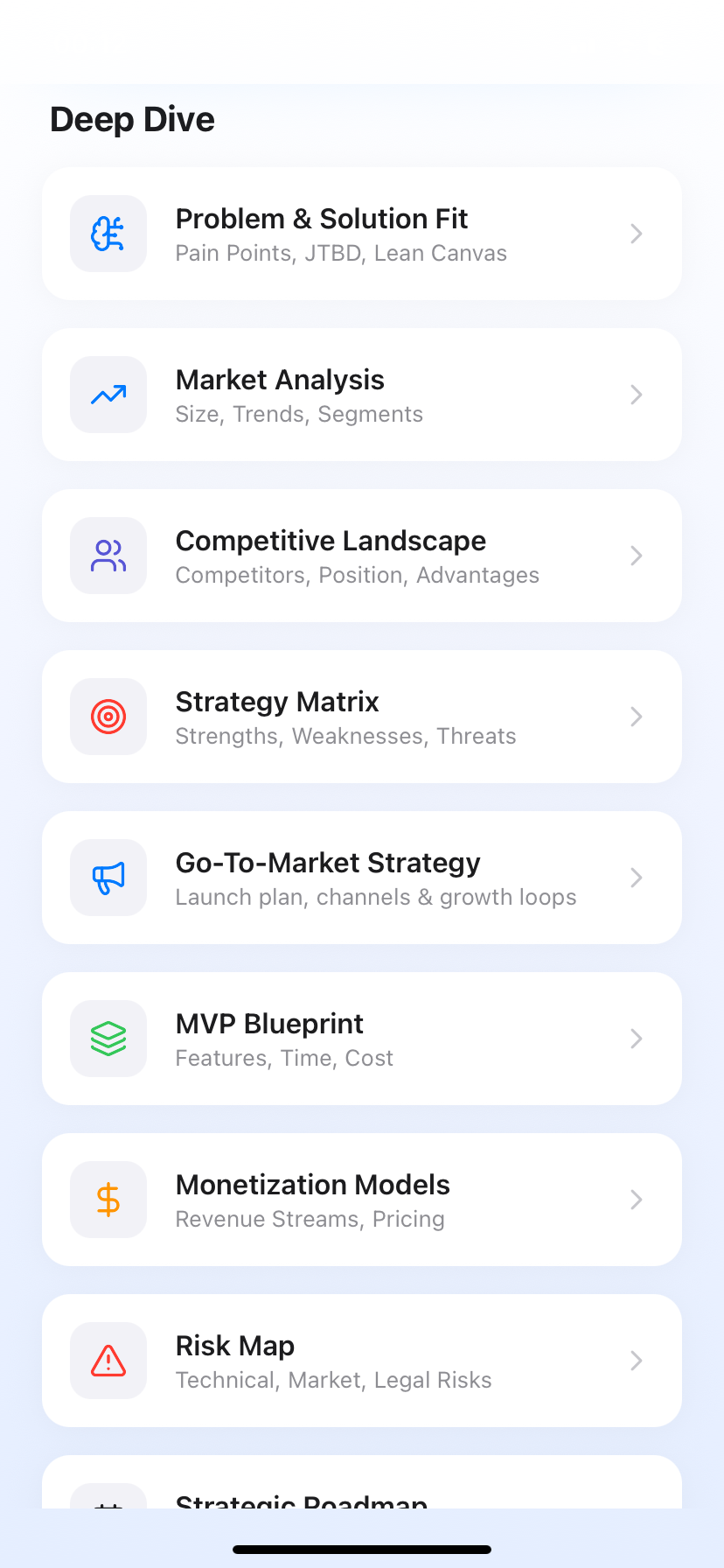

IdeaX: Business Idea Analysis
A structured space for evaluating what to build next.
Generate your structured blueprint instantly.
Staring at a blank Word document is expensive. IdeaX does the foundational business planning heavy lifting for you. Input your raw, scattered midnight brain-dump into the app, and the AI engine automatically organizes your chaotic thoughts into a rigorous, structured Lean Canvas framework. It computes estimated unit economics, maps your key distribution channels to your target personas, identifies your highest-risk assumptions, and generates a realistic 90-day financial milestone roadmap — in seconds, not months.
Frequently Asked Questions (FAQ)
Do I need a traditional 50-page business plan to raise funding?
Unless you are applying for a bank loan to open a physical manufacturing facility, no. Modern VCs want a lean 5-10 slide deck with validated traction metrics, not a 50-page bound report written in business-school jargon.
When exactly should I write the formal business plan?
Write a rough 1-page mental framework immediately. Then aggressively run cheap market validation experiments. Only formalize the full business plan after you have empirical proof — 10 paying users or 100 email signups — that customers are genuinely willing to pay.
Lean Canvas vs. traditional Business Plan: Which should I use?
For digital startups (SaaS, apps, marketplaces, agencies): use the Lean Canvas. It is a single-page, 9-block framework that forces prioritization and can be updated weekly. Traditional 50-page business plans are obsolete for tech businesses and consume months better spent talking to customers.
How do I calculate revenue projections without any data?
Use 'Bottom-Up' modeling rather than Top-Down TAM percentages. Example: Target 100 ideal customers in year 1 × $50/month = $60,000 ARR. Now estimate your CAC and prove the model sustains a 3:1 LTV:CAC ratio.
What is the biggest mistake founders make in a business plan?
Spending 80% of the plan on product features and only 5% on distribution strategy. The hardest part of building a company is not building the product — it is systematically convincing strangers to pay for it. A strong business plan must detail precise acquisition channels, conversion funnels, and retention mechanics.