
Too Many Business Ideas: How to Choose the Right One
Having too many business ideas feels like a privilege — and initially, it is. It signals market awareness, creative thinking, and entrepreneurial energy. But without a systematic elimination protocol, idea abundance rapidly becomes a structural liability: decision paralysis prevents execution, insufficient focus distributes your limited time across multiple concepts, and the cognitive burden of maintaining 7 open loops simultaneously reduces the execution quality of every single one. The vast majority of serial idea-generators never ship anything — not because they lack capability, but because they mistake idea generation for the most valuable part of entrepreneurship. It isn't. Execution is. And execution requires committed, focused, singular attention on one concept. Here is the systematic protocol for choosing that one concept rigorously.

- Filter 1 — TAM Floor Test: Eliminate ideas whose beachhead market is under $10M.
- Filter 2 — Founder-Market Fit Score: Eliminate ideas where you have no demonstrable domain advantage.
- Filter 3 — 90-Day Traction Test: Eliminate ideas with no zero-budget distribution mechanism to reach first 100 users.
- Filter 4 — Competitive Moat Rating: Eliminate ideas defensible only through temporary feature differentiation.
- Filter 5 — Lifestyle Alignment Check: Eliminate ideas whose required sacrifices are incompatible with your actual life.
Why "Just Pick One" is Bad Advice
The most common advice given to founders with too many ideas is "just pick one and go." While directionally correct (commitment and execution matter enormously), this advice fails founders by providing no selection methodology. Picking randomly or by gut feel from a list of 10 unvalidated ideas produces a random outcome. Instead, the correct approach is to systematically reduce your option set by applying non-negotiable filters — each one eliminating the ideas most likely to fail regardless of how impressive the execution — until the surviving ideas are a manageable set from which any final selection is a defensible bet.
Filter 1: The TAM Floor Test
Eliminate any idea whose beachhead market — the specific, narrowly defined initial customer segment you plan to serve — has a Total Addressable Market below $10M. This is not about pessimism; it is about structural viability. A market under $10M cannot support the operational overhead of a standalone business at meaningful scale. Even capturing 100% of a $5M market produces a business that generates less than $5M in annual revenue — before customer acquisition costs, engineering costs, and operational overhead.
The napkin TAM calculation for each idea: (Number of people globally who experience the problem acutely enough to pay) × (Maximum realistic annual price). Run this calculation for every idea on your list. Ideas with TAM under $10M: eliminate. Ideas with TAM between $10M and $100M: viable lifestyle business, not venture-scale. Ideas with TAM above $500M: require a defensible distribution thesis to your beachhead segment.
Filter 2: Founder-Market Fit Score
For each surviving idea, score your personal Founder-Market Fit on 4 dimensions (0-3 points each, 12 points maximum):
| Dimension | 0 Points | 1-2 Points | 3 Points |
|---|---|---|---|
| Domain Expertise | No relevant experience | Adjacent industry experience | Years of direct domain experience |
| ICP Network Access | Zero qualified contacts | A few contacts via 2nd degree | Direct relationships with ≥10 ICP members |
| Problem Experience | Never experienced the problem | Observed the problem in a workplace | Personally experienced the pain acutely |
| Technical Stack Fit | Would need to hire everything | Can build basic prototype | Can ship MVP without external help |
Eliminate any idea scoring below 6/12. Founder-Market Fit score below 6 means you will spend the first 6-12 months acquiring domain knowledge that a competitor with higher Founder-Market Fit already has — a compounding disadvantage that rarely recovers.
Filter 3: The 90-Day Traction Test
For each surviving idea, answer one specific question: "Without spending significant money, can I name a concrete distribution mechanism that reaches my first 100 qualified users within 90 days?" If you cannot answer this question with a specific channel, community, or relationship today, the idea fails the traction test — not because it is a bad idea, but because you lack the execution leverage to generate early traction that proves the concept.
Filters 4 & 5: Moat Rating and Lifestyle Alignment
Filter 4 — Competitive Moat Rating: For each surviving idea, identify one structural defense mechanism that becomes more difficult to replicate the longer you operate: proprietary data accumulation, network effects, switching cost lock-in, regulatory licensing, or brand + community. If the only defensible element of your advantage is "we built it first" or "our UX is better," a funded competitor replicates both in 90 days. Eliminate ideas with no credible moat.
Filter 5 — Lifestyle Alignment Check: For each surviving idea, explicitly calculate the sacrifice its realistic growth requires: years before profitability, hours per week of execution during the build phase, geographic constraints, co-founder requirements, fundraising travel, customer support volume at scale. Then ask honestly: is this sacrifice compatible with my actual life right now — my family situation, financial runway, risk tolerance, and personal goals? A brilliant idea that requires a sacrifice you cannot genuinely make will be abandoned at the first moment of severe difficulty — which in startups, always comes.
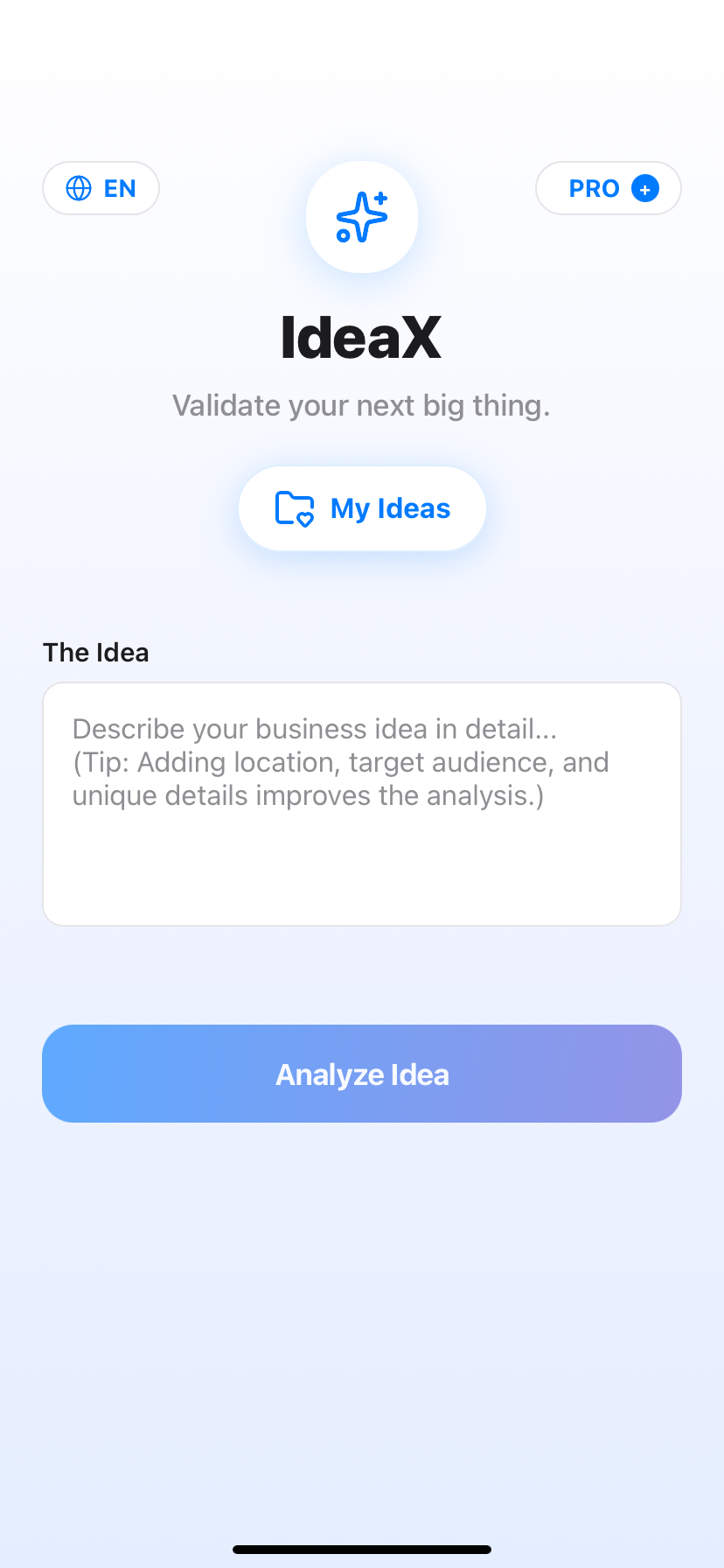
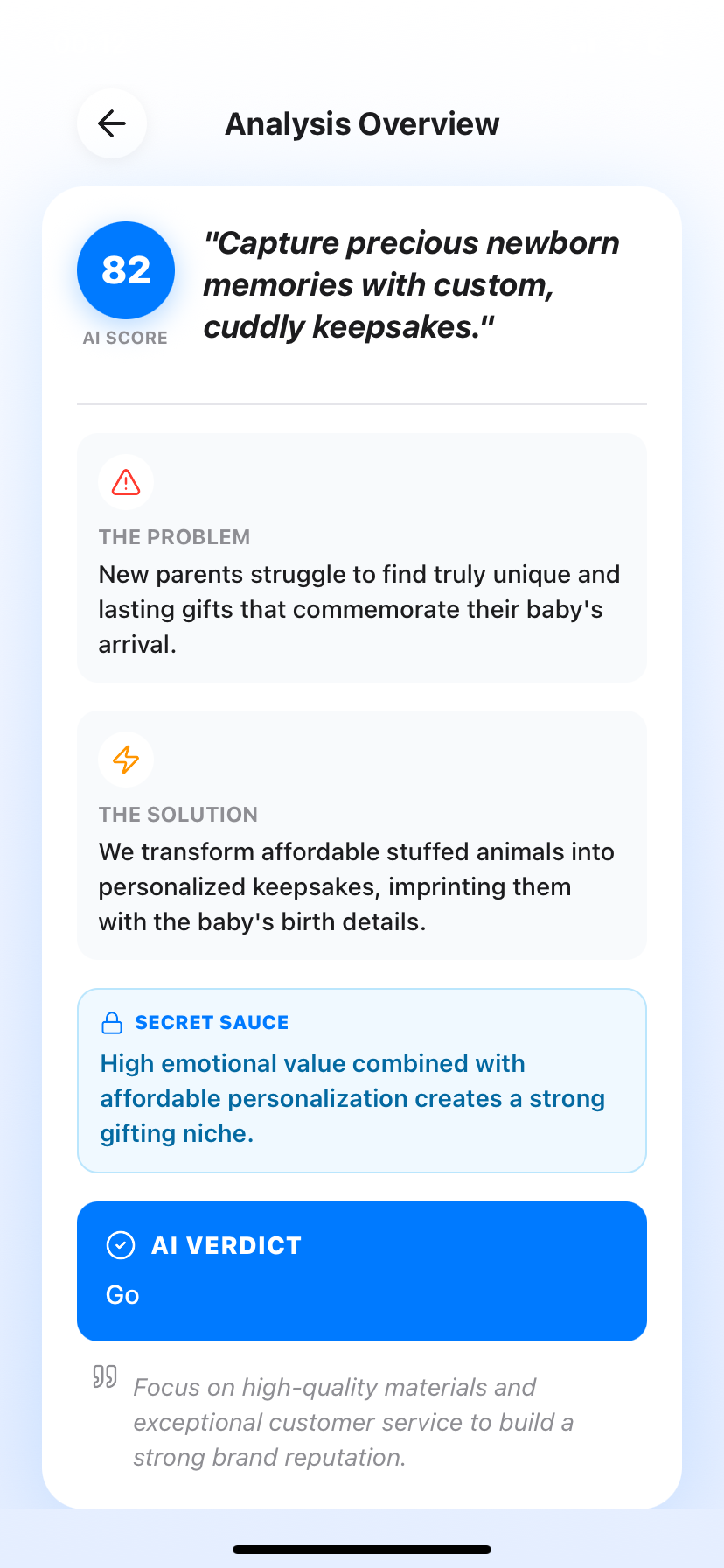
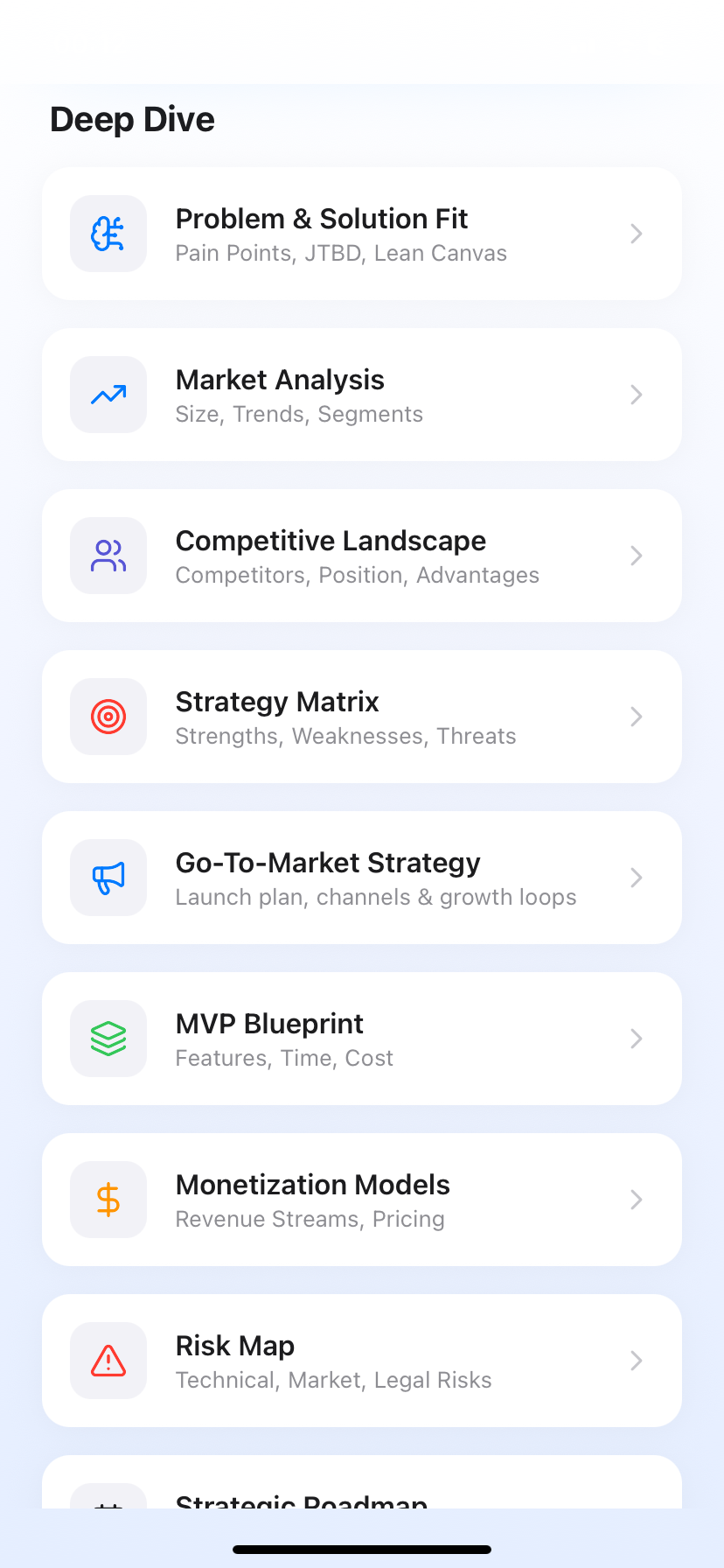

IdeaX: Business Idea Analysis
Run all 5 filters. In 10 minutes per idea.
Apply the 5-filter protocol without the research time.
Manually running all 5 filters across a list of 8 ideas requires 20-40 hours of research. IdeaX automates the most research-intensive components: TAM estimation, competitive moat rating, and structural risk assessment — for each idea, in under 10 minutes. Submit your top 3 ideas, compare the structural audit outputs side-by-side, and use the results to calibrate your Founder-Market Fit Score and 90-Day Traction Test decisions. Eliminate with evidence. Commit with confidence.
Frequently Asked Questions (FAQ)
Is having too many business ideas a good problem or a bad problem?
Initially good — it signals creative thinking and market awareness. Left unresolved, it becomes a structural liability: decision paralysis prevents execution, insufficient focus distributes limited resources across multiple concepts, and the cognitive burden of 7 open loops reduces execution quality on every idea. The goal is converting idea abundance into committed, focused execution on one concept using systematic elimination rather than intuition.
How do I know which business idea to pursue?
Apply the 5-filter sequential elimination protocol: (1) TAM Floor Test, (2) Founder-Market Fit Score, (3) 90-Day Traction Test, (4) Competitive Moat Rating, (5) Lifestyle Alignment Check. Apply each filter in order — earlier filters eliminate more ideas at lower cost. The idea that survives all 5 filters is the one worth committing full execution effort to.
What is Founder-Market Fit?
The degree of alignment between a founder's existing expertise, professional network, personal experience, and the specific market they propose to serve. Scored across 4 dimensions: Domain Expertise, ICP Network Access, Problem Experience, and Technical Stack Fit. Score below 6/12: eliminate. High Founder-Market Fit dramatically increases probability of early customer trust and gives an inherent distribution advantage a competitor without your background cannot quickly replicate.
What is the 90-Day Traction Test?
A single question: "Without spending significant money, can I name a concrete distribution mechanism reaching my first 100 qualified users within 90 days?" Valid mechanisms: LinkedIn DMs to existing ICP connections, posting in a community you already moderate, outreaching to known ICP members via professional network. Invalid: "build a TikTok presence," "run Google Ads," "partner with influencers" — all require time or budget to establish from scratch.
Should I try multiple business ideas simultaneously?
For almost all first-time founders: no. Simultaneous pursuit distributes below-minimum effort across all concepts. The one exception: a parallel micro-test spending one week each on 3 different Painted Door experiments with identical marketing spend, then choosing the concept with highest conversion rate. This is sequential structured experimentation — not simultaneous building.