
I Have a Business Idea but Don't Know Where to Start
The moment after inspiration is the most dangerous moment in entrepreneurship. The idea is electrifying, the possibilities feel infinite, and the immediate instinct of a first-time founder is to begin doing all the wrong things: designing logos, purchasing domains, arguing with friends about brand colors, registering an LLC, and spending three weeks building an elaborate pitch deck. Not one of these activities will help you determine whether your business idea will succeed. Starting a business is a scientific experiment, not an art project — and the first 30 days must be spent generating evidence about the fundamental validity of your core assumption, not building aesthetic artifacts.

- Step 1 — Extract the One-Sentence Value Proposition (Day 1).
- Step 2 — Define the "Desperate" Early Adopter Profile (Day 2-3).
- Step 3 — Map the Business Model Hypotheses on a Lean Canvas (Day 3-4).
- Step 4 — Run 10 Customer Discovery Conversations (Day 5-14).
- Step 5 — Verify Unit Economics Before Spending Anything (Day 10-14).
- Step 6 — Run a Demand Validation Experiment (Day 15-21).
- Step 7 — Decide: Build, Pivot, or Kill (Day 22-30).
The Most Expensive Mistakes First-Time Founders Make
Before walking through the correct steps, it is worth naming the incorrect ones — because they are seductive, they feel productive, and they will consume your first month while generating zero evidence of business viability:
- Building the full product before validating demand. The single most common and most expensive mistake: spending 6-14 months and $30,000+ engineering a fully-featured product, launching it, and discovering that qualified strangers have no interest in paying for it.
- Incorporating an LLC before getting a paying customer. State filing fees, annual compliance, operating agreements, and tax complexity — all for an entity that may be dissolved in 60 days when the idea fails its first validation test.
- Requiring NDAs before customer conversations. This signals inexperience and causes potential mentors, investors, and early adopters to disengage immediately.
- Spending weeks on logo and brand identity. Brand identity is meaningless without customers. Your first 100 customers do not care about your color palette; they care about whether your product solves their specific problem better than what they currently use.
Step 1: Extract the One-Sentence Value Proposition (Day 1)
Your idea is currently a tangled, multi-dimensional cluster of features, use cases, ambitions, and hypothetical revenue streams. Strip it to the single irreducible core in one sentence using this format:
If you cannot complete this sentence, you do not yet understand your own idea with sufficient precision to begin customer conversations about it. This is the first and most critical exercise — and it typically requires 60-90 minutes of focused writing and rewriting to produce a truly tight result.
Step 2: Define the "Desperate" Early Adopter Profile (Day 2-3)
Early adopters are not your eventual mass-market customers. They are the specific, small, identifiable group of people who are in such acute pain with the existing solution that they are actively looking for something better — and will eagerly use an ugly, incomplete, buggy Version 1 of your product if it addresses their core problem even partially.
Define your Early Adopter Profile with four behavioral characteristics — not demographic ones:
- What specific behavior are they doing today that indicates the pain exists? (e.g., "manually copying data between Notion and Airtable every Monday morning")
- What is the pain costing them in measurable time or money every week?
- Where online do they congregate to discuss this pain? (specific subreddits, LinkedIn groups, Slack communities)
- What existing "ugly workaround" are they currently using to cope with the absence of your product?
Step 3: Map Business Model Hypotheses on a Lean Canvas (Day 3-4)
With your UVP and Early Adopter Profile defined, spend 2-3 hours completing a full Lean Canvas — the 9-box hypothesis map that forces you to articulate every major assumption in your business model before testing any of them. The most important constraint: every box represents a hypothesis, not a fact. Be honest about what you are assuming versus what you have evidence for.
Critically, do not skip the Unfair Advantage box. If the box is empty or generic, you have identified the most important strategic question to resolve: what specific, defensible advantage will prevent a well-funded company from copying your concept once you prove the market exists?
Step 4: Run 10 Customer Discovery Conversations (Day 5-14)
Before building anything, you need to sit across from (or on a video call with) a minimum of 10 people who match your Early Adopter Profile and ask them specifically about the problem you believe they experience. The golden rule of these conversations: never pitch your product. Only ask questions about their experience with the problem, their current workarounds, and how much time or money the problem costs them.
The signals you are looking for: unprompted frustration, specific dollar amounts attached to the pain, and confirmation that the described workaround is genuinely inadequate and generating ongoing friction. If 7 of 10 qualified interviewees express genuine pain and active interest in a better solution, your problem hypothesis is validated. If fewer than 4 of 10 express significant pain, the problem is not commercially severe enough — and your idea requires pivoting before proceeding.
Step 5: Verify Unit Economics Before Building (Day 10-14)
Before running a Painted Door test or committing to a specific product architecture, verify that the fundamental financial mechanics of your proposed business model are viable. Calculate:
| Metric | Your Estimate | Minimum Viable Benchmark |
|---|---|---|
| Gross Margin | Calculate: (Price – COGS) ÷ Price | ≥ 60% (SaaS ideal: 80%+) |
| Customer LTV | Avg Monthly Revenue × (1 ÷ Expected Churn %) | ≥ 3× estimated CAC |
| Estimated CAC | Research paid channel CPLs for your category | Payback Period < 12 months |
| Breakeven Customers | Fixed Monthly Costs ÷ Net Revenue Per Customer | Reachable within your runway |
Steps 6 & 7: Validate Demand and Decide (Day 15-30)
With your customer discovery conversations confirming problem severity and your unit economics model confirming financial viability, run a Painted Door or Concierge MVP test to generate your first behavioral demand signal from strangers using real money. Build a landing page, drive targeted traffic, and measure conversion intent.
At Day 30, make a definitive decision based on the evidence collected across all 7 steps. The three possible outcomes:
- Build: Customer discovery validated, unit economics positive, demand test converted at 3%+. Begin building the minimum viable product scoped to exactly the features proven to drive conversion.
- Pivot: Customer discovery revealed a different, adjacent pain that is more acute and commercially severe. Return to Step 1 with the refined hypothesis.
- Kill: Multiple validation experiments consistently failed to surface paying intent. You just saved yourself 14 months of expensive execution on a non-viable concept. Congratulations — this is a win, not a failure.
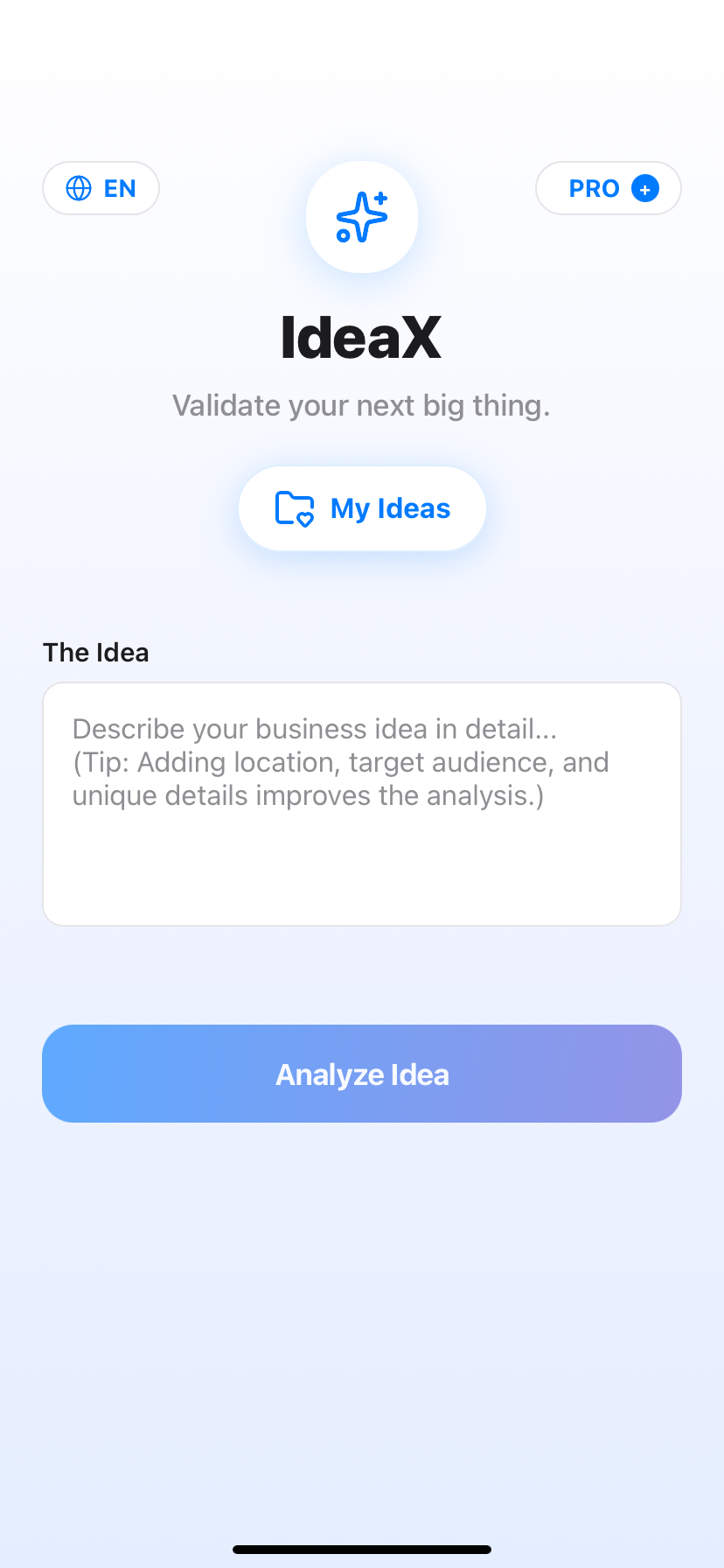
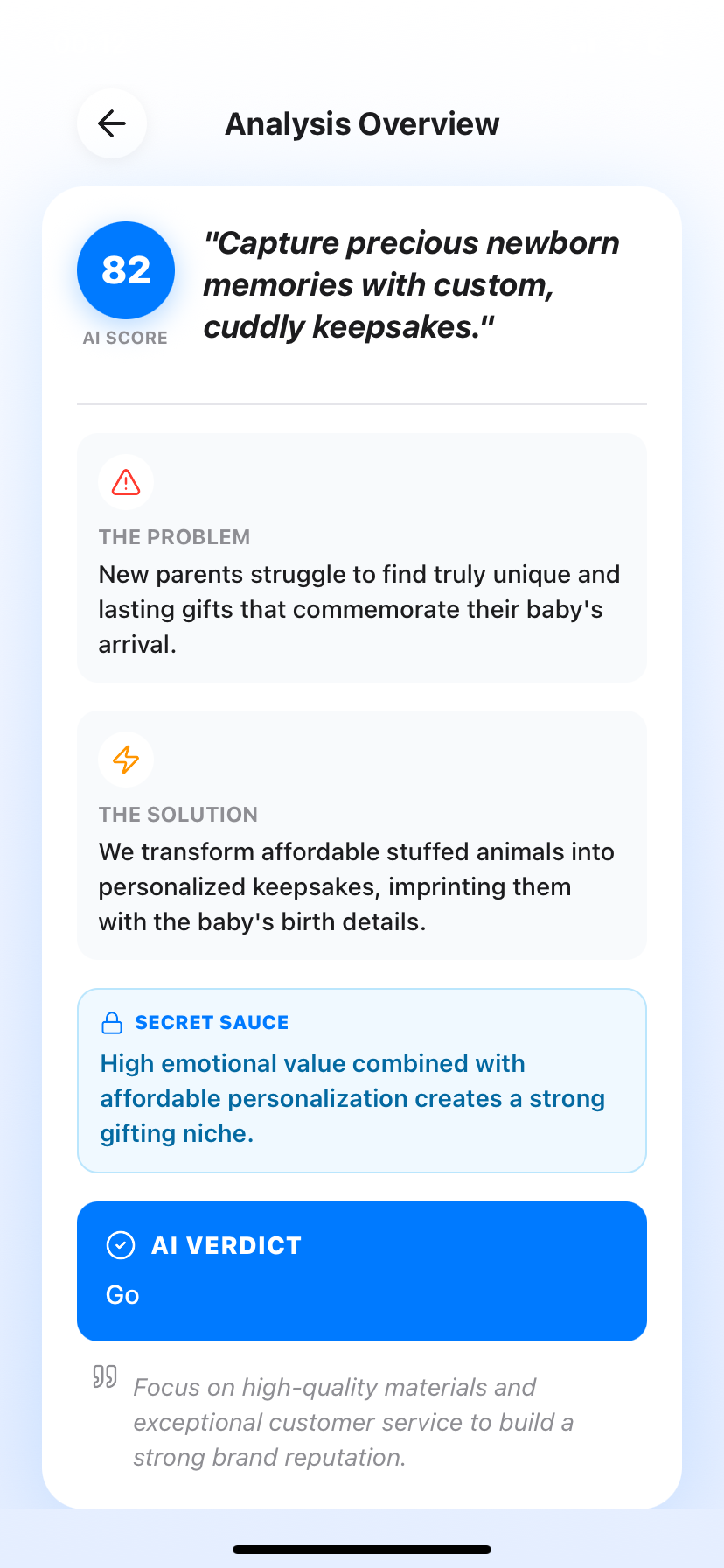
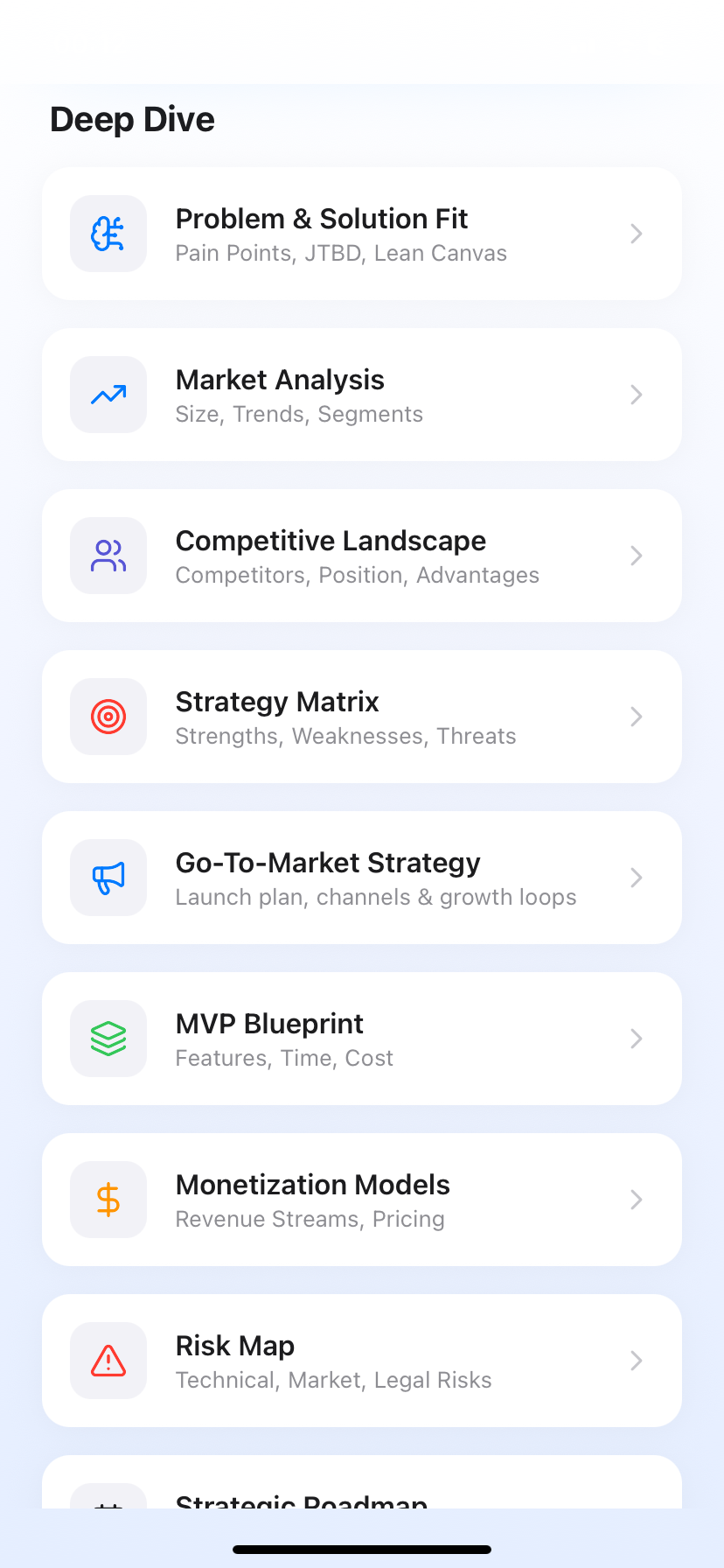

IdeaX: Business Idea Analysis
A structured space for evaluating what to build next.
Turn chaos into a structured roadmap.
Staring at a blank page with a massive idea is deeply paralyzing. IdeaX is the first step in the 7-step roadmap: submit your chaotic, unstructured concept and the AI instantly generates a One-Sentence UVP, a complete Lean Canvas, a unit economics model calibrated to your category, and a prioritized list of the 3 most critical assumptions to validate first. In 10 minutes, you go from paralyzed to having a clear, sequenced Day 1-30 execution plan.
Frequently Asked Questions (FAQ)
Should I incorporate an LLC before validating my idea?
No. LLC formation costs $300-800 in filing fees and creates ongoing annual compliance obligations. Do not spend a dollar on legal structure for an idea that hasn't yet attracted a single paying customer. Incorporate only when you have confirmed revenue or when an investor explicitly requires corporate structure as a condition of investment.
What is the very first thing I should do?
Strip the idea to a single-sentence value proposition: "[Product] helps [specific audience] [achieve specific outcome] without [what they hate most about current solutions]." If a stranger can't repeat it back after hearing it once, it's too complex. Rewrite until they can. This typically takes 60-90 minutes of focused effort.
Should I ask people to sign an NDA?
Never. Requesting NDA signatures before sharing an idea signals inexperience and will cause investors, potential co-founders, and early customers to disengage immediately. Ideas are 1% of success; execution is the other 99%. Experienced people encounter hundreds of ideas annually and have no interest in stealing any of them.
What if I don't know how to code?
Code is not a prerequisite for starting a business. Use the Concierge MVP method to deliver value manually to 5-10 paying beta customers. Use no-code tools (Carrd, Webflow, Glide, Bubble) for frontend interfaces. Validate demand first — then hire a technical co-founder or contractor using the validation data as proof of concept.
How do I know when my idea is ready to build?
When you have: (1) a one-sentence UVP any stranger can repeat back, (2) at least 3 customer conversations confirming the pain is real, (3) a demand test producing at least one genuine purchase intent signal, and (4) a unit economics model showing LTV:CAC ≥ 3:1. This typically takes 2-4 focused weeks.