
Business Idea Validation Checklist for Beginners
Ideas are completely worthless commodities; validated market demand is everything. Use this rigorous, step-by-step sequential checklist to determine if your startup concept will actually survive contact with the brutal forces of the real world—before you write a single line of backend code or spend a dollar on inventory.
- Phase 1: Defining the Hypothesis and identifying "Hair-on-Fire" pain.
- Phase 2: Qualitative Outreach (Cold email scripts to book interviews).
- Phase 3: The Quantitative "Painted Door" test for measuring precise CAC.
- Phase 4: The Core Commitment (Extracting currency and pre-sales).

The Danger of Unvalidated Action
When inspiration strikes, the immediate dopamine rush frequently forces new, untrained founders into reckless, expensive action. They immediately purchase a $50 domain name, register an LLC, order high-end business cards, and spend six consecutive months isolated in their bedrooms writing software that absolutely nobody actually wants to buy.
Validation is the ultimate antidote to this entrepreneurial self-sabotage. Validation is not the process of proving yourself right; it is the methodical, scientific process of desperately trying to disprove your own assumptions. You must treat your startup idea as "guilty until proven innocent" by the free market.
Print out the following checklist. Do not proceed to raising capital or hiring developers until you have checked off every single box sequentially.
Phase 1: Defining the Core Hypothesis
Before you talk to a single human being, you must define exactly what you are testing. Vague, overarching ideas cannot be validated. You must narrow your focus to a laser point.
☐ 1. Define the Hyper-Specific Target Audience
"Millennials" is an offensive demographic, not a highly targeted audience. You must niche down until the audience is painfully specific.
Bad Example: "I am building a calendar app for busy professionals."
Good Example: "I am building a calendar app specifically for freelance graphic designers making over $50k a year who struggle to balance overlapping client deadlines and tax compliance."
☐ 2. Define the "Hair-on-Fire" Problem
Write down the exact pain point your specific audience is experiencing. It must be an urgent, recurring problem, not a mild inconvenience. If the problem only occurs once every five years, the user will never remember to pay for your subscription. The problem must bleed time or money continuously.
☐ 3. Draft a One-Sentence Value Proposition
How will your proposed solution alleviate this specific pain better, faster, or cheaper than the current status quo? Write a clean, jargon-free value proposition. (e.g., "We automate international contractor payments so remote agencies can process payroll in one click without violating compliance laws.")
Phase 2: Qualitative Customer Interviews
Do not send out anonymous surveys via Google Forms. Surveys give you cold, binary data, but face-to-face (or Zoom) interviews provide the emotional "why" behind the data. You must speak to humans directly to read their body language and hear the frustration in their voice.
☐ 4. Source 20 Valid Theoretical Prospects
Find exactly 20 strangers who perfectly match your target audience criteria from Phase 1. Use Reddit, LinkedIn Advanced Search, or targeted cold emails to secure 15-minute interviews. Offer them a $10 Starbucks gift card for their time if necessary.
☐ 5. Pass the "Mom Test"
Avoid asking future-focused questions like, "Would you use this app if I built it?" They will lie and say yes to be polite. Instead, ask about their past behavior. "Tell me about the last time you dealt with [The Problem]. What exactly did you do?" If they haven't actively tried to solve the problem in the last 6 months, the problem is not severe enough to warrant a business.
☐ 6. Identify the "Hacky" Alternatives
Ask them what terrible, broken tools or manual workarounds they currently use to solve the problem. Do they use five distinct Zapier integrations just to process an invoice? Perfect. You have found a massive wedge in the market.
Phase 3: The Quantitative "Painted Door" Test
Verbal conversations are cheap. Everyone loves a concept until they are asked to pay for it. It is time to mathematically measure if people will actually pull out their credit cards based purely on your value proposition.
☐ 7. Build a High-Fidelity Landing Page
Create a single-page website that explains the benefits of the product as if it already exists and functions perfectly. Use professional branding. Treat this as your initial business plan.
☐ 8. Price the Non-Existent Product
Include a highly visible "Sign Up for $29/mo" or "Pre-Order Now" button. Do not make it free. You are validating willingness to pay, not willingness to click.
☐ 9. Drive $100 of Targeted Traffic
Spend roughly $50–$100 on highly targeted Google Search Ads or Facebook Ads to push your exact audience to the page.
☐ 10. Analyze the Conversion Economics (CAC)
When a user clicks the "Buy" button, show them a polite modal explaining that the software is in private beta and ask for their email. Now, calculate your Customer Acquisition Cost (CAC). How much ad spend did it cost to capture one high-intent email?
Result: If zero people out of 1,000 targeted visitors clicked the pricing button, your validation has totally failed. Shut down the project. You just saved yourself a year of wasted labor.
Phase 4: The Core Commitment (The Final Boss)
The ultimate test of an idea is the strict transfer of value. If you cannot secure commitment before you build the product, you will almost certainly fail to secure commitment after you build the product.
☐ 11. Secure Pre-Sales (For B2C / Hardware)
Can you get 10 people to give you a non-refundable $20 to $50 deposit via Stripe for early access to the tool when it launches? This is the ultimate proof of demand.
☐ 12. Secure Letters of Intent (For B2B Software)
If you are building an expensive Enterprise SaaS product, can you secure non-binding Letters of Intent (LOIs) from 3 major businesses stating they fully agree to pilot the software for $5,000 once it reaches beta?
☐ 13. Execute the Concierge MVP
Before writing complex automation algorithms, can you manually perform the service for 5 clients using Google Docs, spreadsheets, and manual email sending? If the manual process solves their problem and they are happy paying for it, you have perfectly validated the need to automate that exact process with code.
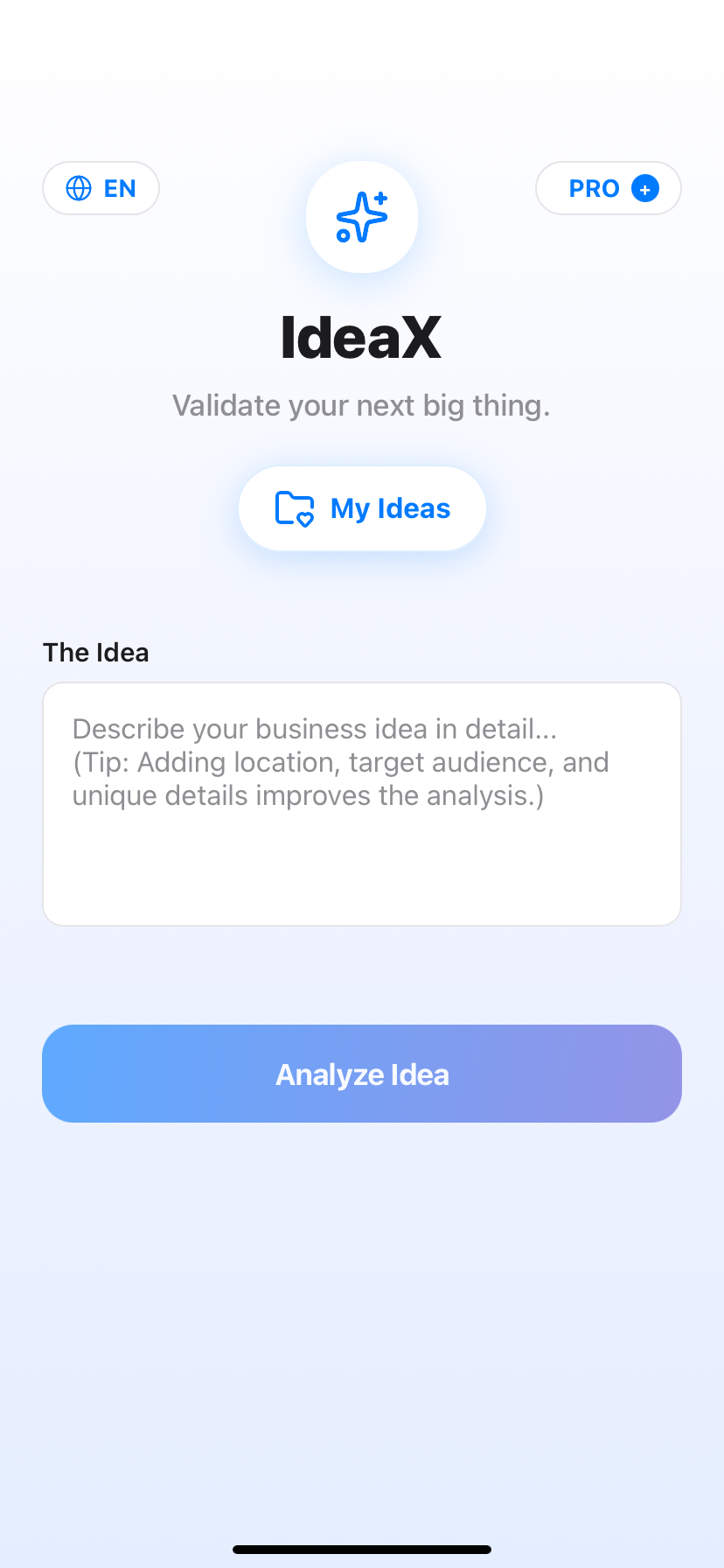
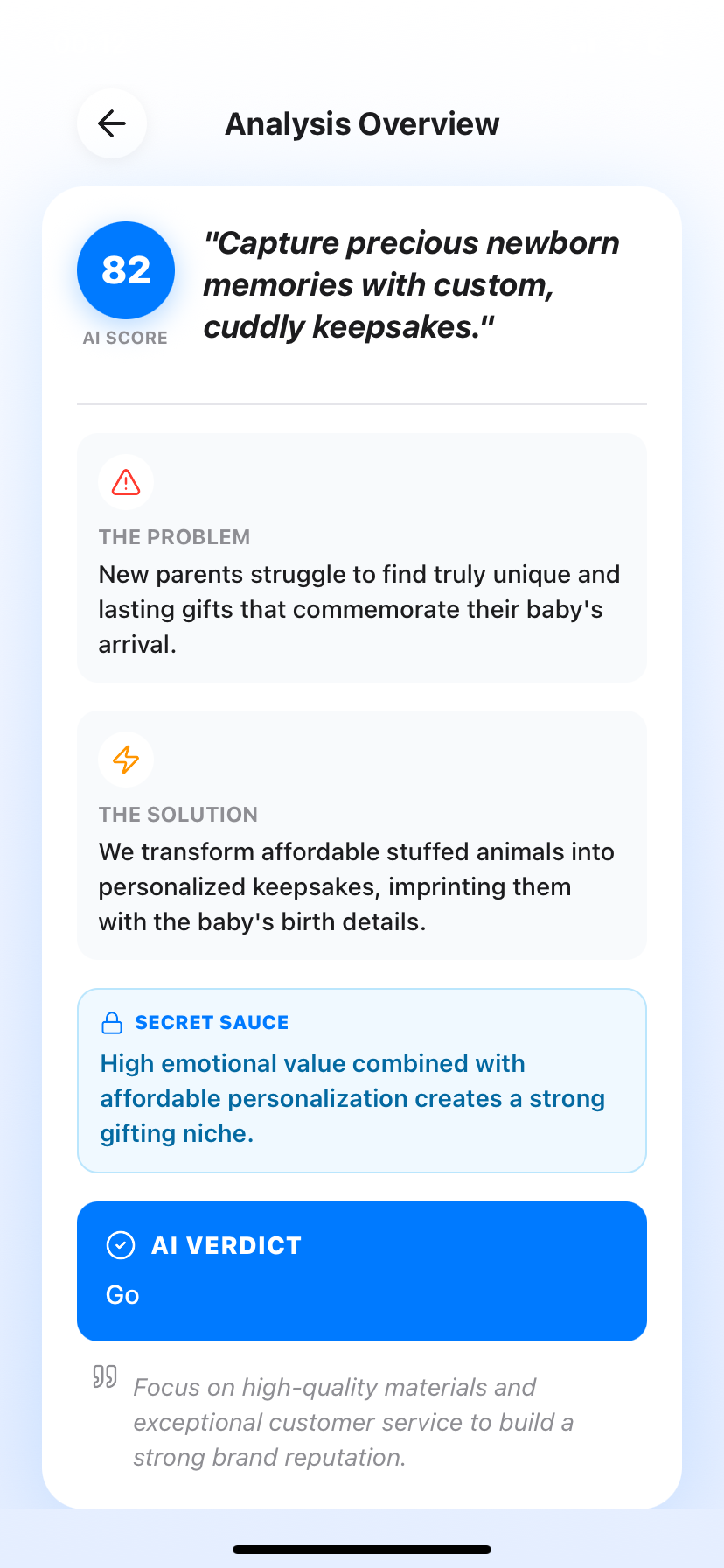
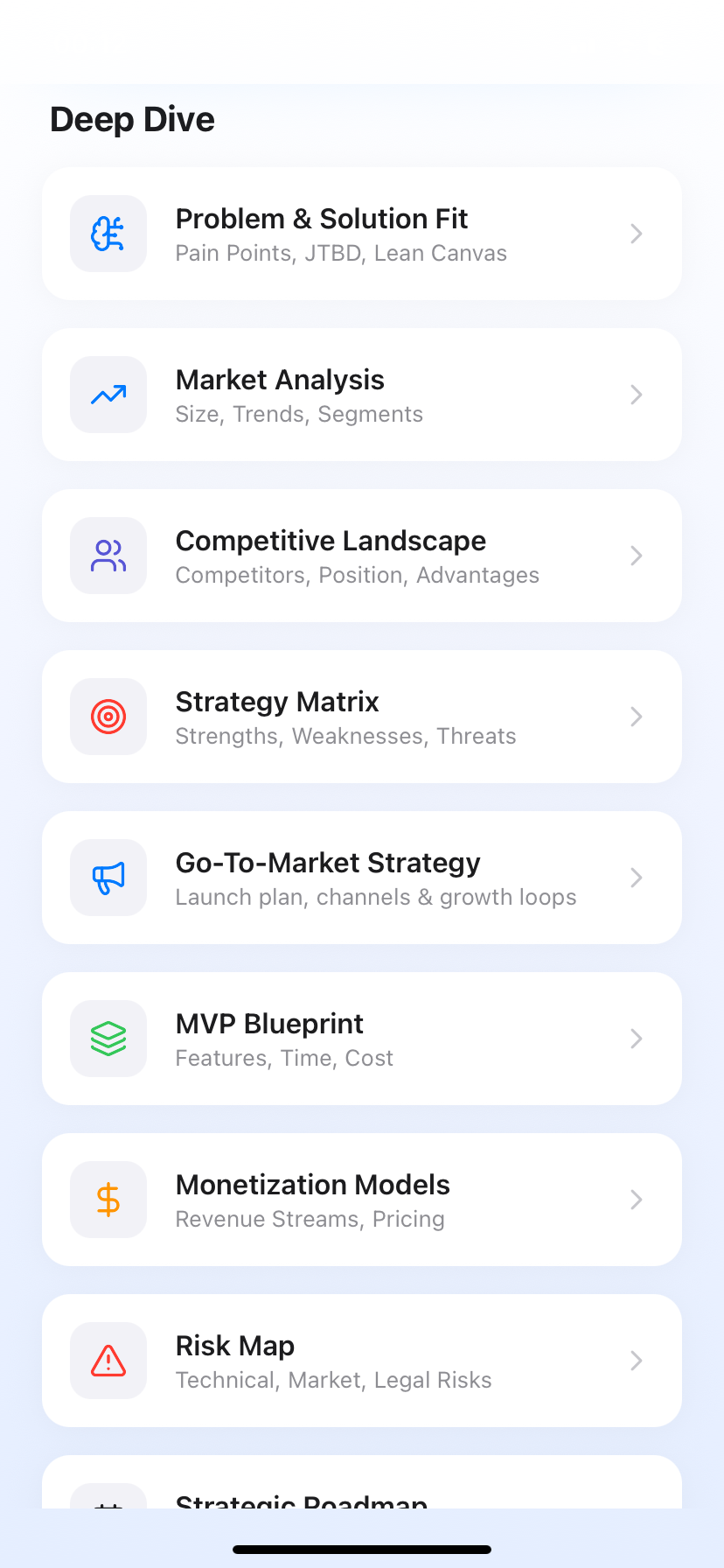

IdeaX: Business Idea Analysis
Your automated validation copilot.
Automate your validation checklist.
Checking abstract boxes manually is easy, but analyzing the complex market data accurately without bias is incredibly difficult. IdeaX fully digitizes your startup validation checklist. Our algorithmic engine scans your concept, highlights logical inconsistencies in your target audience definition, and provides cold, data-backed probability scores on whether your 'Painted Door' test will actually convert. Validate with strict math, not emotion.
Frequently Asked Questions (FAQ)
What is the single most important step in the idea validation checklist?
The most critical step is asking for a financial commitment, usually in the form of a pre-payment, deposit, or Letter of Intent (LOI). If 50 people say they love your idea but exactly 0 people will pre-order it, your idea has objectively failed validation.
Can I validate a software idea without building an MVP?
Absolutely. You can execute a 'Painted Door' test. You set up a highly professional landing page explaining the product as if it exists, and track how many visitors actually input their credit card information before being notified you are in 'private beta'.
How do I find strangers to talk to for initial validation interviews?
Find digital watering holes where your exact target audience congregates. This could be highly specific subreddit threads, niche Facebook groups, closed Slack channels, or LinkedIn groups. Provide free value to the community first, then politely ask for 15-minute interviews.
Why is asking my friends and family about my idea a bad strategy?
Friends and family care about your emotional well-being, meaning they will subconsciously lie to protect your feelings. They will tell you your terrible idea is 'great', which lulls you into a false sense of security. You must validate with strangers who owe you nothing.
How long should it take to complete a full validation cycle?
A rigorous validation cycle should take no more than 14 to 30 days. If you are spending 6 months validating a concept in spreadsheets without launching a single landing page or talking to real customers, you are procrastinating out of fear, not validating.