
How to Do a Competitor Analysis for a Startup Idea
Early-stage founders often view their competitors as a terrifying threat to be completely ignored out of pure anxiety. In reality, a competitor is a massive, free goldmine of structured market data. They have already spent millions of dollars educating the market, acquiring customers, and making highly expensive mistakes. You just need to know how to aggressively read their map.
- The critical difference between Direct vs Indirect vs Status Quo competitors.
- How to leverage "Review Mining" to steal their angriest customers.
- Analyzing complex pricing architectures to find hidden market gaps.
- Understanding defensive Moats (Why can't you easily kill them?).
- Executing a brutal, honest SWOT Analysis on yourself and your rivals.

The "No Competition" Fallacy
"We have no competition."
This is objectively the single most terrifying sentence an angel investor or venture capitalist can ever hear from a founder. It usually means one of two distinct things: either you are so deeply entrenched in your own ego that you haven't researched the market properly, or literally no one else is trying to solve the problem because the market demand is zero.
When entering a new vertical, you must map the entire landscape aggressively. A rigorously structured competitor analysis will reveal exactly where the massive incumbents are weak, lethargic, or vulnerable, giving you the exact strategic blueprint for your own product's value proposition. Here is a step-by-step framework to dissect your rivals without spending a dollar.
Step 1: Identify the Three Tiers of Competition
Do not just look for companies building the exact same React-based software wrapper as you. Broaden your scope to understand how human behavior actually operates in the wild. People don't buy "software"; they buy solutions to severe problems.
- 1. Direct Competitors: Businesses targeting the exact same audience with a nearly identical product architecture. (e.g., Uber vs. Lyft, or Coca-Cola vs. Pepsi).
- 2. Indirect Competitors: Businesses solving the exact same fundamental problem, but delivering a completely different product medium or service execution. (e.g., A fitness app developer competing against local physical Gym Memberships, or Slack competing against legacy Email).
- 3. The "Status Quo" Competitor (The Deadliest): The most dangerous competitor of all. This is simply the act of doing absolutely nothing, or using a messy, convoluted Excel spreadsheet to "get by". Often, your hardest job in B2B software is convincing users to abandon their deeply ingrained, comfortable habits.
Step 2: The "Review Mining" Aggression Strategy
Do not analyze a competitor by reading their own beautifully polished marketing material and landing pages; they will obviously say they are perfect. Instead, listen exclusively to their most violently angry customers.
Go directly to verified software review platforms like G2, Capterra, or Trustpilot. Filter your direct competitor's reviews exclusively to the 2-star and 3-star ratings.
Why ignore 1-stars? Because 1-star reviews are often just irrational anger ("The login page didn't load today! Trash!"). 2-star and 3-star reviews are usually highly detailed, deeply thoughtful critiques of structural product flaws written by power users who wanted the software to be better.
Looking for the "Wedge"
Look for highly recurring negative themes. Are 40 different users complaining about terrible, non-existent customer service? Are they complaining about impossibly slow database load times? Are they furious about missing API integrations?
These complaints are literal, free blueprints for your exact product roadmap. If everyone hates Competitor X's terrible, bloated user interface, your entire aggressive marketing angle violently becomes "The beautiful, lightning-fast alternative to Competitor X."
Step 3: Dissect Their Pricing Architecture
Pricing is not a mathematical afterthought; pricing is the core weapon of market positioning. To defeat an enemy, you must understand their economic fortress.
Look closely at their subscription tiers. Are they exclusively serving massive "Enterprise" clients for $10,000 a month with locked-in yearly contracts, effectively ignoring and alienating small businesses? If so, you have instantly found an open flank.
You can enter the exact same market serving solo-preneurs for $40 a month, entirely undercutting the incumbent where they aren't even competing because the profit margins are too small for their massive overhead. Conversely, if a competitor is giving their tool away for $5/month and bleeding cash, you can position yourself as the premium, high-reliability $200/month "pro" tool. Never compete on the exact same price tier as a VC-funded giant; you will be crushed by their ad spend.
Step 4: Execute a Brutal SWOT Analysis
Finally, aggregate all your unstructured intelligence into a highly visual map. Summarize your findings using a classic SWOT framework for the top three major competitors in your space.
Strengths & Weaknesses (Internal)
Strengths: What is their unfair advantage? (e.g., "They possess 10 years of proprietary ML training data.")
Weaknesses: Where are they bleeding? (e.g., "Their codebase is built on legacy tech from 2012, making it impossible for their engineers to ship new features quickly.")
Opportunities & Threats (External)
Opportunities: The market gap. (e.g., "Nobody is currently building this explicitly for the heavily regulated healthcare sector.")
Threats: Existential risks. (e.g., "If Google updates its core OS api, both our competitor and us will instantly go out of business.")
This visual SWOT map will prevent you from making highly emotional, ego-driven decisions during development. It ensures that your go-to-market strategy specifically attacks their documented blind spots while completely avoiding their entrenched, unassailable strongholds.
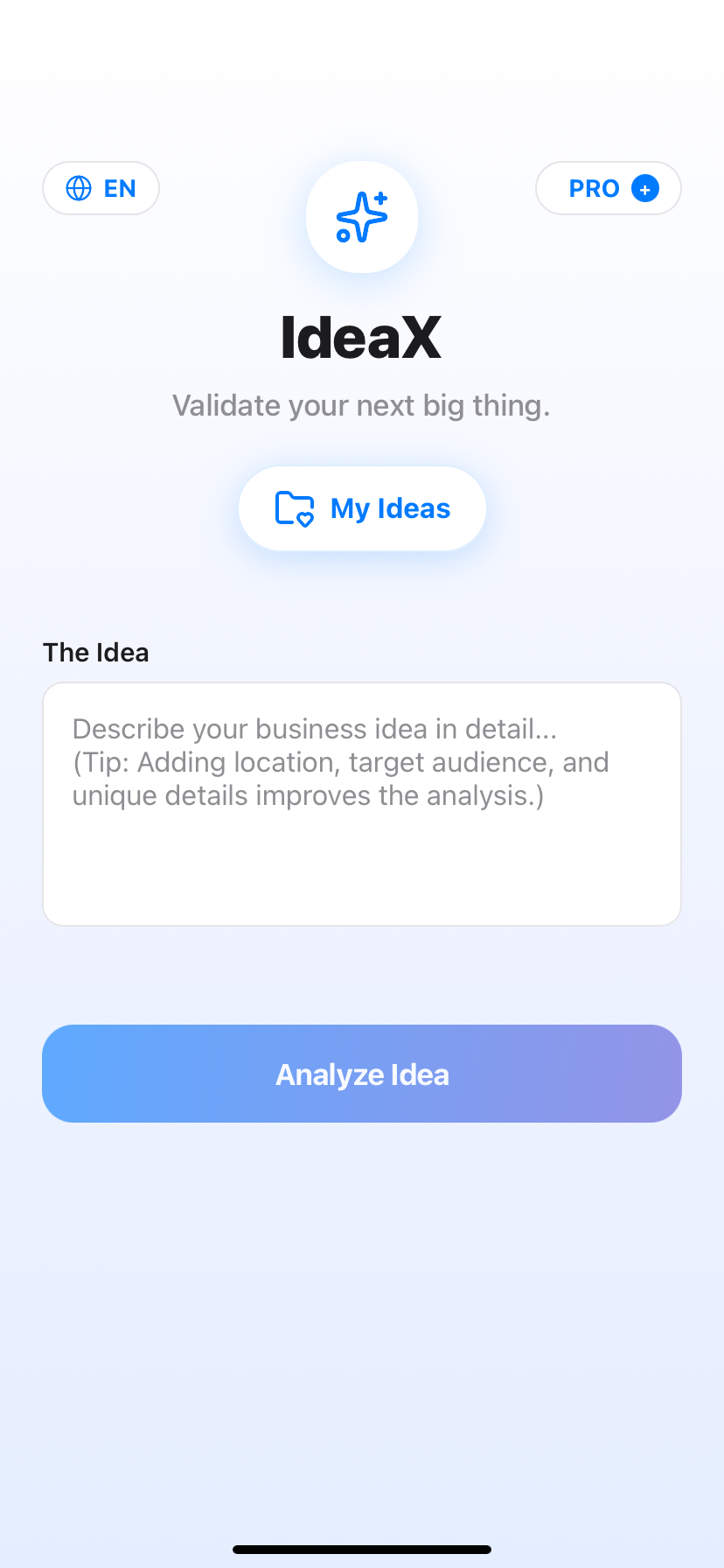
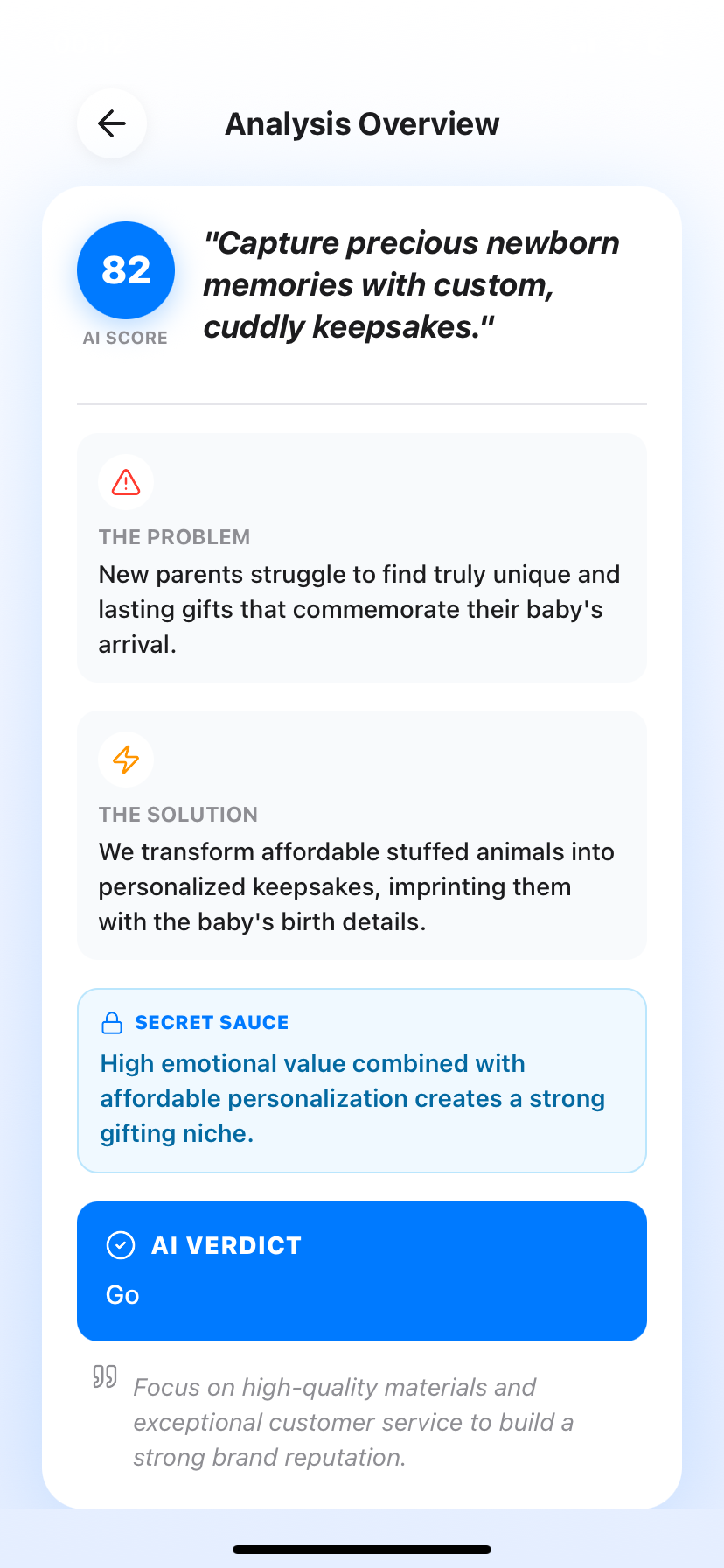
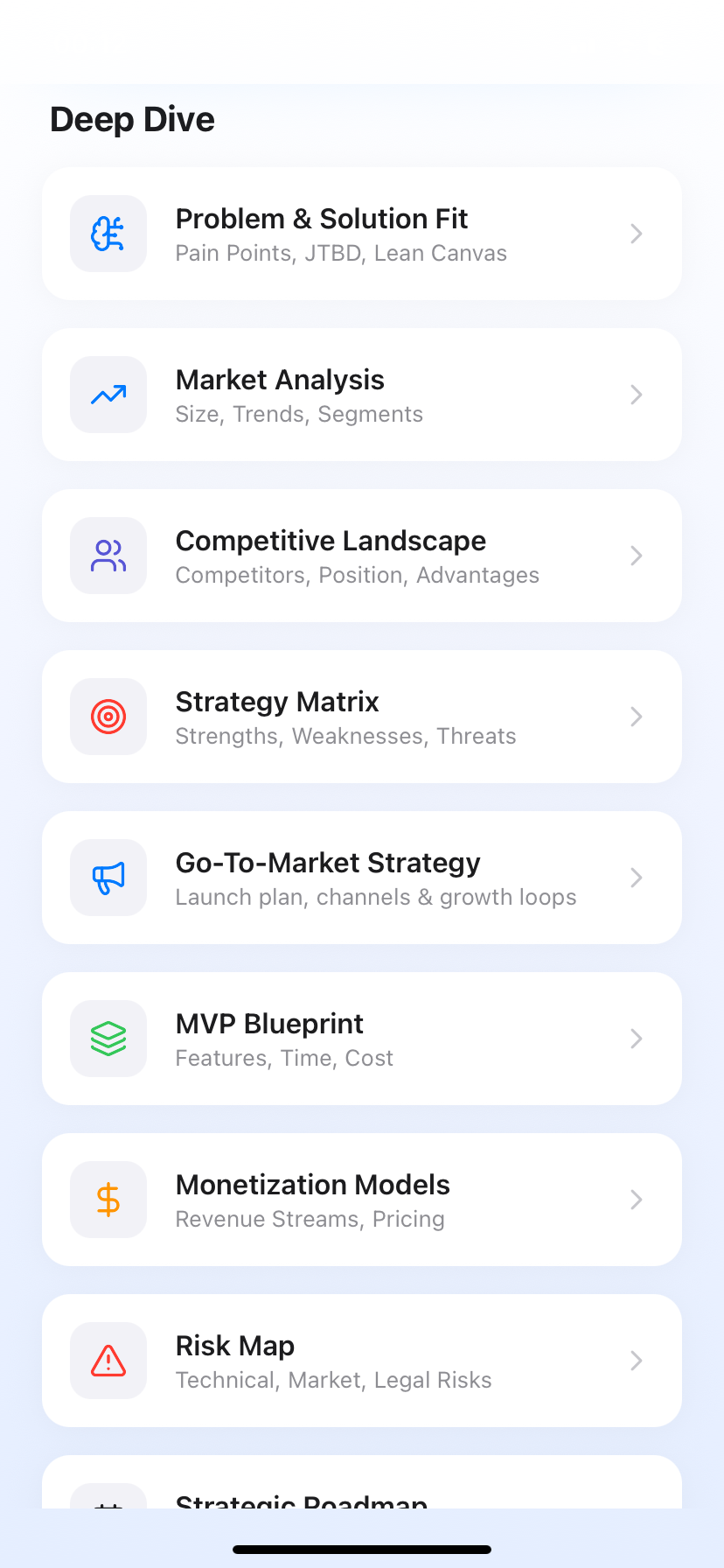

IdeaX: Business Idea Analysis
A structured space for evaluating what to build next.
Automate your competitive intelligence.
Manually hunting down competitor flaws, reading hundreds of Trustpilot reviews, and charting complex pricing matrices takes weeks of agonizing spreadsheet labor. IdeaX features a live, algorithmic Market Surveillance engine. Feed it the names of your rivals, and the AI will auto-generate comprehensive SWOT analyses, aggregate major consumer complaints into actionable data points, and explicitly highlight the strategic economic 'gaps' in the market waiting for you to conquer them. Win the war before you write the code.
Frequently Asked Questions (FAQ)
How do I find my indirect competitors?
Indirect competitors are businesses or tools that solve the exact same problem your customer has, but in a completely different way. If you sell B2B accounting software, an indirect competitor is hiring an outsourced accountant on Upwork, or simply using a messy Google Sheet.
Should my startup try to beat established competitors purely on price?
Almost never. Competing entirely on price triggers a 'race to the bottom' that inevitably destroys your profit margins and starves your startup of cash. Instead, compete on speed, superior user experience, highly specific niche targeting, or premium customer service.
What if my industry is already dominated by a massive, billion-dollar monopoly?
Monopolies are generally slow, bureaucratic, and often universally hated by their trapped users due to terrible customer support. Target a microscopic niche within their user base that is currently being underserved, and build a highly specific, beloved tool just for them.
How often should I conduct a competitor analysis?
You should conduct a deep-dive analysis before you write any code (during the validation phase), and then systematically update your intelligence map every single quarter. Markets shift incredibly quickly; a feature that was a competitive advantage last year is an absolute baseline requirement today.
Is it a good idea to just copy my competitor's exact feature set?
Never. If you build an exact clone of your competitor, you offer the customer zero incentive to endure the massive headache of switching over to your platform. You must offer a distinct, specialized 'wedge' that solves one problem infinitely better than the incumbent.