
How to Analyze Market Demand for a New Idea
Passion, obsession, and intuition are fantastic emotional drivers for brainstorming a company into existence, but they are absolutely lethal when actually making financial allocation decisions. Before investing irreplaceable capital or a year of engineering time, you must step back and mathematically prove that a hungry, paying market actively desires your solution.

- The danger of "Latent Demand" and why educating the market bankrupts startups.
- How to use Keyword Search Volume to measure the exact severity of local market pain.
- Re-framing competitor success as documented proof of commercial viability.
- "Forum Mining": Locating hyper-niche communities literally begging for solutions.
- Executing "Painted Door" validation tests to capture actual willingness-to-pay.
The Fallacy of Operating in a Vacuum
When enthusiastic founders pitch a new software idea to investors, the concept almost always sounds perfectly flawless in a theoretical vacuum. However, modern businesses do not operate in a vacuum; they survive in highly saturated, brutally competitive, attention-starved ecosystems.
If authentic market demand is anemic, it does not matter if your business idea is theoretically brilliant or technically superior; you will quickly run out of venture capital simply trying to educate a stubborn population on why they need to care about you.
Fortunately, analyzing real market demand in the modern era doesn't require complex proprietary focus groups or a magical crystal ball. Humans are highly predictable and leave massive digital footprints everywhere they go. By systematically tracking search trends, analyzing competitor revenue trajectories, and observing frantic community behavior, you can quantify your exact market potential with terrifying accuracy.
1. The SEO Litmus Test: The Urgency of Search Intent
The single most objective, undeniable proof of active market demand is Google Search data. If a specific demographic has a severe, 'hair-on-fire' problem, their absolute first behavioral instinct is to secretly search for a viable, immediate solution online.
Direct Demand vs. Latent Demand
There is a massive distinction between the two types of target demand that dictates your entire marketing budget:
- Direct Organic Demand: This occurs when a user explicitly types a desperately specific term like "B2B accounting software for freelancers" into Google. If thousands of people are typing this every month, you know exactly what to build and exactly how to capture them using SEO content. They know they have a problem, and they know software can fix it.
- Latent (Hidden) Demand: This occurs when a user is suffering from profound workflow inefficiency but fundamentally does not know that a technological solution could possibly exist to save them. Because they don't know the solution exists, they do not search for it. To capture latent demand, you cannot rely on organic SEO. You are forced to spend millions trying to interrupt them on Facebook with educational video ads saying: "Hey, did you know you don't have to do this manually anymore?"
As a bootstrapped or early-stage founder, you must exclusively chase Direct Organic Demand. Use analytical platforms like Ahrefs, SEMrush, or the entirely free Google Keyword Planner to check the explicit monthly search volume surrounding your core value proposition. If nobody is searching for the cure to the pain you cure, you will face an impossibly steep uphill battle.
2. The True Meaning of the "Competitor Revenue Test"
It is a classic irony that first-time, inexperienced founders actively celebrate when they realize their startup idea has no direct competition. They mistakenly believe that a complete lack of competitors provides them with an impenetrable "First-Mover Advantage."
In reality, the brutal truth of economics dictates that entering a market with literally zero competitors is the most dangerous red flag possible. It almost universally implies that there is zero commercial demand. Someone smarter and better funded than you has likely already tried to build it, realized the market wouldn't pay, and quietly shut the company down.
Why Monopoly Exits Are Myths
If you survey the landscape and immediately identify three or four brilliantly funded, highly profitable companies solving the exact same fundamental problem you intend to solve—you should aggressively celebrate.
Those massive, profitable competitors are the greatest economic gift you can ask for. They have already done the hardest work for you: they spent tens of millions of dollars validating the absolute existence of market demand. Your job is no longer proving that abstract demand exists; your strategic job is strictly to target an unsatisfied sub-niche within their user base and execute the interface or pricing strategy just 10% better than the sluggish incumbents.
3. The 'Hack' Indicator: Deep-Sea Forum Mining
Search volume indicates broad market desires, but some of the most lucrative, hyper-profitable B2B SaaS ideas on the planet are born entirely from analyzing the hyper-specific agony of isolated, technical communities.
Looking for "The Spreadsheet Workaround"
The easiest way to validate software demand without spending a dollar is to locate existing users who are attempting to solve a severe problem using broken, highly complex workarounds. Go directly to Reddit, highly specialized industry Discord servers, or professional Facebook groups. Use the search functions to hunt for terms like:
- "I absolutely hate it when..."
- "Is there a better workaround for..."
- "How do I automate this terrible spreadsheet..."
- "I spend three hours a week manually entering..."
If you uncover hundreds of professional logistics managers actively complaining about how miserable their legacy CRM software is—and openly sharing terrifyingly complex, fragile Zapier automation maps just to get the software to function—you have accidentally discovered a goldmine of raw, unfulfilled demand. Where there is extreme emotional friction and wasted administrative time, there is incredibly high willingness to pay.
4. The 'Painted Door' Conversion Protocol
Finally, once you genuinely believe you have located a vein of demand using search data and competitor analysis, you must mathematically prove that the theoretical demand actually translates into literal financial action. You cannot rely on surveys where people politely say they "love the idea."
You must execute a strict idea validation experiment known as the "Painted Door" test.
How to Trap Demand
Do not build the app. Set up a gorgeous, flawless landing page that explicitly details your proposed product as if it already exists right now. Outline your specific pricing tiers clearly. Run exactly $100 of highly targeted Google Ads focusing exclusively on the pain-point keywords you discovered during your SEO phase.
When an interested visitor aggressively clicks the "Start Premium Trial" button, trigger a graceful pop-up modal stating: "We are currently rolling this feature out in private beta. Enter your email to jump the waitlist."
If 15% of your total visitors attempt to buy the invisible product and surrender their primary email address, your demand hypothesis has proven overwhelmingly correct. If your conversion rate is flatly absolute zero, you must shut the landing page down, save your engineering budget, and immediately return to the drawing board.
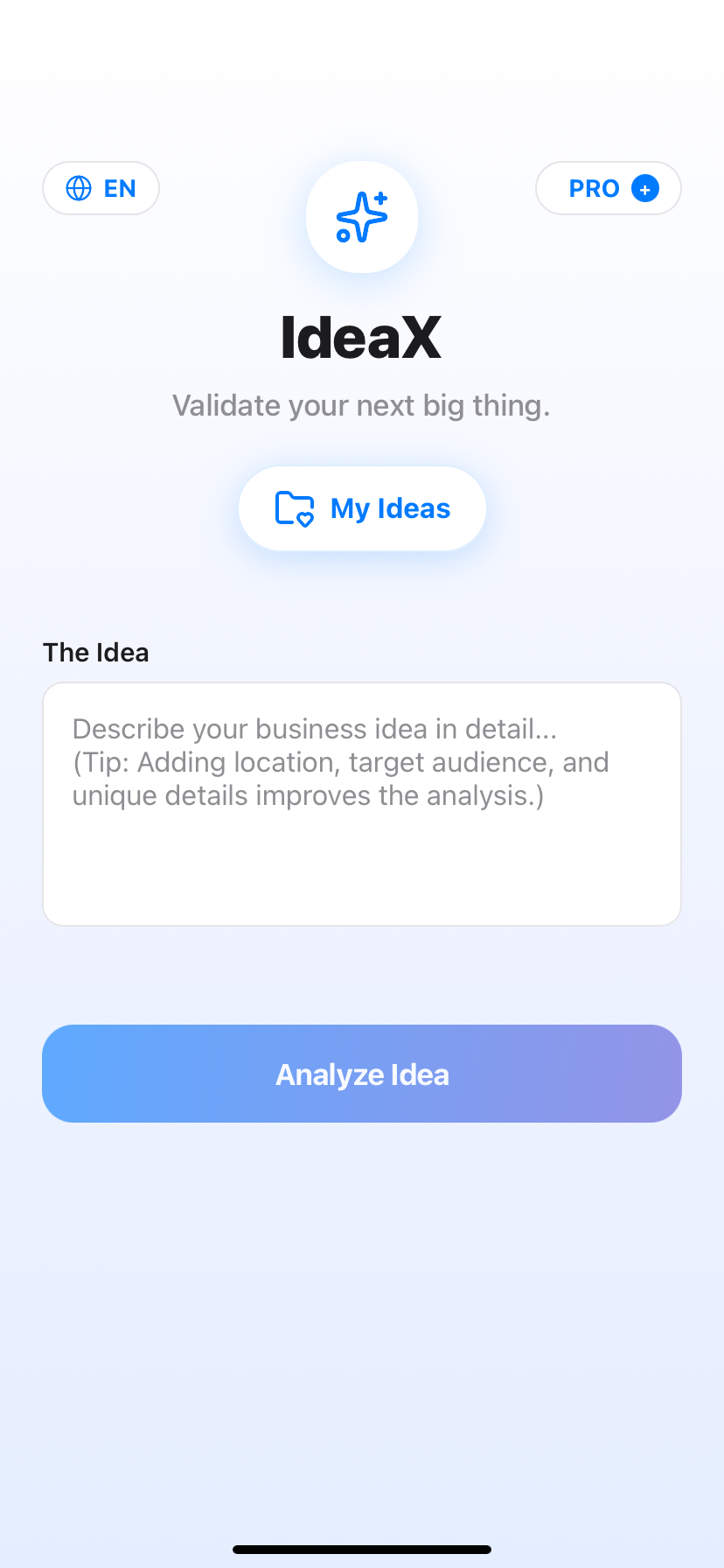

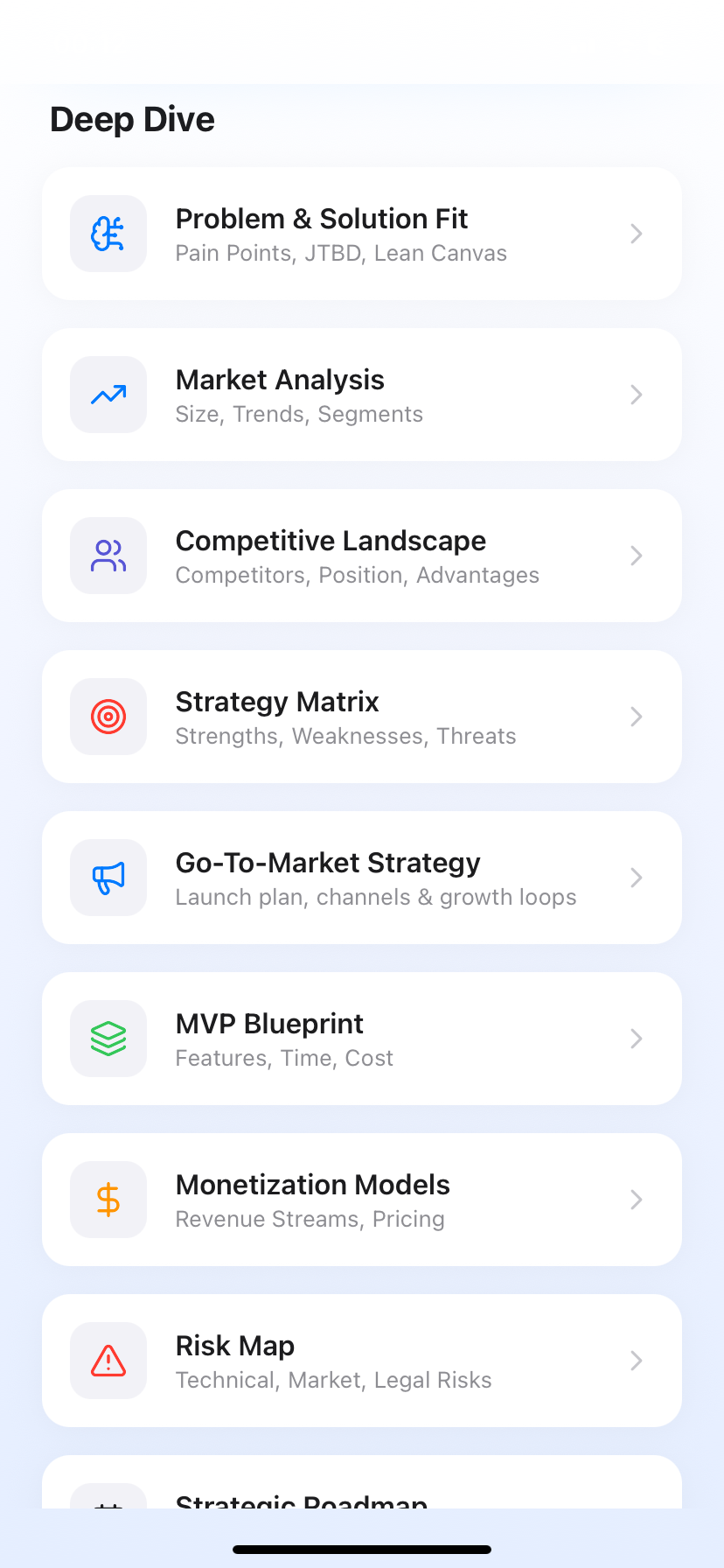

IdeaX: Business Idea Analysis
A structured space for evaluating what to build next.
Automate your market calculations.
Manual market research requires juggling dozens of expensive SEO subscriptions, crawling vast Subreddits for hours, and building complex spreadsheets to track competitor saturation. This consumes weeks of precious founder velocity. IdeaX entirely centralizes the demand forecasting process. Simply feed the engine a brief description of your raw business hypothesis, and the IdeaX predictive algorithm scans the digital landscape to instantly quantify competitor choke-points, calculate your theoretical Total Addressable Market (TAM), and assign a strict mathematical 'Demand Score' to your concept. Make data-backed moves.
Frequently Asked Questions (FAQ)
How do I mathematically prove if the market demand is large enough?
The fastest method is verifying search volume intent. Use tools strictly designed for Keyword Research. If fewer than a few hundred people are naturally searching for the specific solution each month, the organic demand might be far too small to support a scalable, modern software business, effectively forcing you into highly expensive outbound sales cycles.
Are competitors inherently a sign of high market demand?
Yes, absolutely. Entering a broad market with literally zero competitors is incredibly dangerous because it usually implies there is zero financial demand. Highly profitable, scaling competitors are the absolute greatest proof that demand is real and that customers are willing to swipe their credit cards.
What exactly is latent demand?
Latent demand occurs when a population has a profound, painful problem but they do not actively know a technological solution could possibly exist to solve it. Therefore, they do not search for it directly. Latent demand is exponentially harder to capture because it requires massive capital to fund educational marketing.
How long should market demand analysis take?
While manual analysis using spreadsheets and Google Trends can take weeks, using automated synthesis tools can reduce the time to days. You should never write a single line of backend code until your demand thesis is completely validated.
Can I trust surveys to measure market demand?
No. Surveys measure polite intentions, not actual economic behavior. 'Would you pay for this?' is a hypothetical question. The only true measure of market demand is a user handing over their email address or entering their credit card number on a landing page.