
How to Compare Two Business Ideas Objectively
Entrepreneurial creativity is a genuine gift, and it arrives at the most inconvenient possible time: when you are already trying to build one startup, you simultaneously conceive a second idea that appears equally compelling. Or perhaps you have two equally motivated concepts competing in your mind before you commit to any building at all. Both scenarios lead to the same strategic emergency: you must decisively kill one idea to give the other a fighting chance at survival. You cannot commit 50% of your execution bandwidth to two different startup bets. Startups require 100%.

- Dimension 1 — Founder-Market Fit (Weight: 3×): Your cumulative unfair advantage.
- Dimension 2 — Go-To-Market Friction (Weight: 2.5×): Days to first dollar of revenue.
- Dimension 3 — Gross Margin Ceiling (Weight: 2×): Structural financial viability at scale.
- Dimension 4 — Market Timing (Weight: 2×): Is the market pull accelerating or contracting?
- Dimension 5 — Switching Cost Friction (Weight: 1.5×): How painful is it for prospects to choose you?
- Dimension 6 — Scalability Architecture (Weight: 1.5×): Can this scale without linear headcount growth?
- Dimension 7 — Passion and Sustainability (Weight: 1×): Will you still care in year 4?
Why You Cannot Make This Decision With Gut Feeling
The cardinal sin of entrepreneurship is diffused focus. A single startup requires the psychological equivalent of pushing a boulder up a steep hill for 2-4 years before it reaches the crest and begins rolling under its own momentum. If you push two boulders simultaneously, both will roll back and crush you.
But making this decision based on gut instinct is almost as dangerous as splitting your attention. Founders systematically fall in love with whichever idea they have held longest, whichever one is technically most interesting to build, or whichever one their most recent conversation happened to endorse. These are not business-quality decision criteria.
You need an objective, emotionally detached, weighted scoring system that forces both concepts through the same analytical gauntlet and produces a mathematically defensible recommendation that your own bias cannot override. That system is the 7-Dimension Weighted Idea Scoring Matrix.
Dimension 1: Founder-Market Fit — The Most Important Factor (Weight: 3×)
Founder-Market Fit is the cumulative, unfair competitive advantage you possess in a specific market based on your career history, your professional network density, your domain expertise, or your lived experience as the target customer. It is the single most predictive variable of early startup success.
A founder with genuine Founder-Market Fit has already spent years developing the intuitions, relationships, and insider knowledge that a founder without it must spend their first year painfully acquiring. The Founder-Market Fit you possess determines: how fast you learn the domain, how cheaply you access early customers (they're already in your network), and how easily you attract talented co-founders and employees who respect your domain authority.
Founder-Market Fit Scoring Guide (1-10):
- 9-10: 5+ years direct work experience in the industry; 100+ ICP contacts; could sell the first paying customer this week.
- 6-8: 2-4 years adjacent experience; 20-50 ICP contacts; familiar with the domain vocabulary and key pain points.
- 3-5: General awareness; minimal direct experience; no warm ICP relationships.
- 1-2: Complete outsider. Would spend 12 months learning what insiders already know.
Dimension 2: Go-To-Market Friction (Weight: 2.5×)
GTM Friction measures the operational difficulty and capital cost of generating your very first dollar of revenue. This is the single most practically important early-stage consideration. Every day of GTM friction is a day of capital burn without revenue validation.
| GTM Model | Days to First Revenue | Friction Level | Score |
|---|---|---|---|
| B2B outbound to warm network | 1-7 days | Minimal | 9-10 |
| B2B cold outbound (niche ICP) | 14-30 days | Low | 7-8 |
| B2C SEO + content marketing | 60-180 days | Medium | 5-6 |
| B2C viral consumer app | 90-365 days | High | 2-3 |
| Two-sided marketplace (day 1) | 180-540 days | Very High (cold-start) | 1-2 |
Dimension 3: Gross Margin Ceiling (Weight: 2×)
Gross Margin determines the structural financial ceiling of each business model — and therefore how much money is available to fuel growth, pay salaries, and ultimately build equity value. At scale, margin is destiny.
Ask: if both ideas scale to $5M in annual revenue, which one generates more actual wealth and operational freedom? A SaaS company at $5M ARR with 80% gross margins has $4M to deploy into growth, talent, and profit. An e-commerce brand at $5M revenue with 30% gross margins has $1.5M — and after fulfillment, returns, and customer service costs, the founder often earns less than their own employees.
Dimensions 4-7: Timing, Switching Costs, Scalability, and Passion
Dimension 4: Market Timing
The best business idea in the wrong timing window fails. Evaluate: is the macro trend driving demand for this solution accelerating or decelerating? Remote work software (high timing score in 2020), AI-powered productivity tools (high timing score in 2025), and green energy B2B services (high timing score in 2024) all had strong macro pull. A social network for blockchain enthusiasts in 2024 faces severe timing headwinds. Market timing is difficult to predict, but you can analyze the 3-year Google Trends trajectory of your core keyword category as a proxy signal.
Dimension 5: Switching Cost Friction
How difficult is it for your ideal customer to switch to your product from their current solution? High switching costs cut both ways: they protect you from churn once acquired, but they create a major barrier to initial adoption. Score this as a net assessment: an idea where you can offer a one-click data migration and a 30-day free trial significantly reduces adoption friction while you build toward the retention advantage of deeply embedded workflows.
Dimension 6: Scalability Architecture
A business scales efficiently when adding 10× more revenue does not require 10× more people. Evaluate: does the business model require linear headcount growth to serve more customers (low scale score), or does an investment in software infrastructure allow serving 10× users with the same team (high scale score)?
Dimension 7: Passion and Sustainability
Founding a startup is a minimum 5-year commitment at high intensity. If you choose a business model based purely on financial metrics in an industry you find intellectually uninteresting, the probability of motivation collapse in Year 2 — precisely when sustained execution is most critical — is very high. Passion scores 1× weight, not 3×, because passion alone does not overcome structural financial weaknesses. But when two ideas are financially comparable, always choose the domain you find genuinely fascinating.
The Weighted Scoring Matrix Template
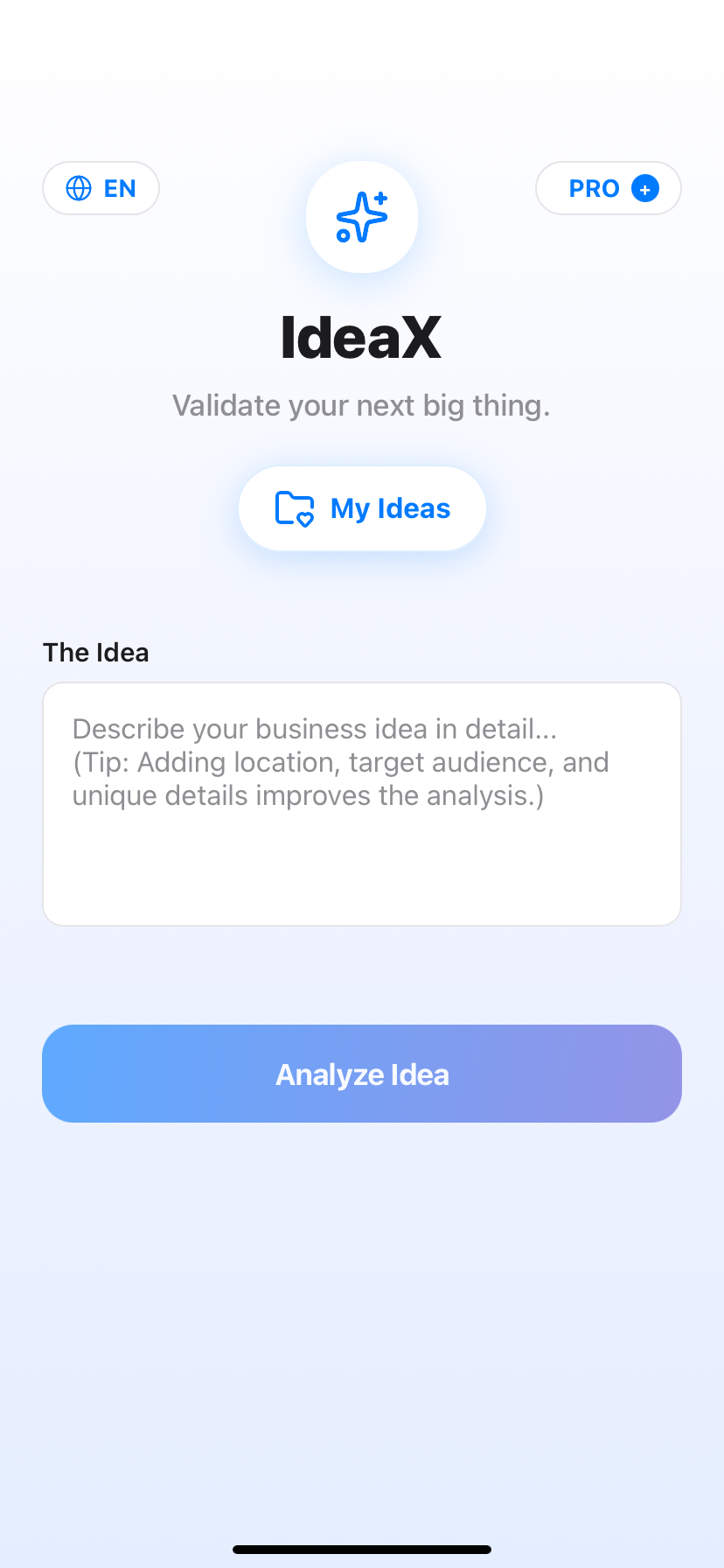
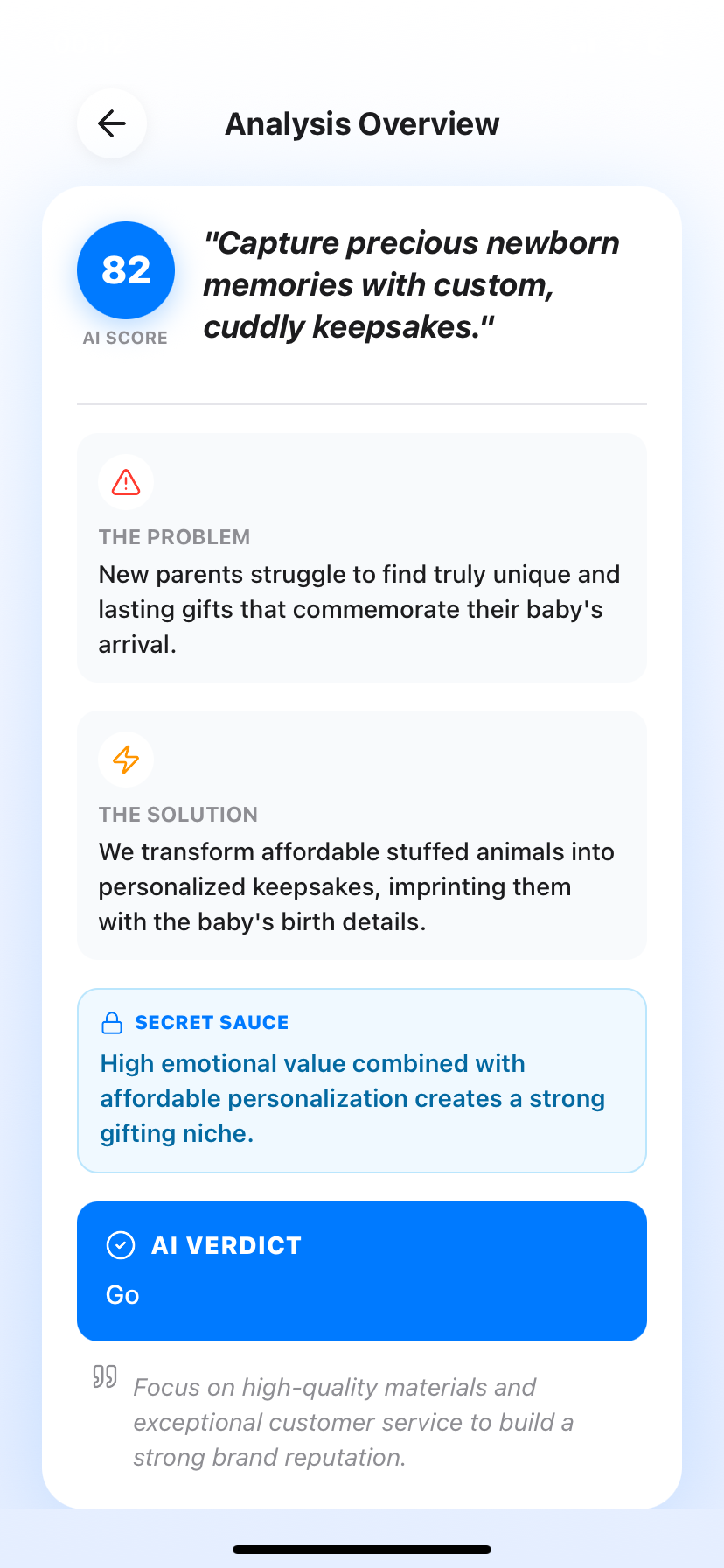
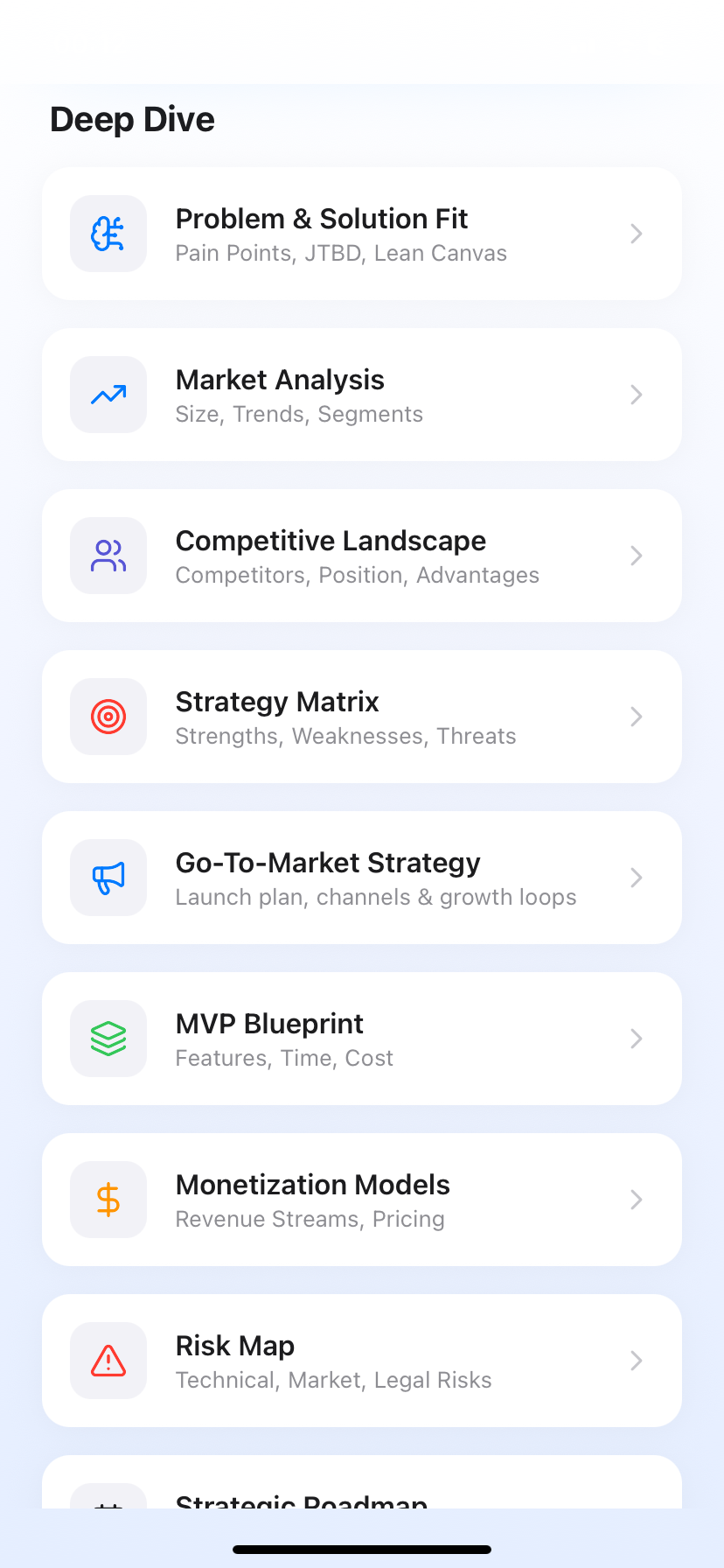

IdeaX: Business Idea Analysis
A structured space for evaluating what to build next.
Compare concepts with ruthless logic.
You cannot make this decision objectively inside your own head — your brain has a built-in preference for whichever idea you conceived first. Submit both your ideas to IdeaX. The AI framework scores each concept across all 7 evaluation dimensions — comparing TAM sizes, forecasting GTM friction, calculating weighted unit economics difficulty, and identifying which concept gives you a statistically higher probability of reaching Default Alive within your runway. Stop deciding with emotions. Let the data decide.
Frequently Asked Questions (FAQ)
Should I pursue both ideas at the same time?
No. Splitting execution bandwidth between two startups guarantees both fail. A single startup requires your full mental energy for 2-3 years minimum. Even world-class operators struggle to build one category-defining company in parallel with another — running two halves the execution intensity available to each and neither reaches escape velocity.
What is Founder-Market Fit?
It's the cumulative unfair advantage you possess in a specific market due to years of direct work experience, a dense professional network, and domain expertise. It predicts how fast you learn, how cheaply you access early customers, and how easily you recruit talent. It is the highest-weight factor in any idea comparison because the same idea executed by a domain expert consistently outperforms the same idea executed by an outsider.
How many dimensions should I use to compare two ideas?
Seven weighted dimensions: Founder-Market Fit (3×), GTM Friction (2.5×), Gross Margin Ceiling (2×), Market Timing (2×), Switching Cost Friction (1.5×), Scalability Architecture (1.5×), and Passion Sustainability (1×). Score each 1-10, multiply by weight, sum the total. The higher total is the mathematically stronger choice for your specific situation.
What if the more profitable idea is less interesting to me?
For bootstrapped founders, lean toward higher passion when financial metrics are comparable. Startups require 5-7 years of sustained high-intensity effort. Choosing a domain you find uninteresting purely for paper margin advantages creates a motivation collapse risk in year 2 — precisely when sustained execution matters most.
What is GTM Friction and how do I evaluate it?
GTM Friction is the operational difficulty and capital cost of generating your first dollar of revenue. Low friction: email 10 LinkedIn contacts today, close a paying B2B client this week. High friction: need 100,000 users before network effects activate. Always favor lower friction when you are bootstrapped or have limited runway.