
Lean Canvas vs SWOT Analysis: Which One Should You Use?
Every year, thousands of first-time founders waste their first productive weeks filling out the wrong strategic framework for their stage of business. They open a SWOT Analysis template in Notion, stare at the four quadrants labeled Strengths, Weaknesses, Opportunities, and Threats, and begin listing "We are a passionate team" under Strengths — producing exactly nothing of diagnostic value. The Lean Canvas and the SWOT Analysis are not interchangeable tools. They are instruments calibrated for entirely different diagnostic questions, at entirely different stages of the company lifecycle. Using the wrong one is the equivalent of measuring blood pressure with a thermometer: you'll get a number, but it won't tell you anything useful.

- The fundamental architectural difference between the two frameworks.
- What each of the 9 Lean Canvas boxes is actually asking you to define.
- The 4 SWOT quadrants and what makes each one genuinely useful.
- When each framework catastrophically fails and produces misleading outputs.
- The exact correct sequence to use them across your company's lifecycle.
The Fundamental Architectural Difference
The Lean Canvas, designed by Ash Maurya as a startup-optimized derivative of Alexander Osterwalder's Business Model Canvas, is a forward-looking hypothesis map. Every box in it represents an assumption about the future — a belief you hold about your customer, your market, and your product that must be tested and either confirmed or falsified by real-world data.
The SWOT Analysis is a backward-looking diagnostic snapshot. It asks you to honestly inventory the current capabilities, vulnerabilities, external opportunities, and competitive threats of an organization that already exists and has operational history to analyze.
| Dimension | Lean Canvas | SWOT Analysis |
|---|---|---|
| Time orientation | Forward-looking (hypotheses) | Present snapshot (operational data) |
| Primary question | What should we build and for whom? | Where are we strong and exposed right now? |
| Ideal startup stage | Day 0 — Pre-revenue ideation | Month 6-12+ — Post product-market fit |
| Framework structure | 9 interconnected boxes | 4 quadrants (2×2 matrix) |
| Output type | Business model blueprint with testable hypotheses | Strategic position assessment with prioritized risks |
| Origin | Ash Maurya, 2010 (startup-optimized) | Stanford Research Institute, 1960s (corporate) |
The Lean Canvas: Deep-Dive Into the 9 Boxes
The Lean Canvas must be filled in a specific sequence that prevents founders from jumping to Solutions before they have articulated Problems with sufficient precision.
The Correct Filling Sequence
The most commonly misunderstood box is the Unfair Advantage. "We are passionate" is not an unfair advantage. "We have 3 years of proprietary anonymized transaction data from 200 restaurants" is an unfair advantage. "We built our first 5,000-person community organically before the product launched" is an unfair advantage. If you cannot articulate a genuine, defensible unfair advantage, you have a critically important strategic risk to resolve before launch.
The SWOT Analysis: When It Actually Works
The SWOT framework produces genuine strategic insight when you have real operational history to analyze. A company 12 months post-launch, with paying customers, measurable churn data, and 3 identified competitor movements, can run a SWOT that produces immediate, actionable strategic recommendations.
The framework's power lies in its cross-quadrant analysis: specifically, identifying which Strengths best neutralize which Threats (the SO strategy), which Weaknesses are most dangerously exposed to which Threats (the WT risk), and which Opportunities require which Strengths to capture (the ST strategy). SWOT is most powerful when it leads to TOWS matrix construction — converting the four quadrants into four actionable strategic postures.
When Each Framework Fails
Lean Canvas Failure Modes
- Filling Solution before Problem is articulated.
- Defining ICP as "everyone 18-65" — too broad to test.
- Leaving Unfair Advantage blank or generic.
- Treating it as a document rather than a living hypothesis set.
- Never updating it after validation experiments.
SWOT Analysis Failure Modes
- Running it at Day 0 before any operational history exists.
- Filling Strengths with team traits instead of business advantages.
- Listing generic Opportunities without market evidence.
- Not converting the output into a TOWS action matrix.
- Running it annually instead of in response to competitive events.
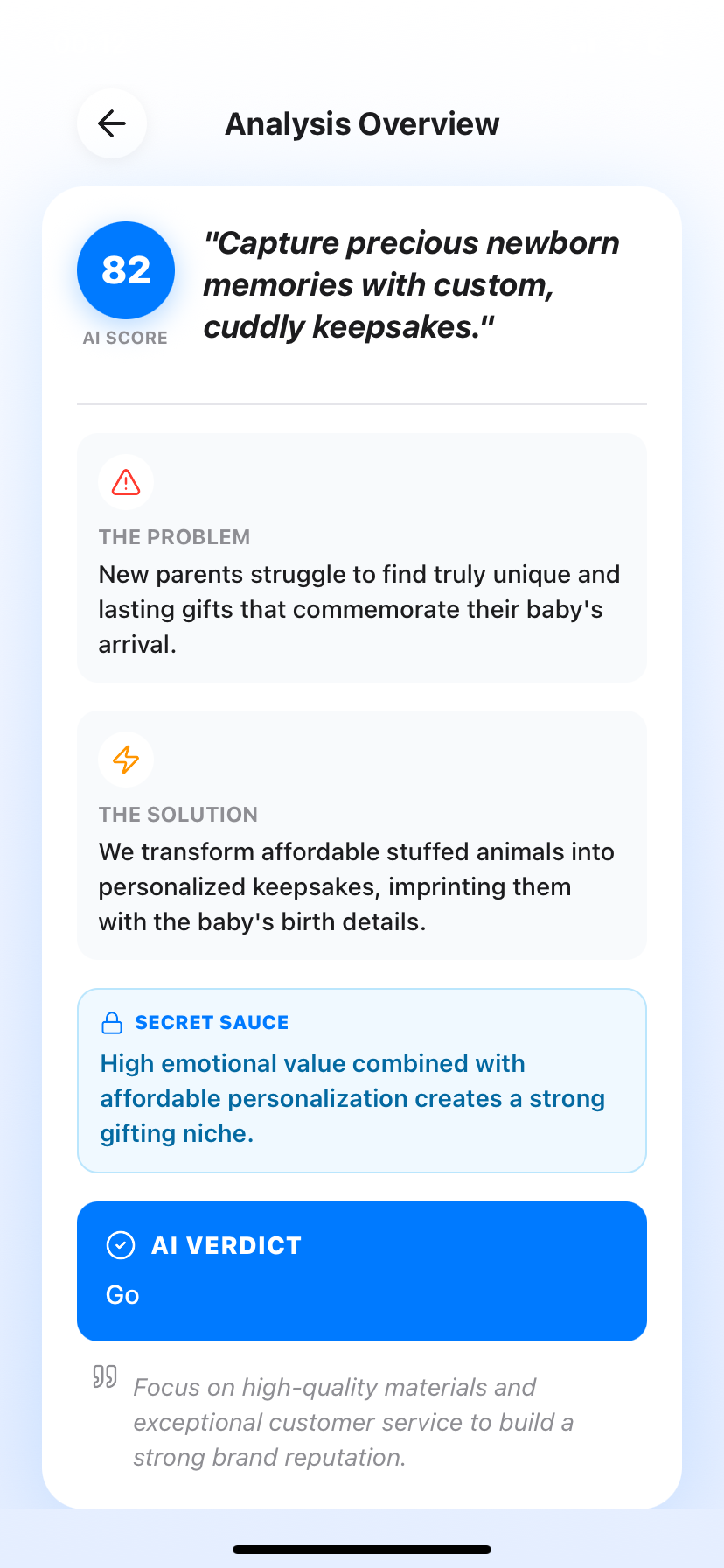
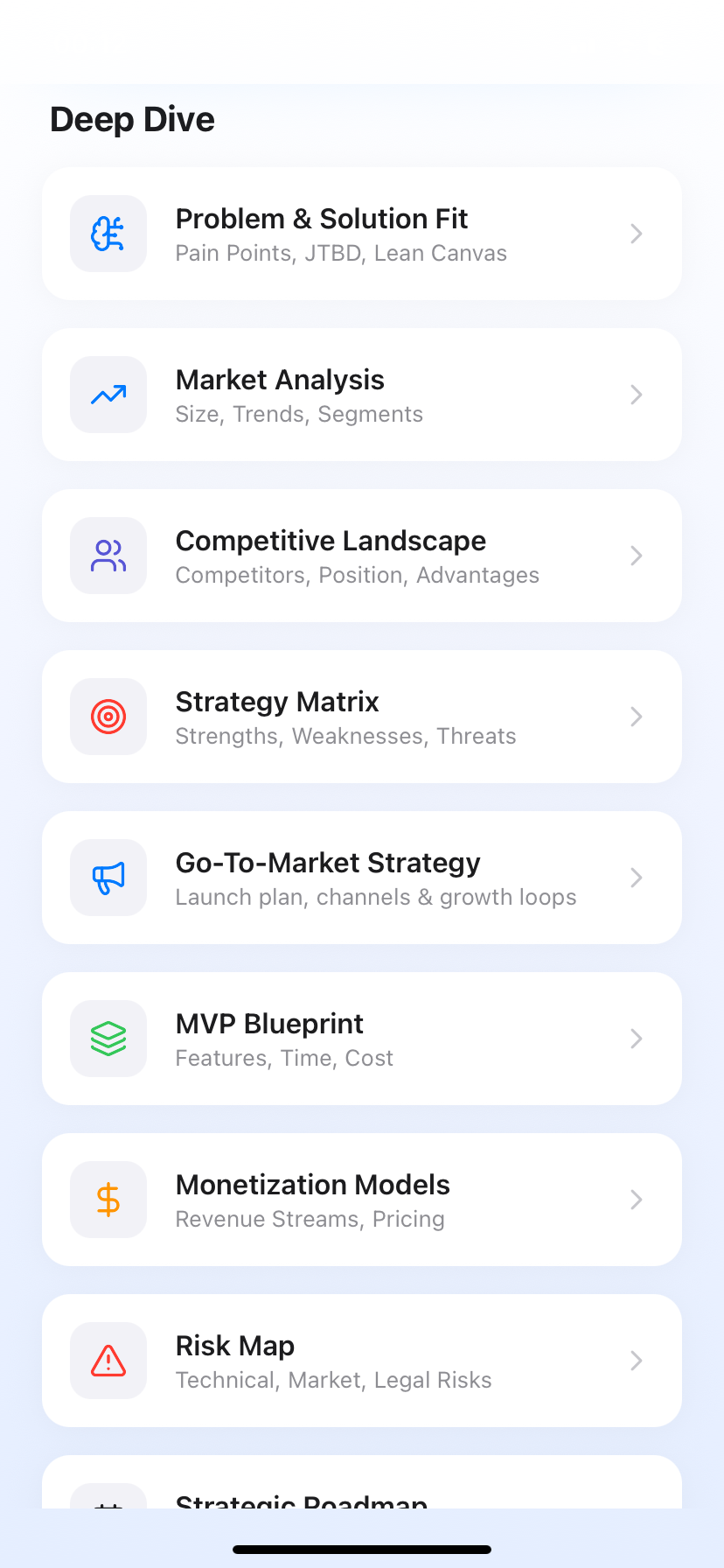

IdeaX: Business Idea Analysis
Get both frameworks calculated instantly.
Stop formatting templates. Start executing.
Filling out a Lean Canvas manually takes hours and is heavily distorted by founder optimism bias. IdeaX bypasses the busywork: submit your core concept and the AI architecture instantly populates all 9 Lean Canvas boxes with hypothesis-level precision — including the Unfair Advantage and Key Metrics boxes that founders most commonly leave blank. It simultaneously generates a competitive SWOT snapshot based on your market category, flagging the external threats that directly contradict your stated strengths before you discover them 12 months into execution.
Frequently Asked Questions (FAQ)
What is the core architectural difference between these two frameworks?
Lean Canvas is a 9-box forward-looking hypothesis map for pre-revenue startups: it defines what you believe about your customers, market, and product before any of it is proven. SWOT is a 4-quadrant diagnostic snapshot for operational businesses: it assesses your current strategic position within a competitive landscape based on real performance data.
Can I use SWOT for a brand new startup idea?
You can, but it will produce misleading outputs. SWOT's Strengths and Weaknesses quadrants require analyzing an existing organization's operational capabilities — which a pre-revenue startup doesn't have. You'll fill Strengths with team adjectives rather than defensible business advantages. Use Lean Canvas first. Run SWOT at Month 6-12 when real operational data exists.
What is the correct order to use them?
Sequential: (1) Lean Canvas at Day 0 to map business model hypotheses and design validation experiments. (2) SWOT at Month 6-12 after achieving initial product-market fit to assess operational strengths and competitive threats. They are phase-specific tools, not alternatives.
What does each Lean Canvas box represent?
9 boxes in order: Problem (top 3 pains), Customer Segments (ICP), Unique Value Proposition (headline), Solution (minimum feature set), Channels (discovery and purchase), Revenue Streams (pricing model), Cost Structure (CAC and fixed costs), Key Metrics (one success number), Unfair Advantage (defensible moat).
What is a genuine 'Unfair Advantage'?
Something a well-funded incumbent cannot easily copy or buy: a proprietary dataset, exclusive contracts, deep regulatory expertise, a community with high switching costs, or a founder with unique domain authority. "We are passionate" is not an unfair advantage. If the box is empty, you have an unresolved strategic risk to address before launch.