
Common Reasons Business Ideas Fail Before Launch
The startup world obsessively celebrates the public, dramatic, high-profile collapses of VC-funded unicorns that burn through $200 million before shutting down. But the vast majority of real entrepreneurial dreams die a far quieter, sadder death — disappearing without ceremony in a founder's bedroom, suffocated by perfectionism, fear of judgment, and a catastrophic lack of honest external feedback.

- Feature Creep: The procrastination masked as perfectionism.
- Building in Isolation: The "Mom Test" failure that wastes months.
- Disastrous Co-Founder Dynamics: Equity, roles, and the handshake agreement disaster.
- The "Solution Looking for a Problem" trap: Solving a pain nobody feels.
- Fatal Unit Economics: Why fast growth with broken math equals faster bankruptcy.
The Quiet Death Nobody Writes About
Building a business from absolute zero to one is profoundly unnatural. It demands managing intense daily anxiety, ruthless strategic prioritization, and the unique psychological resilience to be publicly embarrassed by your own deliberately unfinished early work.
If you are currently sitting on what you believe is a "brilliant idea" that you have been quietly perfecting for entirely too long without showing it to strangers, you are actively in the startup danger zone. Let's meticulously dissect the five most fatal psychological and economic traps that kill ambitious businesses before they ever earn their first dollar.
1. The Slow Poison of 'Feature Creep'
"It's almost ready. We just need to add persistent dark mode. And social login via Apple. And an AI-powered data insights dashboard. And push notifications. Then we will be ready to launch."
Feature Creep is a sophisticated, subconscious psychological defense mechanism. Founders are genuinely, viscerally terrified of being coldly rejected by a brutally indifferent market. As a natural result, they subconsciously and continuously delay the launch deadline by insisting the product must be "even more perfect." They continuously pile new features onto the roadmap — not because the features add genuine user value, but because each new feature justifies another week of comfortable, consequence-free delay. The market cannot reject something that hasn't shipped.
The Embarrassment Heuristic
There is a legendary heuristic coined across Silicon Valley: "If you are not deeply embarrassed by the first public version of your product, you launched far too late."
Your mandate as a first-time founder is to ruthlessly strip your product down to the absolute bare minimum required to deliver your core value proposition at a basic but functional level. Ship it immediately. Then let the actual paying users — not your own perfectionist imagination — tell you which features they actually want next. Your roadmap should be driven by validated demand, not inventor fantasy.
2. Building in Complete Isolation (The 'Mom Test' Failure)
Experienced, battle-hardened second-time founders have one sacred ritual that separates them from amateurs: they talk to real potential customers constantly, obsessively, and without shame. First-time founders hide behind noise-canceling headphones, a dark bedroom, and a MacBook screen, and talk to absolutely nobody.
Why Your Inner Circle Will Lie to You
If you spend six months engineering a complex B2B compliance tool without interviewing at least 30-50 complete strangers who precisely match your target audience profile, you are not building a product; you are hallucinating a product.
The "Mom Test" — a brilliant concept from entrepreneur Rob Fitzpatrick — teaches that asking your mother, best friend, or college roommate for product feedback is entirely useless. They love you unconditionally and will politely lie to protect your feelings. Instead, you must subject your raw, unpolished idea to the brutal, emotionless, unfiltered feedback of total strangers who have zero social reason to spare your ego.
Ask them about their current problems, not about your solution. If they do not describe the problem you are solving as one of their most agonizing daily frustrations without any prompting from you, your target market is wrong.
3. Catastrophic Co-Founder Dynamics
You and your best friend since university decide to change the world. You split the company equity exactly 50/50 on a verbal handshake agreement over coffee. Three months later, you are working 65 intense hours a week writing production code, designing infrastructure, and doing cold sales outreach. Meanwhile, your co-founder is contributing approximately 8 hours a week "managing the social media strategy."
Toxic resentment builds silently over weeks. Communication breaks down. Tempers erupt over a missed deadline. The company legally dissolves before the app ever ships to the App Store.
The Three Co-Founder Agreements You Must Sign
Co-founder risk is one of the most underrated and lethal killer of pre-launch startups. Before writing a single line of code, you must legally formalize three separate non-negotiable agreements:
- Vesting Schedule: Standard 4-year vesting with a 1-year cliff. If a co-founder vanishes in month 8, they walk away with zero equity — not 40% of your dream company.
- Role & Responsibility Matrix: Who owns the final decision on product? Marketing? Hiring? Legal? Ambiguity in roles is how co-founders paralyze each other with bureaucracy.
- Exit Strategy Alignment: Do you want to build a bootstrapped lifestyle business or shoot for a $500M acquisition? If your goals are diametrically opposite, you are not compatible co-founders.
4. Solving a Problem Nobody Actually Has
You, personally, spend 20 minutes a week reorganizing a spreadsheet. You decide to build a $50/month AI-powered spreadsheet reorganization tool. You build it. Nobody buys it. You are devastated.
You did not solve a market problem. You solved a minor personal frustration. A real, commercially viable market problem triggers irrational, urgent behavior: people Google for solutions at 11pm, they pay premium prices for imperfect tools, they complain loudly on Reddit, they build complex workarounds using duct-tape Zapier automations. If people are not currently experiencing those symptoms, you do not have a real problem — you have an interesting hobby project.
Before building anything, validate the severity of the pain by doing Forum Mining across Reddit, Discord, G2 reviews, and Slack communities. If your Ctrl+F searches for "I hate this," "workaround," and "is there a better tool" return hundreds of desperate, frustrated results — you have found a real problem worth solving.
5. Fatal Unit Economics (Broken Revenue Math)
Sometimes a startup idea is entirely culturally brilliant, incredibly well-timed, and backed by passionate founders — but it is mathematically impossible to make profitable.
A food delivery startup that spends $75 in Google Ads to acquire one customer who orders twice and generates $5 in total platform margin before churning will burn $70 per user acquired. This model exists. Multiple famous, VC-backed companies ran this exact model at scale and subsequently imploded spectacularly. In the raw excitement of building and shipping technology, founders frequently forget to calculate their acquisition costs against their lifetime value.
A business is fundamentally a machine for converting $1 of marketing spend into at least $3 of customer revenue. If your spreadsheet cannot prove a 3:1 LTV:CAC ratio even in a theoretical best-case scenario, your core business model must be restructured before you spend a dollar on advertising.


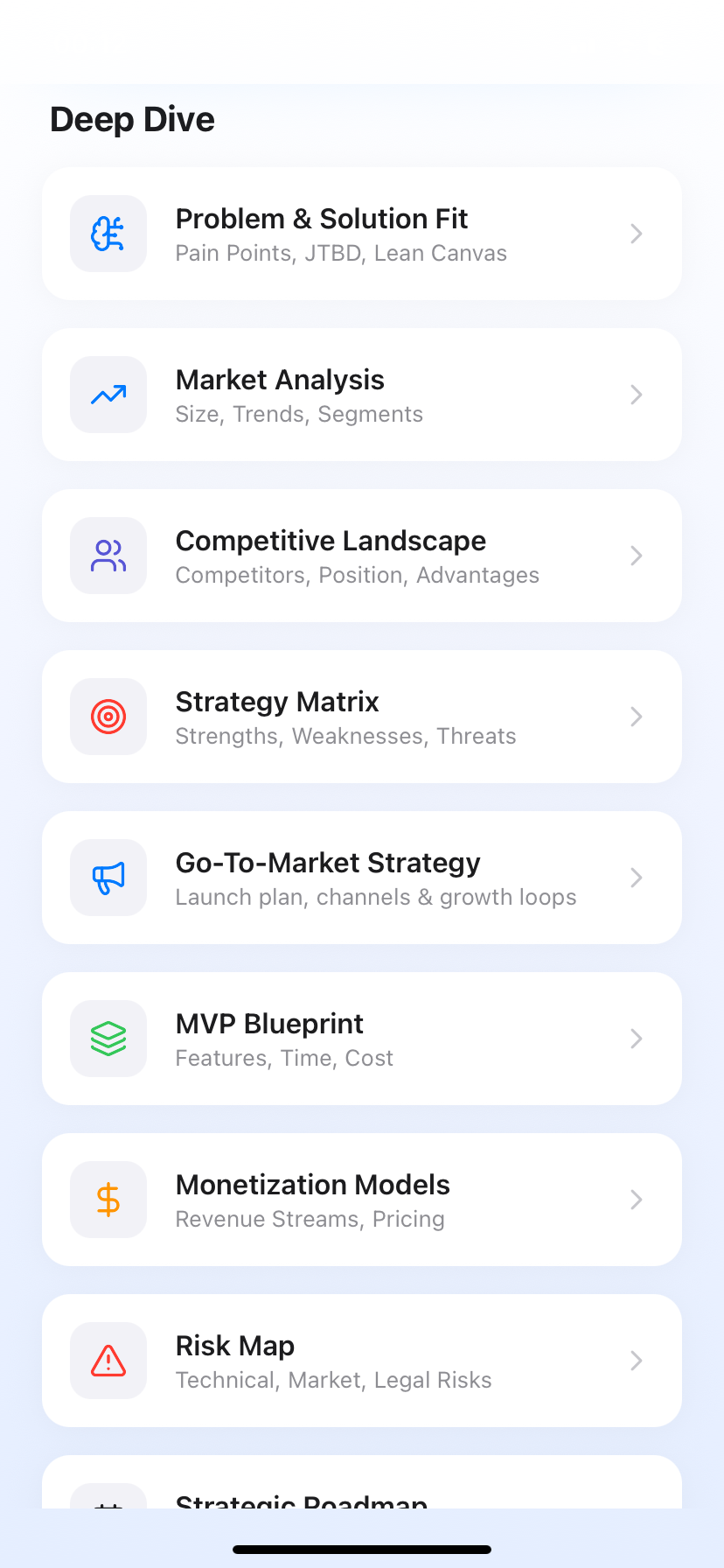

IdeaX: Business Idea Analysis
A structured space for evaluating what to build next.
Find the fatal flaw before the market does.
Your brain is evolutionarily designed to unconsciously ignore the most severe weaknesses in your own ideas. Confirmation bias is a survival mechanic that is catastrophically incompatible with entrepreneurship. IdeaX acts as your brutally honest, emotionless co-founder. By running your concept through a rigorous algorithmic stress-test, IdeaX explicitly highlights your execution traps, demographic blind-spots, broken unit economics, and market timing vulnerabilities — all the things that are statistically certain to kill your project before you write your first line of code.
Frequently Asked Questions (FAQ)
How does 'Feature Creep' silently kill a startup?
Feature Creep is a psychological defense mechanism rooted in the fear of market rejection. Founders subconsciously delay launching by adding 'just one more feature' to achieve perfection. This exhausts their cash runway and timeline, causing the business to die before a single real customer ever sees the product.
Is it dangerous to validate an idea indefinitely?
Yes. This specific failure mode is called 'Analysis Paralysis'. A founder can spend 9 months interviewing customers and endlessly refining spreadsheets out of pure fear of committing to a launch. At some point, perpetual planning becomes a sophisticated procrastination mechanism. You must ship the product.
What are the most common cofounder problems that doom startups?
The most lethal cofounder failure modes are: unequal contribution disguised by equal equity splits, vague role definitions that create catastrophic overlap, and deeply misaligned visions of exit strategy. All three are entirely preventable with a signed co-founder agreement.
What does 'solving a problem you invented' mean?
It means you built a solution to a problem that primarily bothers you personally but generates insufficient urgency among the greater population to motivate mass purchasing behavior. A real market pain causes people to abandon their sleep, Google desperately for solutions, and complain publicly on Reddit.
What is the most predictable warning sign a startup will fail?
The most predictable single warning sign is a founder who has been 'building in secret' for more than three months without showing the product to a single stranger outside their immediate social circle. Real market feedback is the only antidote to building the wrong thing.