
Signs Your Business Idea Has Real Market Potential
Every founder is completely, unconditionally convinced their idea is the next category-defining unicorn. The market, however, does not care remotely about your feelings, your personal passion, or your beautifully designed Figma prototype. It only cares about utility, urgency, and economic value. If you want to empirically know whether your idea is actually worth building, you must learn to systematically identify the undeniable behavioral signals that exclusively appear in markets with genuine, explosive commercial potential.

- Signal 1 — The Workaround Economy: Messy spreadsheets as accidental proof of demand.
- Signal 2 — High Search Intent with Terrible Results: The SaaS opportunity in a Google gap.
- Signal 3 — Profitable but Stagnant Incumbents: The safest proof of commercial viability.
- Signal 4 — Inbound Exceeds Outbound: When pull beats push.
- Signal 5 — The Switching Cost Override: When pain overcomes migration friction.
The VC Proverb That Changes How You Evaluate Ideas
Venture capitalists have refined their pattern-recognition over decades of backing thousands of companies. One of the most powerful insights they have distilled is this: "When a great team meets a lousy market, the market wins. When a lousy team meets a great market, the market wins."
In other words, the inherent quality of the underlying market opportunity will almost always dominate the outcome — overriding team quality, product quality, and fundraising ability. You can have the best engineers on the planet, the most beautiful brand identity, and the most connected investor network — but if the fundamental market demand for your concept is structurally capped or non-existent, you are competing against gravity.
So how do you reliably spot a "great market" before you invest 18 months building in it? Look for these five clear, empirically verifiable signals.
Signal 1: The 'Workaround Economy' (The Spreadsheet Test)
The most potent single indicator of ripe market potential is the existence of a thriving "Workaround Economy" — a collection of desperate, resourceful users who are already actively solving a painful problem using complex, fragile, time-consuming manual processes because no adequate automated solution exists yet.
The Spreadsheet as a Pre-Authorization
People will refuse to pay for software that solves a minor inconvenience. They will absolutely pay for software that eliminates a problem severe enough that they are currently spending hours each week maintaining a baroque Excel spreadsheet, eight-step Zapier automation chain, or custom Google Apps Script to work around it.
The test: go directly to Reddit, niche LinkedIn Groups, and specialized Discord servers. Search for phrases like "is there a tool that," "I manually," "anyone else using spreadsheets for," and "workaround for." If you find 30+ independent users who have separately invented their own makeshift manual system to solve the same problem, you have found a commercially potent, underserved niche. Their existing workaround investment is effectively a pre-authorization of their willingness to pay for a real SaaS solution.
If the target audience is spending two collective hours every Friday manually reconciling data across three disparate legacy platforms, they will genuinely throw their corporate credit cards at you the moment you offer a clean, modern $49/month SaaS tool that automates the reconciliation process in 90 seconds.
Signal 2: High Search Intent, Terrible Results
The second definitive signal is a Google Search Gap. This occurs when there is substantial, verified search volume for a specific problem category, but the existing search results are either catastrophically outdated, technically underwhelming, or absurdly expensive for the segment you are targeting.
How to Identify a Google Search Gap
Perform a keyword search for "Best tool for [Your Niche Problem]" or "[Your Problem] software alternative". Systematically analyze what Google returns:
🚨 High Potential Gap Signals:
- Top results are forum threads from 2012-2017 complaining about the lack of options.
- The only solutions listed require $500+/month enterprise pricing targeting Fortune 500 companies.
- The "tools" listed are manual consulting services, not actual software products.
- Review site (G2, Capterra) results show your target segment rating existing tools 2.5/5 stars with consistent "too expensive" or "too complex" complaints.
High search volume (thousands of monthly searches) combined with low-quality, outdated, or prohibitively expensive competitors is one of the clearest market gap signals available without spending a dollar on research.
Signal 3: Profitable but Stagnant Incumbents
Contrary to widespread first-time founder instinct, the presence of multiple successful, profitable competitors is not a deterrent — it is the most reliable empirical proof of commercial market viability.
Consider the SaaS startup graveyard: thousands of founders have entered markets with literally zero direct competitors, celebrating their "first-mover advantage," only to discover through brutal financial reality that there were zero paying customers at the end of the road either. Early markets without any proven commercial incumbents are deceptively dangerous.
The Ideal Incumbent Profile
The scenario that maximizes your opportunity advantage is: 2-4 existing competitors who are profitable and established (proving the market is commercially real), but who are clearly stagnant, slow to innovate, and receiving consistent negative reviews about their user experience, pricing, or customer support. These "fat and happy" incumbents have captured the original market but are no longer actively fighting to serve it well.
This environment means you do not need to educate the market or prove that the problem is worth solving — the incumbents have already spent years and millions of dollars doing that foundational work for you. Your strategic task is strictly to enter with a superior design, more aggressive pricing, or a sharper niche focus and execute the delivery experience by 20% better than the sluggish incumbent.
Signal 4: Inbound Pull Exceeds Outbound Push
During your validation phase, you will inevitably run a Painted Door landing page experiment. The conversion data from this experiment is an objective, ruthlessly honest measure of your market potential.
Reading the Pull-vs-Push Signal
If you post your landing page URL in a highly targeted subreddit or niche Discord server, and within 24 hours you observe dozens of completely unprompted, organic sign-ups — users who found and clicked the link with zero external prodding, who then proactively emailed you asking "when is this launching?" and "can I join the beta?" — you have just witnessed a market with powerful inorganic pull.
Market pull is exponentially more valuable than marketing push. You cannot manufacture organic pull with clever copywriting; it emerges exclusively when a product addresses a problem that is genuinely, severely painful for the audience. When the natural gravitational force of the market is stronger than your active marketing effort, you have found product-market potential — and the entire distribution strategy becomes dramatically cheaper and simpler as a result.
Signal 5: Switching Cost Override
The final signal is perhaps the most powerful, the rarest, and one of the most frequently misunderstood: it occurs when potential customers express strong willingness to absorb significant switching friction to access your product — even before it's fully built.
Under normal circumstances, professional buyers intensely resist switching software. Data migration processes are painful, workflow re-training is disruptive, and change management is expensive. If a prospect's current solution is working "well enough," the psychological and logistical switching cost is typically sufficient to keep them locked in despite their discontent.
However, if you pitch a prototype, explicitly describe a 3-week data migration process, and your prospect immediately responds: "I don't care how long the migration takes — I need to get off our current tool immediately, I'll have our IT team handle it this week" — that is a signal of immense, explosive market potential. It reveals that the emotional pain of their current situation massively outweighs the massive logistical friction of switching to a completely new system. Where there is that level of urgency, there is enormous pricing power and minimal sales cycle resistance.
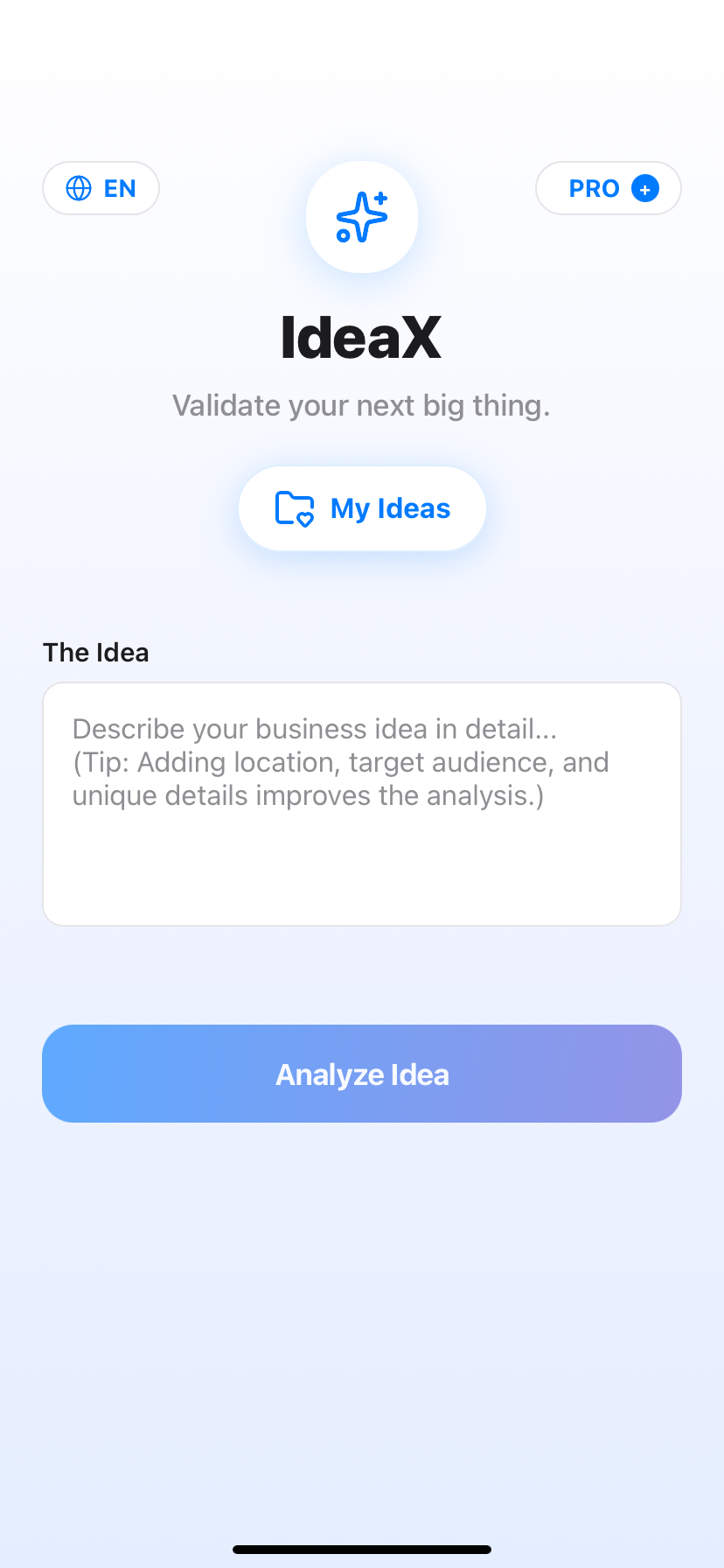

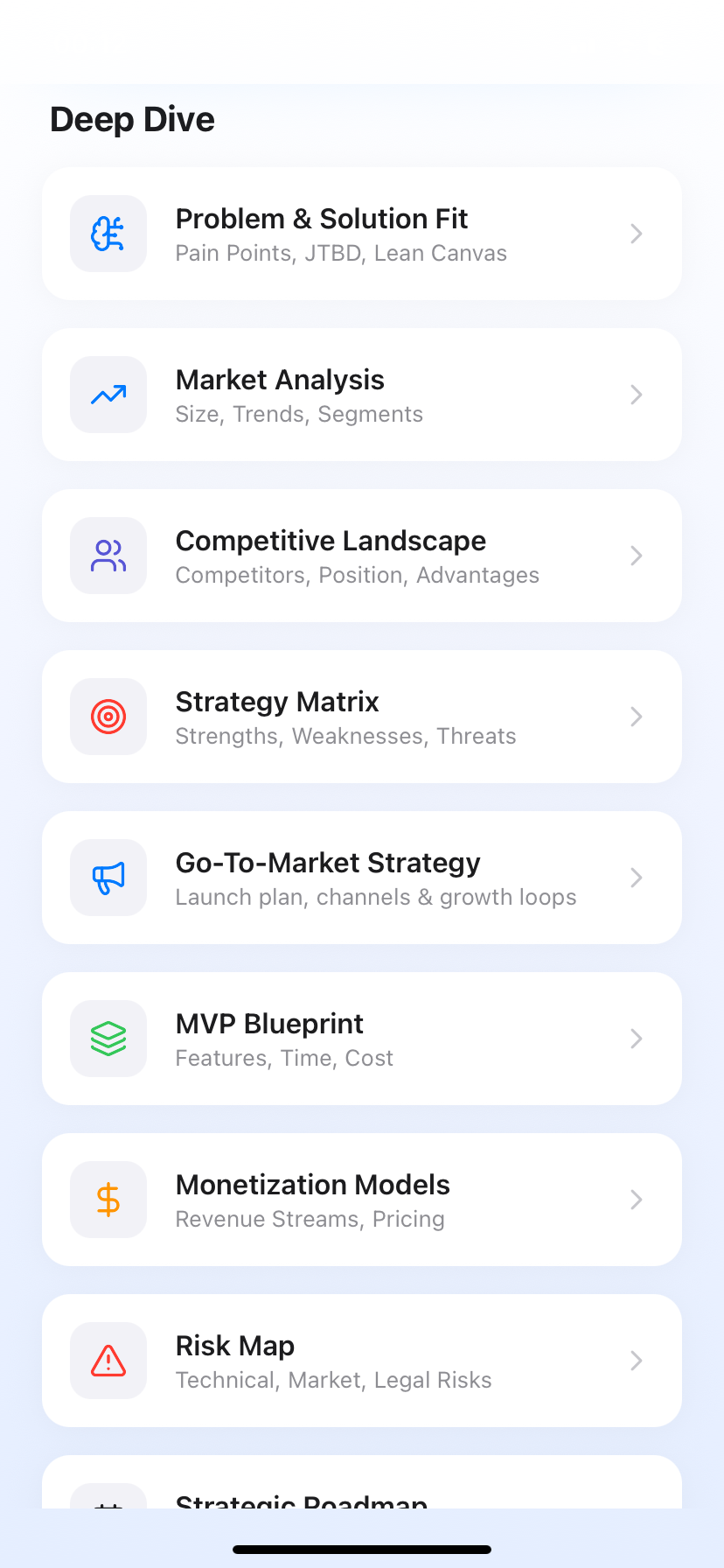

IdeaX: Business Idea Analysis
A structured space for evaluating what to build next.
Calculate your potential mathematically.
Stop relying on gut instinct and founder optimism to evaluate your market. IdeaX automatically calculates your Total Addressable Market by scanning real demographic database signals and competitor pricing models within your target niche. The AI engine instantly identifies whether your specific market is structurally expanding, saturating, or dangerously contracting — and assigns a definitive, data-backed 'Market Potential Score' to your concept before you spend a single dollar on development.
Frequently Asked Questions (FAQ)
How do I calculate Total Addressable Market (TAM)?
TAM = total number of realistically reachable potential customers × annual average revenue per user (ARPU). Example: 50,000 target businesses × $200/year = $10M TAM. Always use bottom-up customer counting rather than top-down percentage estimates of large abstract markets.
Is 'organic word of mouth' truly a reliable sign of market potential?
Yes — it is the single ultimate, undeniable signal. If you release a genuinely buggy, incomplete MVP and early users are still enthusiastically and unprompted forcing their colleagues or friends to use it, you have discovered explosive market potential. Product-led viral growth cannot be manufactured, only recognized and scaled.
Should I pursue an idea with a deliberately small TAM?
Absolutely, if you are a solo founder or small bootstrapped team. A $3-5 Million TAM is entirely ignored by enterprise tech companies and VCs, meaning you can dominate it profitably with zero well-funded competition. Many $1M+ ARR lifestyle companies operate inside micro-niches that larger players structurally cannot serve cost-effectively.
How many active workarounds signal real market potential?
If you find more than 30 people across Reddit, LinkedIn, or industry forums who have independently invented their own manual workaround to a specific problem — a complex Zapier automation, a private spreadsheet, a manual copy-paste ritual — you have found market potential. Their workaround investment is their credit card pre-authorization for a real solution.
What is the ideal competitor landscape for maximum market potential?
The ideal landscape is 2-4 profitable but slow, clunky, or expensive incumbents who have stopped aggressively innovating. This proves the market is commercially real and financially viable, while signaling that a modern, better-priced, or better-designed solution has a clear opportunity to capture significant market share.