
Latte vs Cappuccino vs Flat White: What's the Real Difference?

Telve: Coffee Recipes & Fortunes
Discover unique recipes and daily cup readings in one app.
If you've ever stood at a café counter unsure whether to order a latte, cappuccino, or flat white — and picked based on what sounded most familiar rather than what you actually wanted — you're in excellent company. These three drinks together account for the majority of espresso orders worldwide, yet most people who drink them daily couldn't accurately explain the structural difference between them. They all contain espresso. They all contain steamed milk. The differences — foam thickness, milk volume, espresso ratio, and drink size — seem subtle on paper but produce dramatically different drinking experiences in practice. Here is the definitive breakdown.
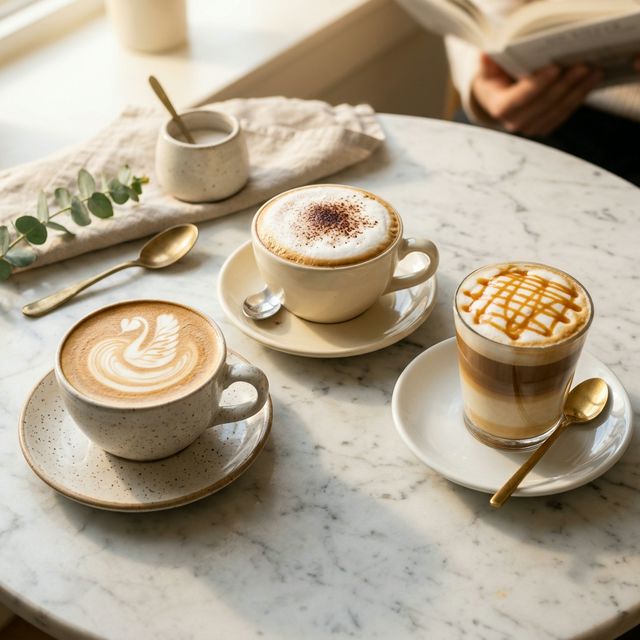
The 8-Dimension Comparison Table
| Dimension | ☕ Cappuccino | 🥛 Latte | ◻️ Flat White |
|---|---|---|---|
| Size | ~180ml | 240–350ml | 160–180ml |
| Espresso base | Double shot | Double shot | Double ristretto |
| Milk volume | ~60ml steamed | ~180–240ml | ~120ml |
| Foam type | Thick, dry foam dome | Thin microfoam layer | Fully integrated microfoam |
| Coffee intensity | ⭐⭐⭐⭐ | ⭐⭐ | ⭐⭐⭐⭐⭐ Strongest |
| Caffeine (per drink) | ~120mg | ~120mg | ~100–120mg |
| Calories (whole milk) | ~120 kcal | ~190 kcal | ~120 kcal |
| Origin | Italy | Italy / USA (popularized) | Australia / New Zealand |
The Key Insight: Foam Is the Real Difference
Most explanations of these three drinks focus on size and espresso amount. The more useful frame is foam type:
- Cappuccino foam is the thickest — airy, dry, and voluminous. It sits on top of the steamed milk like a dome and doesn't integrate into the liquid. You drink through the foam to reach the coffee below. The foam's air content means the espresso hits your palate more directly — hence the stronger taste despite the same espresso shot as a latte.
- Latte foam is thin microfoam — steamed milk with minimal extra air incorporated. It sits as a 1-2cm layer on top and integrates slightly with the liquid below during drinking. The dominant experience is creamy, mild, and sweet from the milk.
- Flat white foam is unique: it is fully integrated into the milk during pouring, resulting in a uniform velvety texture throughout the entire drink with no distinct foam layer. The surface is literally flat and glossy — this is where the name comes from.
Nutrition Comparison
☕ Cappuccino (180ml)
🥛 Latte (300ml)
◻️ Flat White (170ml)
Origin Stories
Cappuccino — Italy, 1930s
The cappuccino gets its name from the Capuchin friars — the color of the drink resembles the brown robes of the order. The modern espresso-based cappuccino developed in northern Italy in the 1930s as espresso machines became widespread. The Italian tradition is strict: a cappuccino is drunk in the morning (never after lunch — a cultural rule Italians take seriously), always in a smaller cup with a notable foam dome. The dry, thick foam style is the Italian original.
Latte — Italy Origin, USA Evolution
"Caffè latte" is Italian for "coffee milk" — a simple name for a simple combination. In Italy, a caffè latte is a home-consumed morning drink: strong coffee with a large amount of hot milk, often drunk from a bowl. The large, milky, espresso-based latte served in cups worldwide was popularized in the United States in the 1980s, particularly in Seattle's emerging specialty coffee culture. The latte art tradition emerged as baristas discovered microfoam could be poured in patterns.
Flat White — Australia/New Zealand, 1980s
The flat white emerged from café culture in either Sydney or Wellington (both cities claim it) in the 1980s as a reaction to poorly made cappuccinos with excessive dry foam. The idea: all the intensity of espresso in a smaller format, without the foam dome that cools fast and adds air without flavor. The name reflects both the appearance (flat surface) and the milk (white) — no artistic framing required. It spread globally as Antipodean baristas emigrated to London and beyond.
How to Make All Three at Home
When to Order Each
- Order a cappuccino: You want a traditionally sized Italian-style coffee experience with a distinct foam texture. You'll drink it within 5 minutes of ordering (foam degrades fast). You appreciate the espresso hitting your palate through the foam rather than diluted by milk.
- Order a latte: You want a large, gentle, milky coffee experience. You're sensitive to bitterness. You want latte art. You're drinking it slowly over 20+ minutes (a latte holds its temperature well due to its volume).
- Order a flat white: You want strong coffee intensity but in a milk-based drink. You prefer fewer calories than a latte. You want velvety texture without a foam layer. You find lattes too weak and cappuccinos too foam-heavy.
Telve: Master Your Daily Brew
Learn pro coffee recipes, track your caffeine, and explore fortunes.
🔑 Barista Pro Tips
- Use a thermometer until your hands can judge temperature. The single most common home cappuccino failure is over-steamed milk above 70°C. At this temperature, milk proteins denature and produce a grainy, "cooked" foam that collapses immediately. A cheap clip-on thermometer eliminates this problem entirely.
- For cappuccino: use fresh full-fat milk, cold. Cold whole milk creates the best foam because the fat and protein structures are intact and the temperature differential with the steam wand is greatest. Pre-warmed milk foams poorly.
- Pour flat white milk faster than latte milk. The fully integrated flat white foam requires pouring quickly with the cup tilted, maintaining a continuous flow without stopping. Slow pouring allows the foam to separate from the liquid before it reaches the cup — destroying the integrated texture.
⚠️ Common Mistakes
Cause: Milk over-steamed (above 70°C) or too little air incorporated. Fix: Keep the steam wand right at the surface and listen for the characteristic tearing sound during the air-incorporation phase.
Cause: Adding air like a cappuccino or not integrating the foam before pouring. Fix: Tap the jug hard on the counter after steaming and swirl vigorously for 5-10 seconds until the milk looks uniformly glossy before pouring.
Cause: Too much milk relative to espresso, or a weak espresso shot. Fix: Use a double shot (not a single) for any latte larger than 240ml. The espresso needs to hold its character against all that milk volume.
Milk Substitution Guide
| Milk Type | Best For | Foam Quality | Flavor Impact |
|---|---|---|---|
| Whole milk | All three drinks | Excellent | Rich, natural sweetness |
| Oat milk (barista) | Latte, flat white | Very good | Slightly sweet, oaty undertone |
| Almond milk | Latte only | Fair (thin foam) | Nutty, lower calories |
| Soy milk | Cappuccino, latte | Good (can separate) | Neutral, may curdle with acidic espresso |
| Skim milk | Cappuccino (foam) | High volume, unstable | Foams easily but collapses fast, thin taste |
Wet Cappuccino vs Dry Cappuccino — The Secret Order
Within the cappuccino itself, there's a dimension most people never discover: the wet/dry spectrum. All cappuccinos share the same base, but the ratio of steamed milk to foam can be explicitly ordered in specialty cafés:
- Dry cappuccino — maximizes foam, minimizes steamed milk. Sometimes called an "extra dry cap." The result tastes most intensely of espresso, because less liquid milk dilutes the shot. The foam dome is tall and airy. Texture: very light, airy, almost meringue-like.
- Standard cappuccino — the classic equal-thirds rule. Balanced between espresso character and milk/foam texture.
- Wet cappuccino — more steamed milk, less foam. Starts approaching a latte in character. The espresso is more diluted. Texture: smoother, creamier. Some people who "don't like cappuccinos" are actually responding to dry cappuccinos specifically — a wet cap is much closer to a latte.
- Bone dry cappuccino — pure espresso with only foam, no steamed milk liquid at all. Extreme. Not recommended for milk lovers.
How to order: "Can I get a wet cappuccino?" or "Can I get a dry cap?" at any specialty café — the barista will understand immediately. At chain cafés, specifying "extra foam" (drier) or "less foam" (wetter) achieves the same result.
Latte Macchiato vs Latte — Are They the Same Drink?
Despite sharing the word "latte," a latte macchiato and a caffè latte are essentially built in reverse order and produce a different flavor experience:
| Property | 🥛 Caffè Latte | 🥛 Latte Macchiato |
|---|---|---|
| Build order | Espresso first, milk poured over | Milk first, espresso poured through milk |
| Visual | Uniform brown-cream color | Distinct layers: white bottom, brown middle, foam top |
| Primary flavor | Integrated coffee-milk blend | Milky at first sip, coffee hit later |
| Size | 240–350ml | Generally larger (300–400ml) |
A latte macchiato is the more visual, more milk-dominant of the two. The espresso shot drops through the foam and steamed milk, "staining" the milk (macchiato = stained). It's popular at chains like Starbucks and favored by drinkers who want a milky coffee experience with visible espresso layering. A caffè latte is integrated from the first sip — there are no distinct layers to experience.
Iced Latte vs Iced Cappuccino vs Iced Flat White
All three drinks have cold versions — but the iced versions create some interesting differences from their hot counterparts:
- Iced Latte — by far the most common. Espresso over ice, cold milk poured in. Simple, refreshing, lower calorie than the hot version (~130-150 kcal for a 12oz). The lack of foam is irrelevant for most people over ice. Best iced coffee for daily drinking.
- Iced Cappuccino — structurally tricky because the signature thick foam doesn't work the same way over ice. Cafès handle this differently: some use cold foam (milk frothed cold with a whisk or special frothing attachment), some use standard microfoam. Calories similar to iced latte if made without cold foam; higher with cold foam addition.
- Iced Flat White — gaining popularity. Double ristretto over ice, cold whole milk, no foam layer. The concentrated espresso base holds up well against the diluting effect of ice better than a standard latte. More coffee-intense, similar calories to an iced latte.
For the complete cold coffee technique guide, see our iced coffee recipes and cold coffee drinks guide.
Latte vs Cappuccino vs Flat White for Calorie-Conscious Drinkers
If you're tracking calories, the differences between these drinks become more significant over daily consumption:
| Version | Cappuccino | Latte (300ml) | Flat White |
|---|---|---|---|
| Whole milk | ~120 kcal | ~190 kcal | ~120 kcal |
| Oat milk | ~110 kcal | ~175 kcal | ~110 kcal |
| Almond milk | ~70 kcal | ~120 kcal | ~70 kcal |
| Skim milk | ~65 kcal | ~120 kcal | ~65 kcal |
The calorie-conscious verdict: flat white or cappuccino are the lowest-calorie options due to their smaller size. Over a year of daily drinking, choosing a flat white over a large latte saves approximately 25,000 calories — roughly 7 pounds of body weight in caloric equivalent. If you want the large-drink experience without the calorie cost, order a large iced latte with almond or skim milk.

Telve: Coffee Recipes
Cappuccino, latte, flat white — and 200 more.
Master all three. At home. Free.
Telve includes step-by-step recipes for the perfect cappuccino, latte, and flat white — with precise temperatures, ratios, and milk technique guides. Stop guessing which foam style you're making and start brewing café-quality drinks with confidence.
Frequently Asked Questions
What is the main difference between latte, cappuccino, and flat white?
All three use espresso + steamed milk. Cappuccino (180ml): equal thirds espresso/steamed milk/thick foam. Latte (240-350ml): most milk, thin foam, mildest taste. Flat white (160-180ml): double ristretto, fully integrated microfoam, no separate foam layer, strongest coffee character.
Which is strongest — latte, cappuccino, or flat white?
Flat white, by far. Small volume + double ristretto + high coffee-to-milk ratio makes it the most coffee-intense of the three despite being milk-based. Cappuccino second (less milk than latte, foam separates espresso). Latte is mildest (most milk, most dilution).
What is the difference between latte and flat white foam?
Latte has a distinct thin microfoam layer sitting on top. Flat white has no separate foam layer — the microfoam is fully integrated into the milk during pouring, creating a uniform velvety texture. The surface of a flat white is literally flat and glossy, not domed.
Where did the flat white originate?
Australia and New Zealand both claim it (disputed). Most historians credit New Zealand cafés in the 1980s. It spread globally as Antipodean baristas moved to London and beyond, entering mainstream awareness when Starbucks added it to their US menu in 2015.
Can I make a cappuccino without an espresso machine?
Yes — use a Moka pot for the base. Heat milk to 65°C and use a handheld frother for 30-45 seconds with the head just below the surface to create foam. Spoon foam over the Moka pot coffee. Not identical to a machine cappuccino but very satisfying.
Related Coffee Guides
Mocha vs Latte: Full Comparison
Taste, calories, caffeine, sugar — and which to order in every situation.
3 Most Common Cappuccino Mistakes
Why your home cappuccino looks or tastes different from the café version.
What Is a Flat White? Complete Guide
The full flat white deep dive — origin, milk ratio, and how to make it perfectly.
How to Make a Latte at Home
Step-by-step latte guide including milk steaming technique and latte art basics.