
How to Find Weaknesses in Your Startup Idea
When a founder conceives a new idea, their brain enters an involuntary state of hallucinatory optimism. Neural pathways flood with dopamine as they imagine viral launch days, Bloomberg profiles, and Series A term sheets. This biological phenomenon is extraordinarily useful for sustaining motivation — and extraordinarily dangerous for accurately forecasting risk. To survive as a founder, you must deliberately cultivate the capacity to put on a "black hat" and systematically, methodically attempt to destroy your own concept before the market, a competitor, or a regulator does it for you.

- Weakness 1 — Distribution Vulnerability: The "Build It and They Will Come" fallacy.
- Weakness 2 — Unit Economics Death Trap: When the math is structurally upside-down.
- Weakness 3 — Key Man Dependency: When you are the only person who can deliver the product.
- Weakness 4 — Platform Dependency: Building on someone else's land.
- Weakness 5 — Switching Cost Friction: Why your users won't actually switch to you.
- Weakness 6 — Regulatory and Compliance Exposure: Overnight death by policy change.
Why Most Founders Avoid This Exercise
Venture capitalists are not oracles. They are specialists in rapid, systematic idea destruction. When you pitch them a concept, they are not listening with excitement — they are running your pitch through a silent mental gauntlet, looking for the specific, concrete mechanism by which the company will almost certainly die in Month 18.
You do not need to wait for a VC to reject you to receive this analysis. You can perform an immediate, structured, preemptive "Red Team Audit" on your own business model. The goal is not pessimism. The goal is intellectual honesty. If you can break your own idea on paper in 30 minutes while sitting at a desk, you just saved yourself 18 months of grinding, capital-destroying execution failure.
Weakness 1: The Distribution Vulnerability
The single most common, most devastating, and most entirely predictable weakness in technically-gifted startups is the "Build It and They Will Come" fallacy. The founder spends 14 months building a beautiful, fully-featured product, launches it, and discovers with horror that absolutely zero strangers can find it, and the ones who do have no compelling reason to pay for it.
The Distribution Red Team Questions
If your only honest answer to "how do users find us?" is "we will run Facebook and Google ads," you have a fatal distribution vulnerability. Paid advertising is a real-time auction that inflates every year. A competitor with 3× your funding will outbid you for every impression and force your Customer Acquisition Cost above your Lifetime Value. Distribution must be either inherently cheap (SEO, community-based), inherently viral (referral engine built into the product), or a channel you have a specific, built-in operational advantage within.
Weakness 2: The Unit Economics Death Trap
"Move fast and break things" is startup mythology that applies to product interface decisions, not business financial physics. A startup that costs $100 to acquire a customer who only pays $30 over their entire lifetime with you is not a business — it is a capital incinerator.
Before launch, run the LTV:CAC Stress Test: estimate your Customer Acquisition Cost at realistic paid channel prices ($40-80 CPL for competitive B2B SaaS markets), and your realistic Lifetime Value based on the average contract value and estimated churn rate for your category. The minimum viable business requires LTV ≥ 3× CAC. If your modeled number is below 2:1, the business model requires fundamental restructuring — not better marketing.
Weakness 3: The Key Man Dependency
Does your business model require your specific personal genius, reputation, or non-transferable specialized expertise to fulfill the core product promise? If yes — you do not have a business. You have a high-paying, high-stress, inherently unscalable job.
The Key Man test: "If I were incapacitated for 6 weeks with no phone access, would the company continue generating revenue at 80% of normal capacity?"
If the answer is no, the product delivery process is not systematized, documented, and trainable. This means the company's value is inseparable from your physical presence — a fatal weakness for equity value, investor interest, and long-term sustainability.
Weakness 4: The Platform Dependency Trap
Building on top of a third-party platform — an Amazon FBA store, an Instagram analytics tool, a Shopify plugin, a Twitter API-dependent product — dramatically accelerates initial growth by leveraging the platform's existing user base. The weakness, however, is existential and potentially immediate.
In 2023, Twitter (now X) raised third-party API access prices from free to $42,000/month with 30 days notice, destroying over 100 API-dependent startups simultaneously. In 2018, Facebook's algorithm change destroyed the organic traffic of thousands of media businesses overnight. The rule: any business whose entire revenue model depends on continued access to a third-party platform's API, algorithm, or marketplace policies is permanently operating with an unmitigated existential risk.
The mitigation: from day one, build a direct communication channel (email list, SMS subscribers, owned community) with every customer that is wholly independent of the host platform. Own the customer relationship data so your business survives the platform.
Weakness 5: Switching Cost Friction Against You
Switching Cost Friction — the psychological, operational, and financial cost a customer incurs when migrating from an existing solution to your new product — is a weakness that founders consistently underestimate. Your potential customer is not using your competitor's inferior product out of ignorance. They are using it because they have 3 years of data stored in it, 12 teammates trained on it, and API integrations built around it. The switching cost is real and substantial.
The Red Team question: "What is the realistic, total cost — in hours, in dollars, in organizational disruption — for a potential customer to migrate from their current solution to ours? And is the value we deliver visibly and dramatically worth that total migration cost?"
If you cannot articulate a specific, compelling answer to that question, you have a switching cost weakness that will cause prospects to continuously agree that your product is better in principle while never actually spending the budget to migrate to it.
Weakness 6: Regulatory and Compliance Exposure
For startups operating in fintech, health tech, edtech for minors, legal tech, food and beverage, or any product category involving users in the European Union, regulatory compliance is not an optional post-launch consideration. It is a pre-build prerequisite.
A 2-hour regulatory research session before writing any code can eliminate what would otherwise be a 14-month, $500,000 compliance remediation project after acquiring 50,000 users in violation of a regulation you didn't know existed. The Red Team question: "Is there any reason a government regulatory body in any country where our users live could issue a cease-and-desist, fine, or mandatory shutdown of our product?"
The Red Team Scorecard
| Weakness Category | Severity (1-10) | Mitigation Status | Next Action |
|---|---|---|---|
| Distribution Vulnerability | Rate 1-10 | None / Partial / Full | Define 3 organic channels |
| Unit Economics Death Trap | Rate 1-10 | None / Partial / Full | Model LTV:CAC at worst-case CAC |
| Key Man Dependency | Rate 1-10 | None / Partial / Full | Document and systematize delivery |
| Platform Dependency | Rate 1-10 | None / Partial / Full | Build owned communication channel |
| Switching Cost Friction | Rate 1-10 | None / Partial / Full | Quantify migration time/cost vs. ROI |
| Regulatory Exposure | Rate 1-10 | None / Partial / Full | 2-hour regulatory research session |
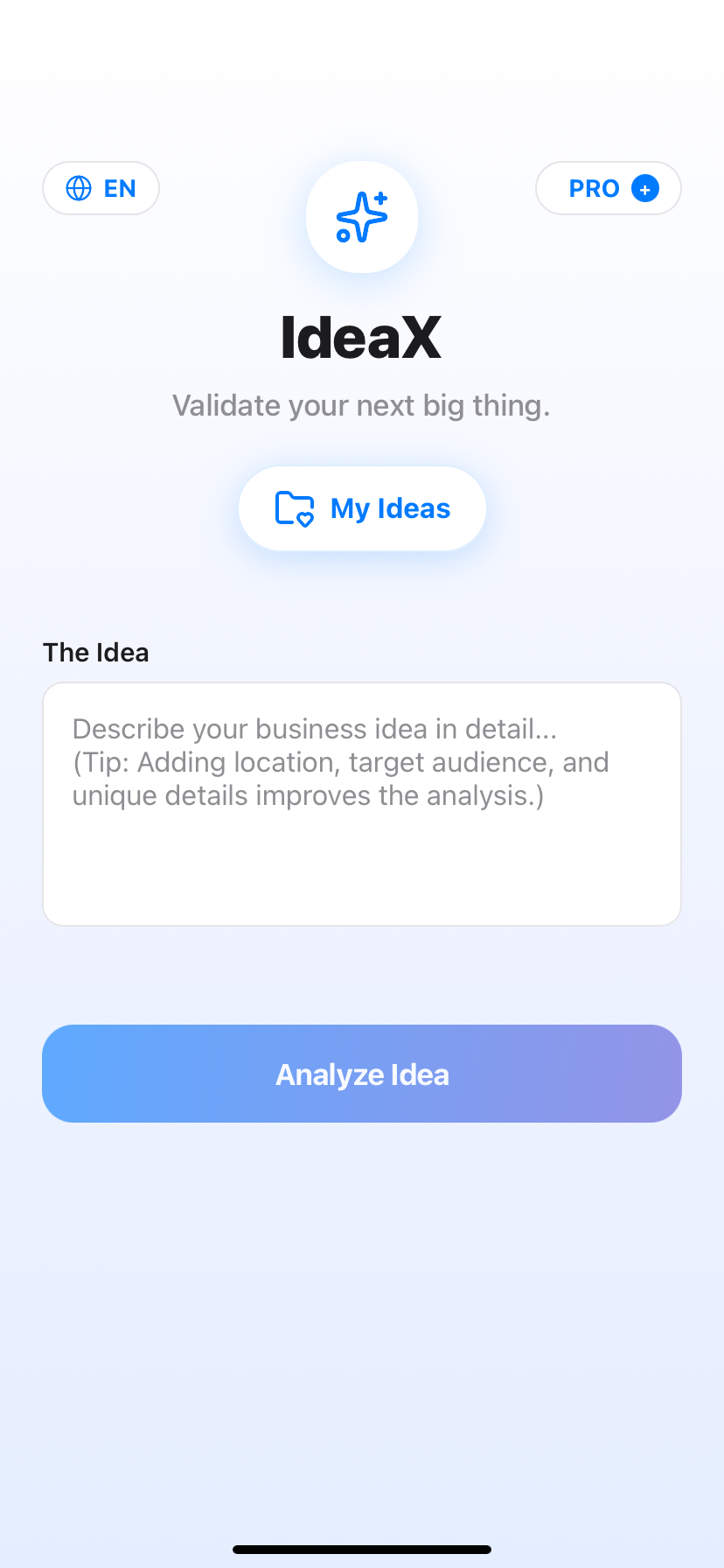

IdeaX: Business Idea Analysis
A structured space for evaluating what to build next.
Expose the hidden flaws instantly.
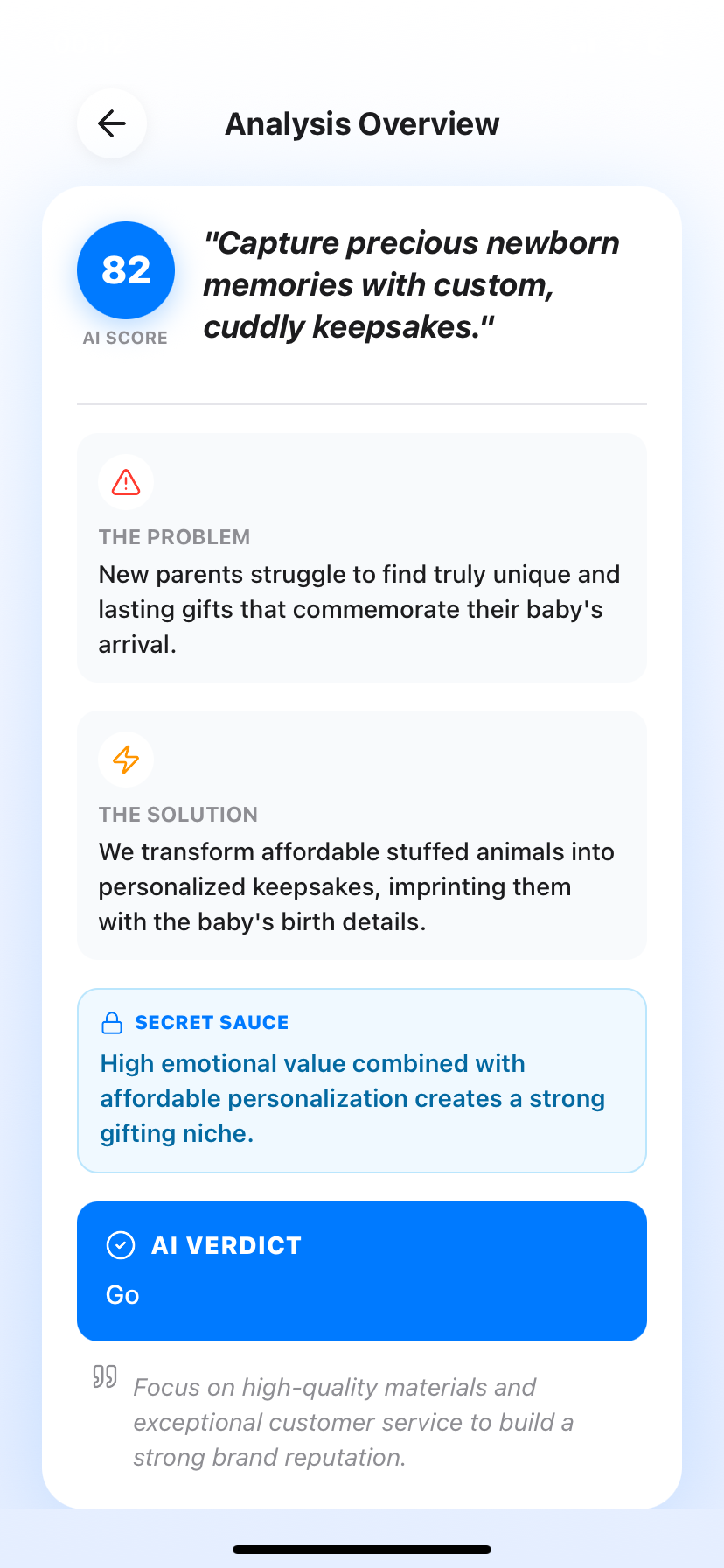
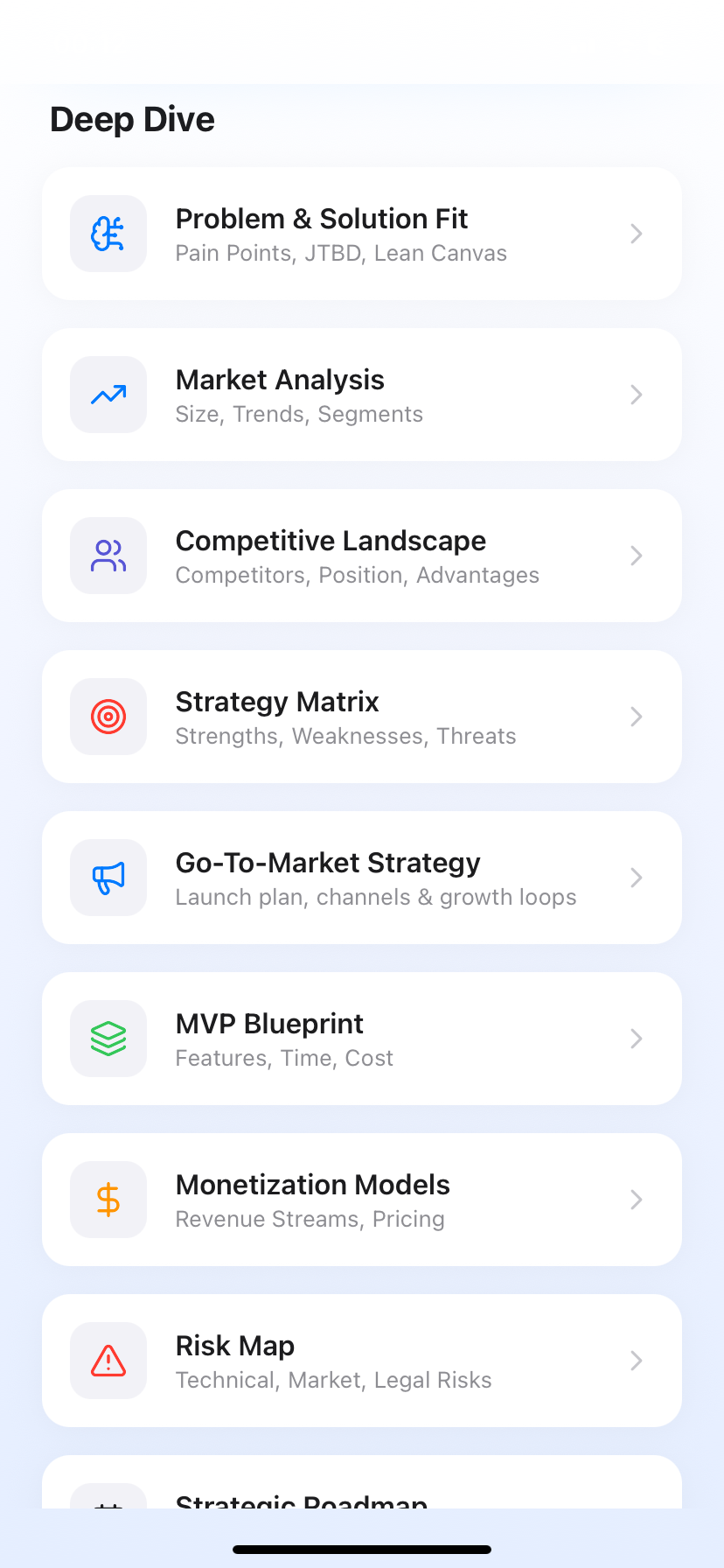
You are biologically wired to minimize the frightening weaknesses in your own ideas. IdeaX is structurally immune to founder bias. When you submit your concept, the AI acts as a ruthless Red Team — methodically scanning all 6 vulnerability categories, identifying distribution bottlenecks, flagging unit economics failures, and mapping platform dependencies. It generates a "Vulnerability Report" showing you exactly which structural flaws require immediate mitigation before you invest your capital.
Frequently Asked Questions (FAQ)
Should I change my idea if I find a weakness?
Not necessarily. Every successful business has structural weaknesses. The goal is to identify fatal flaws — the ones that could cause catastrophic, unrecoverable failure — and design explicit mitigation systems before they materialize. Not every weakness requires a pivot; some require a process change or a contingency plan.
What is the distribution vulnerability?
It's when a startup has no clear, sustainable, defensible path to its first 1,000 paying customers. If your only acquisition answer is 'run Facebook ads,' you have a fatal vulnerability — advertising is an auction that well-funded competitors will win, driving your CAC above your LTV.
What is a 'Key Man' risk?
Key Man risk exists when product delivery depends entirely on the unique skills of one individual — usually you. Test: could a $60K employee replicate 90% of output quality within 30 days? If no, you don't have a scalable business; you have a high-paying job.
Why shouldn't I just launch and figure out weaknesses later?
Unit economics failures, platform dependencies, and regulatory violations cannot be "figured out later" at scale. If your CAC exceeds LTV, launching faster just means going bankrupt faster. These structural issues must be resolved before capital is committed.
How do I identify my startup's single point of failure?
Ask: "What single event would cause 80%+ of our revenue to disappear in 30 days?" Common answers: total dependence on one platform API, one customer representing 70% of B2B revenue, one marketing channel representing 90% of traffic, or one co-founder holding all technical expertise.