
How to Identify Risks in a Business Idea Early
Irrational optimism is a startup founder's absolute greatest superpower, but blind, untested optimism will rapidly burn through your entire life savings. Building a highly successful business is not about magically eliminating risk; it is about systematically identifying it, mathematically isolating it, and strategically surviving it before it kills your company.

- The difference between Market Risk (Deadly) and Technical Risk (Common).
- Performing a "Pre-mortem" analysis to predict your own company's funeral.
- Protecting yourself against fatal Co-Founder disputes and equity theft.
- Understanding Platform Risk and the danger of building on rented land.
- Calculating fundamental financial risk via Unit Economics (CAC vs LTV).
The Psychological Danger of Confirmation Bias
When a founder is deeply, passionately in love with their new idea, they tend to look exclusively for evidence that confirms their brilliant intuition, while actively and aggressively ignoring flashing red warning signs. This psychological phenomenon, formally known as confirmation bias, is the primary hidden reason why over 90% of all tech startups eventually fail.
To build a genuinely resilient, profitable enterprise, you must employ a ruthless "pre-mortem" approach. You must mentally assume that your business has already failed catastrophically twelve months from today, and then work aggressively backward to figure out exactly what specific mechanism killed it.
Here are the four ultimate domains of startup risk you must interrogate before writing a single line of backend code.
1. Market Risk: Will Anyone Actually Care?
This is the undisputed king of all startup risks. You can execute flawlessly, build a beautiful native iOS application, and maintain 100% server uptime for five years—but if literally nobody wants to buy the software, you are completely dead.
The "If We Build It, They Will Come" Fallacy
Founders often confuse a massive "Total Addressable Market" (TAM) with actual willingness to pay. You must isolate this risk immediately. Do not build the product assuming that abstract demand magically exists; you must strictly force the market to prove their demand first by running cheap validation experiments.
Run targeted "Painted Door" tests. Demand real currency pre-orders or firm email waitlist commitments. If the specific target market shrugs in complete apathy at your proposed value proposition, you must pivot immediately. Never try to fight market apathy with venture capital; it is a war of attrition you will inevitably lose.
2. Technical Risk: CAN This Truly Be Built?
For 90% of standard B2B SaaS apps, basic e-commerce websites, or traditional consulting agencies, technical risk is practically absolute zero. We already know exactly how to build a scalable PostgreSQL database, we know how to write a REST API, and we know how to secure user authentication.
When Technical Risk Matters
However, if your startup idea relies on entirely untested nuclear physics, unproven LLM AI capabilities that hallucinate wildly, or manufacturing highly complex deep-tech consumer hardware, your fundamental technical risk is massive.
If your entire value prop relies on a battery running efficiently for 10 years, you must build a highly focused prototype designed exclusively to test that singular scientific assumption first. If the fundamental physics or the underlying API constraints do not mathematically work, do not waste 3 months designing a beautiful logo and choosing brand colors.
3. Execution & Co-Founder Risk
Ideas are simply cheap, theoretical multipliers; flawless execution is worth a million dollars. Are you legally, emotionally, and financially aligned with your founding team?
The Danger of Unvested Equity
Internal cofounder disputes quietly kill thousands of businesses that are otherwise highly profitable. You must have the excruciatingly brutal conversations early.
Implement strict 4-year legal vesting schedules with a standard 1-year cliff. If a co-founder gets bored or stressed and bails after just six months of hard work, they should not legally retain 50% of the entire company forever while you do the remaining 10 years of labor.
Furthermore, ask yourself with total honesty: Are you personally the right individual to execute this specific idea? If the B2B enterprise business demands a masterful, aggressive outbound sales leader to close $100k contracts and you are a highly introverted software engineer who hates phone calls, you face immense execution risk unless you hire properly.
4. Financial & Platform Risk
Platform Risk occurs when your entire business relies on "rented land." If you build a wildly successful app that relies 100% on the Twitter API or the OpenAI API, you are entirely at the mercy of a singular corporation. If they decide to suddenly change their pricing model or completely revoke your developer access tomorrow, your revenue instantly hits zero. You must always plan an architectural escape route.
The Mathematics of Unit Economics
Finally, you must confront pure financial risk: Are you actively losing money every single time someone actually uses your heavily hyped product?
Many consumer startups aggressively grow their user base rapidly but possess fatally flawed fundamental math. If you spend $200 on expensive Google Search Ads to confidently acquire a customer who only pays you a $10 monthly subscription for 3 months before inevitably churning, your entire business is essentially a hyper-accelerated Ponzi scheme waiting to collapse. Early financial de-risking requires mapping out your precise acquisition costs (CAC) and lifetime value estimates (LTV) brutally in an isolated Excel model.


IdeaX: Business Idea Analysis
A structured space for evaluating what to build next.
Run a pre-mortem on your startup.
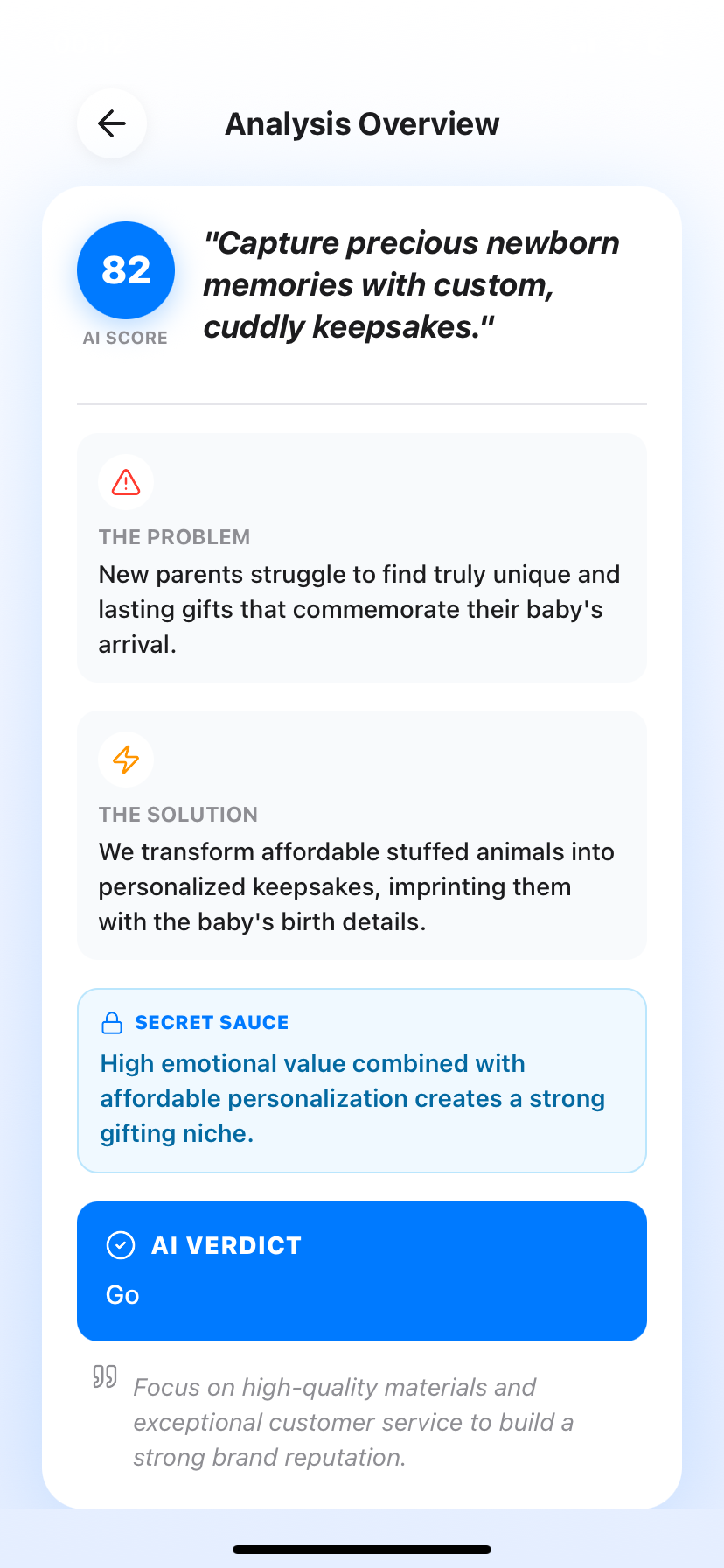
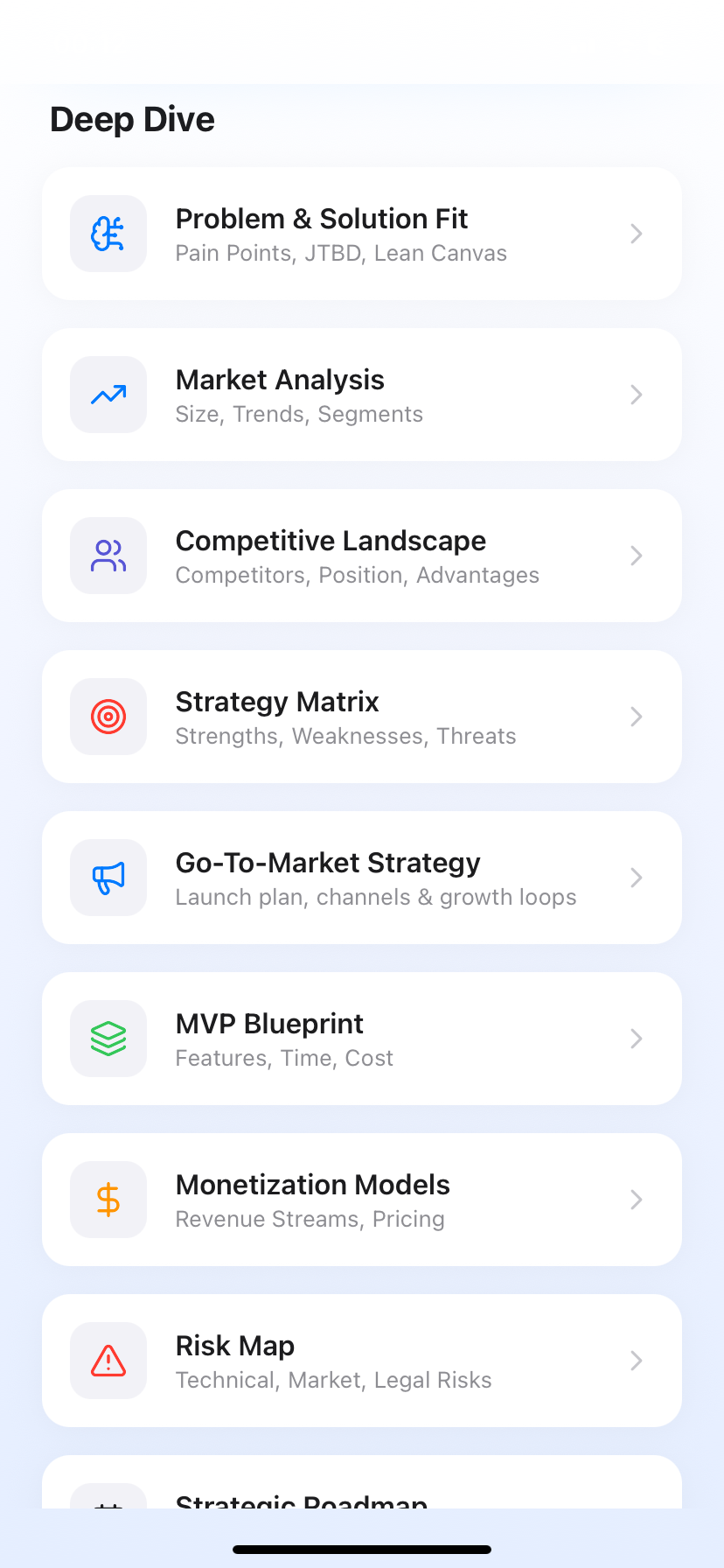
Don't wait until your budget is gone and your co-founder quits to discover the fatal flaw in your business model. IdeaX features an automated, ruthless Risk Matrix engine that rigorously scans your concept inputs for hidden vulnerabilities. By playing literal "Devil's Advocate," our AI explicitly isolates your largest points of failure across market demand, competitive moats, platform dependency, and financial unit economics before you launch. Fix the holes before the ship sinks.
Frequently Asked Questions (FAQ)
What is the single biggest risk in a new software startup?
The absolute biggest threat is 'Market Risk'—the very real possibility that you will spend nine months building a flawless product that literally nobody actually wants to pay for. Building things people don't want kills far more startups than technical failure or funding drying up.
How do I mitigate Co-Founder risk?
Never start a company without a legally binding founder agreement that implements a strict 4-year vesting schedule with a 1-year cliff for equity. If a co-founder quits after 3 months because it gets too hard, they should not legally walk away with 50% of the company forever.
What is Platform Risk?
Platform Risk occurs when your entire business model is completely reliant on a third-party platform's API (like Twitter, Facebook, or OpenAI). If that massive company suddenly changes their terms of service or revokes your API access overnight, your entire business revenue immediately goes to zero.
Is it better to take massive risks or play it completely safe?
Entrepreneurship is entirely about taking aggressively calculated risks and capturing asymmetric bets. You cannot avoid risk entirely, but you can systematically isolate and de-risk the most lethal aspects of your business through cheap validation and modeling.
How do you calculate financial risk before launching?
You must calculate your projected Unit Economics. If your estimated Customer Acquisition Cost (CAC) is exponentially higher than the Lifetime Value (LTV) of your average consumer, your business model is inherently flawed and will burn capital rapidly upon scaling.