
What Is Lean Canvas and When Should You Use It?
Writing a 50-page traditional business plan for an early-stage startup is not just a waste of time — it is actively counterproductive. By the time you finish writing Chapter 4's competitive analysis, your core assumptions have already been invalidated by three customer interviews you didn't do. The Lean Canvas was invented to solve this problem: it forces you to map your entire startup hypothesis on a single page, in under 60 minutes, with enough structural honesty to identify your most lethal risks before you spend a single dollar on development.

- The origin story and core philosophy of the Lean Canvas.
- The critical difference between Lean Canvas and Business Model Canvas.
- The correct sequential filling order of all 9 blocks.
- Deep-dive breakdown of each block with common founder mistakes.
- How to use it as a living, iterative document throughout your build cycle.
The Core Problem the Lean Canvas Solves
Classical MBA-era business schools trained a generation of founders to write formal, exhaustive documents filled with five-year financial projections, detailed market share calculations, and 40-page competitive landscape analyses. This approach has three fundamental structural problems when applied to early-stage startups:
- It optimizes for presentation, not learning. A 50-page document is designed to impress a banker — not to challenge your own assumptions.
- It calcifies wrong decisions. Once you have spent three months writing a plan, the sunk cost psychology makes it psychologically almost impossible to update it when evidence contradicts your assumptions.
- It cannot move at startup speed. A startup must update its strategy weekly. A 50-page document cannot be re-printed weekly.
Created by entrepreneur Ash Maurya — who himself adapted it from Alexander Osterwalder's Business Model Canvas — the Lean Canvas addresses all three problems by constraining the entire business model to a single visual page of nine concise blocks.
Lean Canvas vs. Business Model Canvas: Key Differences
| Dimension | Business Model Canvas | Lean Canvas |
|---|---|---|
| Designed for | Established enterprises | Early-stage startups |
| Core assumption | Problem is already validated | Problem must be discovered |
| Unique blocks | Key Partners, Key Activities | Problem, Unfair Advantage |
| Update frequency | Quarterly / Annually | Weekly / After each experiment |
| Investor use | Growth-stage investors | Angels, pre-seed VCs |
The Correct Filling Order (And Why It Matters)
The most common, costly Lean Canvas mistake is filling the Solution block before the Customer Segments and Problem blocks. This is the exact backwards sequence that produces great technology solutions to problems nobody has. Always follow this evidence-first order:
Deep Dive: All 9 Blocks Explained
Block 1: Customer Segments
Identify your primary customers with intense specificity. Also identify your Early Adopters — the desperate, motivated subset of your broader market who will use your buggy version 1.0 in exchange for being first. Early Adopters are not the same as your eventual mass-market audience. They are typically more tech-savvy, more pain-aware, and less price-sensitive. Focus all initial acquisition efforts exclusively on this group.
Block 2: Problem
List the top three most painful problems your Customer Segments experience daily. Underneath each problem, list how they currently solve it (the "Existing Alternative"). The Existing Alternative is critical: it defines your real competition, which is almost never who you initially think it is. If you are building a B2B analytics tool, the primary alternative might be "manually exporting to Excel" — not a direct competitor software.
Block 3: Unique Value Proposition
A single, clear, compelling message that answers: "Why should my ideal customer choose us over everything else available to them right now?" This is not your company tagline. It is a specific, results-oriented promise. Great UVPs are concrete ("Save 5 hours a week on client reporting") rather than abstract ("Increase your productivity").
Block 4: Solution
Map exactly three product features against the three problems listed in Block 2. Each feature should directly and specifically address one documented problem. Do not list features that don't correspond to a documented pain point — they are scope creep by definition.
Block 5: Channels
Document the precise path customers will travel from never having heard of you to becoming loyal, paying users. Map the complete GTM channel sequence: awareness → interest → conversion → retention. For an early-stage startup with zero brand equity, cold outreach, niche community posts, and SEO content are typically the highest-ROI channels.
Block 6: Revenue Streams
Specify the exact pricing model, price points, and payment frequency. A subscription model at $49/month is not the same as a one-time fee of $149. They have radically different LTV calculations, different customer expectations, and different support burdens. Choose the model that maximizes long-term retention, not initial conversion volume.
Block 7: Cost Structure
List all fixed monthly costs (server costs, SaaS subscriptions, salaries) and variable costs (customer acquisition, payment processing fees). The purpose of this block is not accounting — it is to calculate your monthly cash burn rate and determine your minimum revenue target to reach break-even.
Block 8: Key Metrics
Identify the one or two behavioral user metrics that are leading indicators of business health — the actions that, when completed by users, reliably predict long-term retention and revenue. For SaaS: this might be "number of active integrations connected per user." For a marketplace: "number of repeat purchases per buyer per month." Never use vanity metrics (total signups, page views) as Key Metrics.
Block 9: Unfair Advantage
This is the block that identifies whether your business will have defensible long-term value or will be immediately cloned by a well-funded competitor. An Unfair Advantage is something that cannot easily be replicated or purchased. Examples: exclusive proprietary data from a unique source, 10 years of personal trust relationships within the precise target niche, a regulatory license that takes 3 years to obtain. "We work harder" is not an Unfair Advantage. If you cannot fill this block today, your business model has an existential vulnerability that must be solved before you scale.
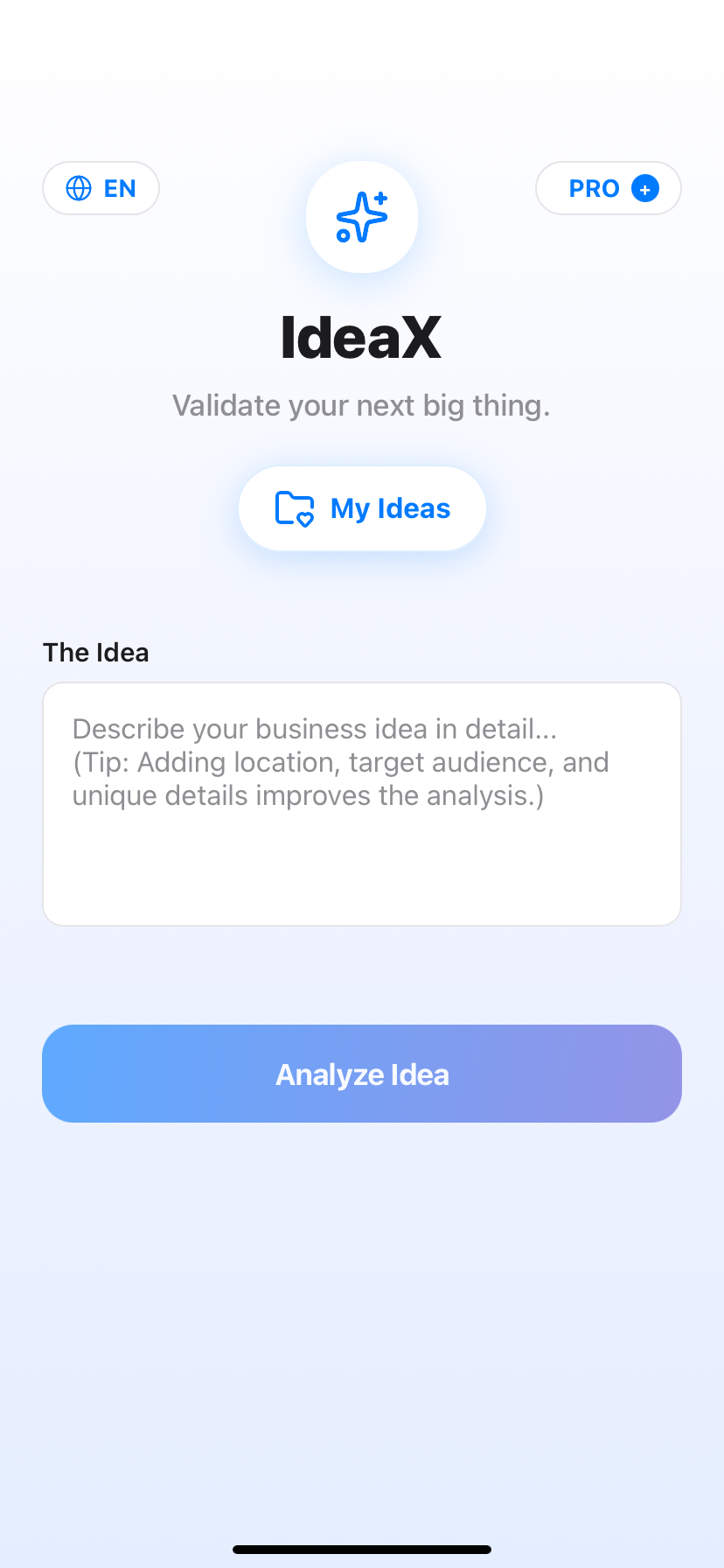
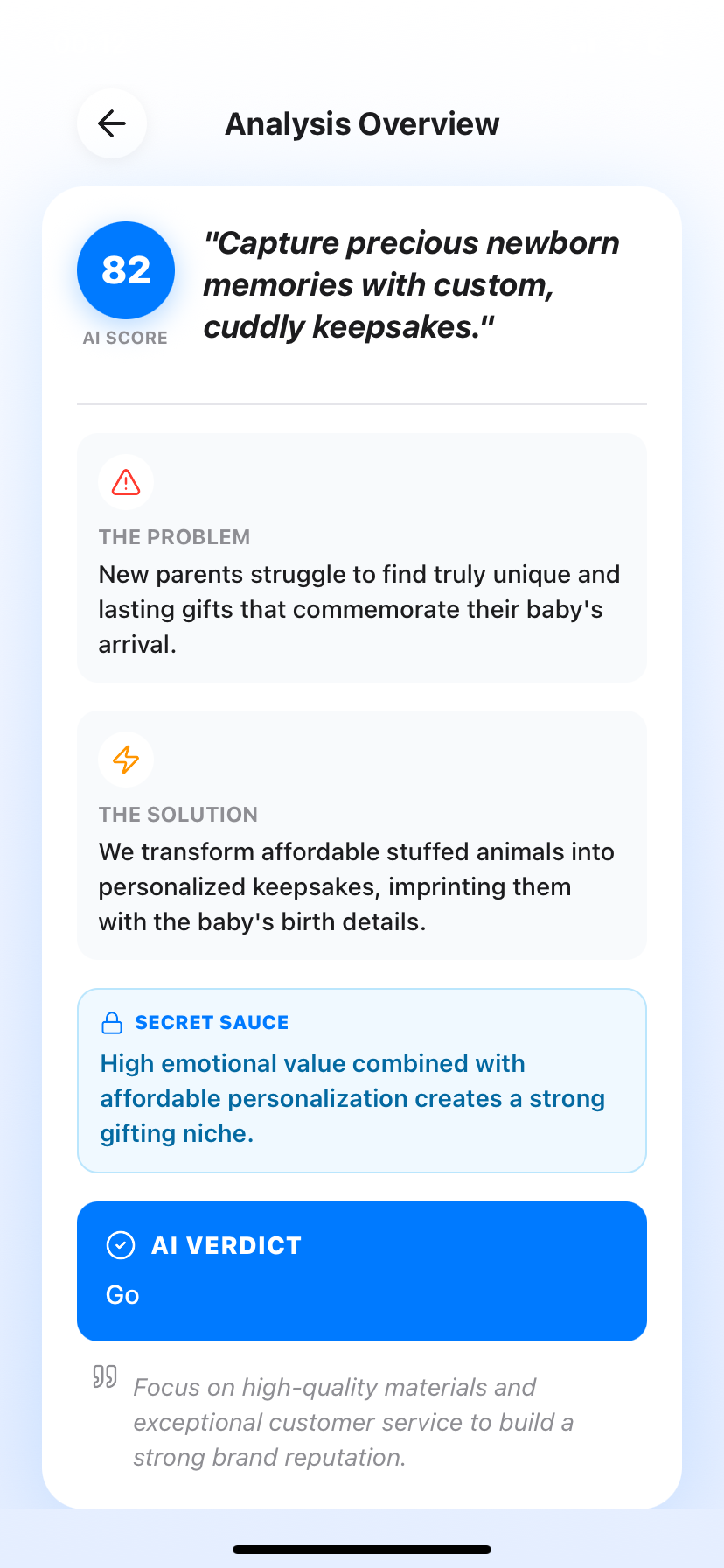
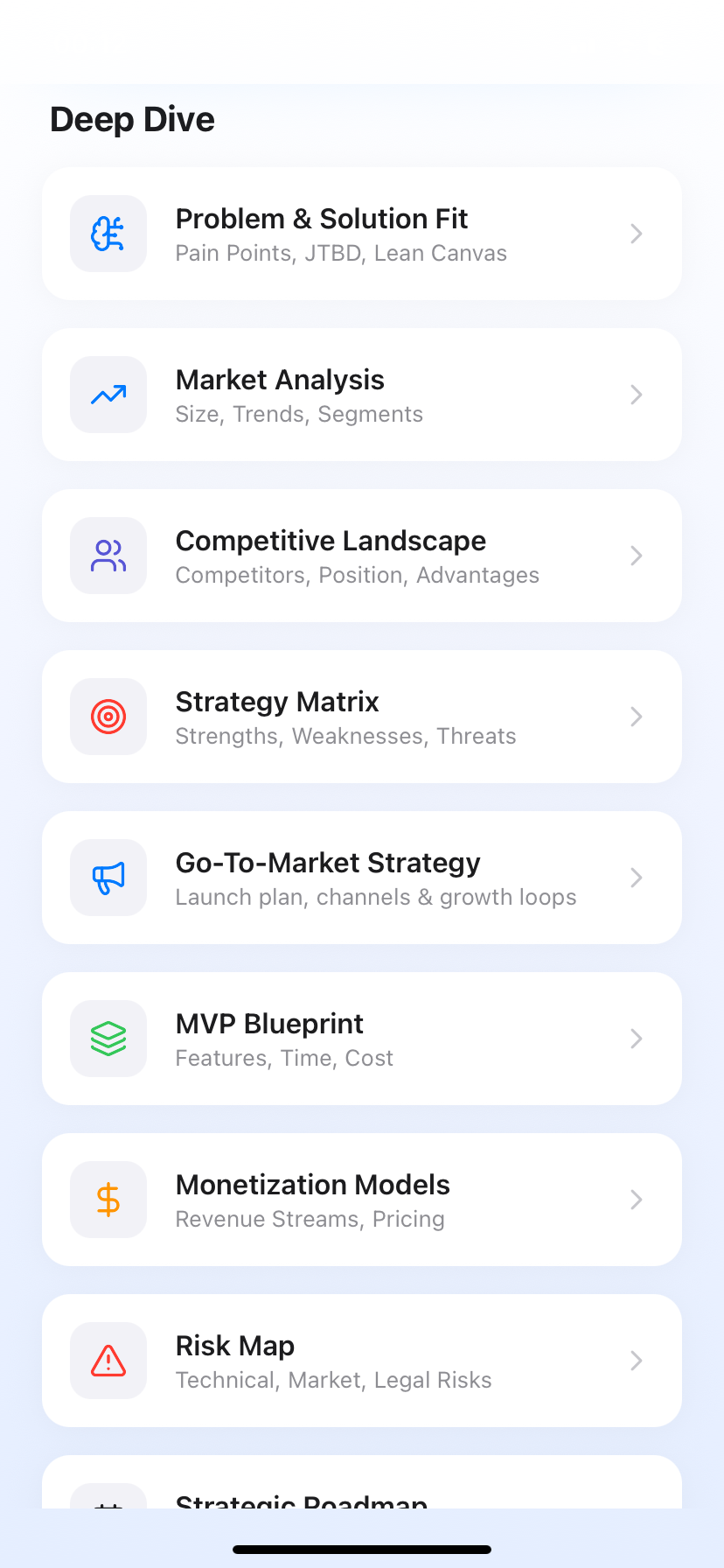

IdeaX: Business Idea Analysis
A structured space for evaluating what to build next.
Generate a structured Lean Canvas in seconds.
Staring at 9 empty text boxes is intimidating. IdeaX removes that friction entirely. Describe your concept conversationally inside the app, and the AI engine automatically populates a complete, structured 9-block Lean Canvas assessment — identifying your most critical Customer Segments, mapping your most viable Distribution Channels, and explicitly flagging the blocks where your current hypothesis is dangerously under-specified. Evaluate the architecture of your business model before you invest a single hour of engineering time building it.
Frequently Asked Questions (FAQ)
What is the difference between Lean Canvas and Business Model Canvas?
Lean Canvas replaces the BMC's 'Key Partners' and 'Key Activities' blocks with 'Problem' and 'Unfair Advantage'. This reflects the startup reality that you must first prove the problem exists before optimizing execution. The BMC is for established enterprises. Lean Canvas is for startups operating under extreme uncertainty.
In which order should I fill out the Lean Canvas blocks?
Start with Customer Segments, then Problem, then Unique Value Proposition, then Solution. Always define WHO and WHAT before HOW. Filling the Solution block first is the most common and most costly Lean Canvas mistake — it produces elegant solutions to problems nobody actually stated they had.
How often should I update my Lean Canvas?
Every time you complete a market validation experiment that produces materially new learning. If a customer interview invalidates your target audience or pricing model, update it immediately. A Lean Canvas that hasn't been updated in 30 days is likely no longer reflecting reality.
Can I show a Lean Canvas to investors?
Yes. Most modern angel investors and early-stage VCs prefer the Lean Canvas to a traditional plan. It signals founder maturity: you understand the core economics of your business, you are operating iteratively, and you are focused on the right questions.
What is the most important block in the Lean Canvas?
The 'Unfair Advantage' block. It tests whether your business has a defensible long-term moat. An Unfair Advantage is something a well-funded competitor cannot quickly replicate: exclusive data access, a proprietary network, a regulatory license, or dominant personal trust within a closed niche. "We work harder" is not a valid answer.