
The Fatal Flaw of Assuming Demand
The startup graveyard is filled with beautifully designed applications that possess perfect code architectures, yet zero users. This tragic outcome happens when founders fall in love with the *solution* rather than the *problem*. They assume that if they build a superior product, the market will naturally appear. This is the "Field of Dreams" fallacy, and it is the fastest way to bankrupt a company.
Historically, evaluating true market potential was a grueling endeavor. It required purchasing $5,000 industry reports from legacy consulting firms, running exhaustive focus groups, or spending weeks manually scraping search volume data to fill out your Lean Canvas. Because this process felt academic, slow, and detached from the thrill of building, many founders skipped it entirely. Today, AI eliminates that friction completely.
Deciphering TAM, SAM, and SOM with AI
Investors demand to understand the scale of your market using the TAM/SAM/SOM framework. Calculating this manually involves heavy assumptions. But when you ask an AI business analysis tool to structure your market potential, it calculates these tiers using vast macroeconomic datasets:
- TAM (Total Addressable Market): The absolute limit of revenue if you achieved 100% market share. AI helps identify if this ceiling is high enough to warrant venture capital or if it's best suited as a lifestyle business.
- SAM (Serviceable Available Market): The portion of the TAM you can reach with your specific product model and sales channels. AI refines this by cross-referencing your intended Go-To-Market strategy.
- SOM (Serviceable Obtainable Market): The realistic slice you can capture in the next 1-2 years considering current incumbents. AI exposes the viciousness of the competition, keeping your SOM projections ruthlessly realistic.
Validating the 'Why Now?' Factor
A large market is irrelevant if it is stagnant or actively dying. The most critical assessment AI performs during market evaluation is the "Why Now?" timing check. Artificial intelligence algorithms identify macro-trends—such as the sudden migration to remote work, changes in data privacy regulations (like GDPR compliance), or spikes in specific API usages.
If your startup idea requires a behavioral shift that consumers are not ready to make, the AI will warn you that you are trying to force a market prematurely. Conversely, it will highlight overlapping "tailwinds" that prove the market is rapidly moving toward your exact solution.

IdeaX: Don't Build Blind
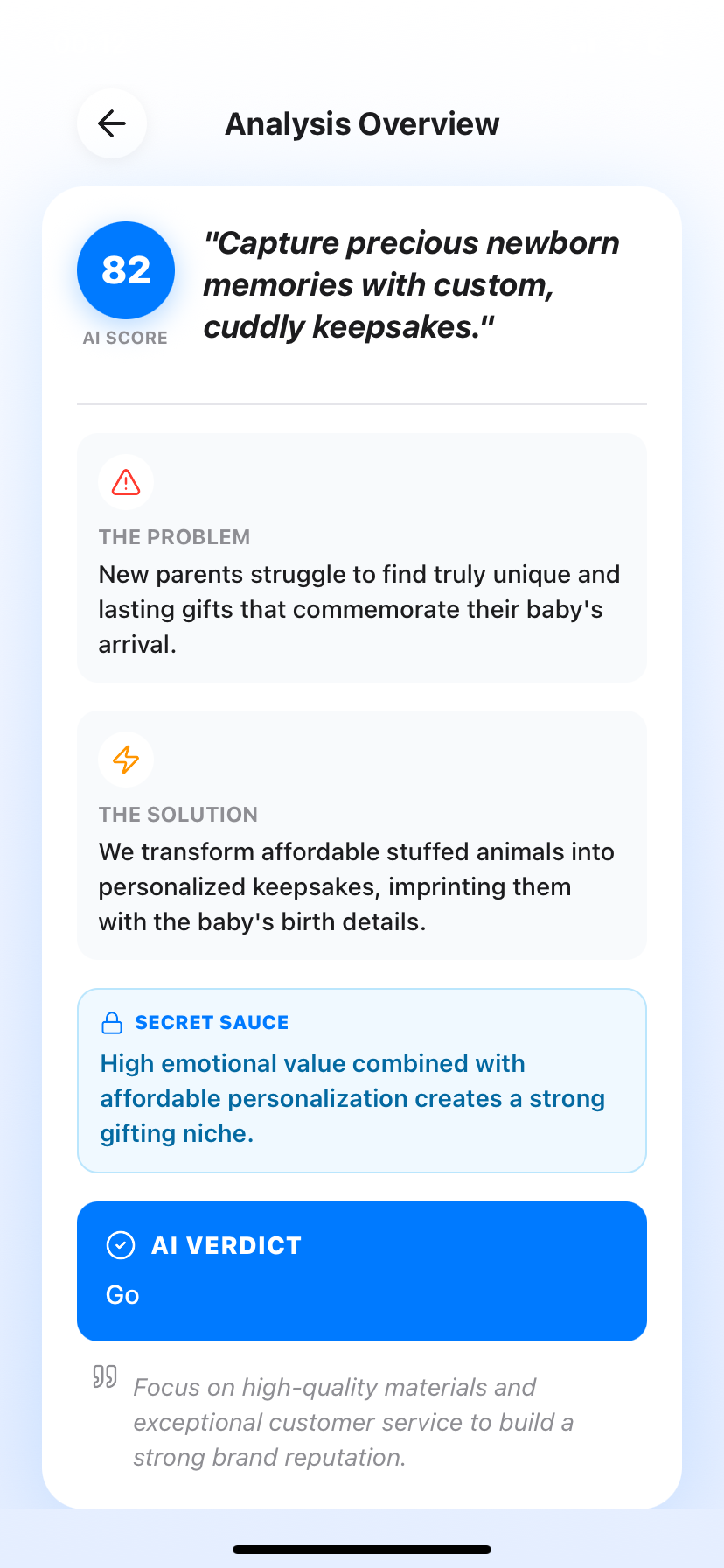
Let AI mathematically calculate your TAM and market viability instantly.
Finding Micro-Niches Through AI Discovery
Perhaps the most underrated superpower of conducting AI market research is the discovery of adjacent micro-niches. You might input an idea for a generic B2B invoicing tool. The AI, after analyzing market saturation and incumbent dominance, will likely tell you that the general SaaS space is a 'Red Ocean' (highly competitive).
However, the AI might also analyze demand intent and reveal a 'Blue Ocean' gap: *Invoicing software specifically designed for freelance structural engineers.* By pivoting to this highly specific micro-niche recommended by the AI, you lower your Customer Acquisition Cost (CAC), face zero direct competition, and guarantee a devoted early adopter base. Finding these pivots before you lock in your code architecture is invaluable.
Conclusion: Pre-Code Due Diligence
Code is the most expensive way to test a business hypothesis. Before you hire an engineer or open your IDE, you must execute rigorous due diligence on the market itself. By utilizing artificial intelligence, you transform a sluggish, 3-week research sprint into a 10-minute structural audit, guaranteeing that the market you are entering actually has the depth, growth, and demand to support your vision.