
Startup Idea Scorecard: 12 Questions Before You Build

IdeaX: Business Idea Analysis
Score demand, audience, market, risks, and MVP logic before you build.
A startup idea scorecard gives you a colder way to judge an idea before enthusiasm turns into months of product development. Instead of asking "Do I like this idea?", score the evidence: who needs it, how painful the problem is, whether people pay for alternatives, and what you can test before building.

This scorecard is designed for founders, indie hackers, app builders, and product teams who are deciding whether an idea deserves development time. It works best before you write code, hire a developer, build a full MVP, or commit to a long roadmap.
If you are still at the earliest stage, start with validating a business idea without building anything. If you already have several options, use this scorecard alongside how to compare two business ideas objectively.
Give each question 0, 1, or 2 points. A 0 means weak or no evidence. A 1 means partial evidence. A 2 means strong evidence from real customer behavior, market data, or clear operational logic. Maximum score: 24.
The 12-Question Startup Idea Scorecard
Do not score based on optimism. Score based on evidence. If you do not know the answer yet, give yourself a 0 and design a test.
1. Can you name the exact buyer or user?
A strong idea starts with a specific person or business type. "Creators" is broad. "US-based YouTube editors managing 5+ client channels" is useful. If you cannot name the customer clearly, your marketing, product, and pricing decisions will stay vague.
- 0 points: The audience is broad or generic.
- 1 point: You can describe a niche, but not where to find them.
- 2 points: You know the exact segment, role, context, and where they gather.
2. Is the problem painful and repeated?
Good startup problems happen often enough to create urgency. A one-time annoyance may not support a real business unless the stakes are high. Ask whether the problem costs time, money, reputation, or emotional energy on a recurring basis.
Use this real-problem framework if the pain still sounds abstract.
3. Are people already trying to solve it?
Existing workarounds are a positive signal. Spreadsheets, consultants, screenshots, manual checklists, hacked automations, and expensive tools all show that people care enough to act.
- 0 points: No clear workaround exists.
- 1 point: People complain but rarely take action.
- 2 points: People already spend time or money solving it poorly.
4. Can you explain why current alternatives are not enough?
Competition is not automatically bad. It often proves the market exists. The key question is whether you can name a real wedge: simpler workflow, lower price, better niche focus, faster setup, stronger integration, or a different buyer.
Review complaints, feature gaps, and pricing friction using a startup competitor analysis before assuming your product is different.
5. Can you reach your first 100 potential users?
A good idea still fails if you have no path to customers. Before building, know the first distribution channel. That could be search traffic, outbound email, a niche community, partnerships, app stores, content, paid ads, or an existing audience.
If the opportunity sounds large but the first reachable market is unclear, estimate TAM, SAM, and SOM for the startup idea before scoring this section too highly.
- 0 points: "People will find it" is the plan.
- 1 point: You have a channel idea but no proof.
- 2 points: You know where the first users are and how to contact them.
6. Is there evidence of willingness to pay?
Interest is not the same as demand. Stronger signals include pre-orders, deposits, paid pilots, letters of intent, repeated usage of a paid competitor, or budget already allocated to the problem.
If you have not tested price, use the business idea validation checklist before you write code before moving to development.
7. Does the pricing have room for healthy economics?
Some ideas are useful but hard to monetize. If customers only want to pay $2 once, but acquisition and support cost more than that, the product may not become a sustainable business.
Score this higher if there is a believable path to repeat revenue, strong margins, or a high-value transaction. For more detail, read how to check if a business idea is profitable.
8. Is the market timing favorable?
Timing matters. A market can be too early, too late, or just right. Look for triggers: new regulations, platform changes, AI adoption, rising costs, workflow shifts, new buyer behavior, or recent dissatisfaction with existing tools.
- 0 points: No clear reason this needs to exist now.
- 1 point: The timing seems reasonable but unproven.
- 2 points: There is a concrete market shift creating urgency.
9. Do you have founder-market fit?
Founder-market fit means you have some advantage in the market: experience, relationships, unusual insight, distribution access, or personal pain. You do not need to be a world expert, but you should have a reason to learn faster than a random competitor.
If the idea looks good only because the market is trendy, be careful. Trend awareness is not the same as market access.
10. Can the MVP test one risky assumption?
The first version should not be a complete product. It should test the most dangerous assumption. If the riskiest assumption is demand, a landing page may be enough. If it is value delivery, a manual concierge version may be better.
Use MVP feature prioritization to keep the first build narrow.
11. Can the idea survive obvious competitor responses?
Ask what happens if a competitor copies the feature. Your defense might be niche focus, data, workflow integration, switching cost, brand, distribution, speed, or better customer understanding. If your only advantage is "we will have a feature", the idea is fragile.
12. Are the biggest risks visible and testable?
A strong idea does not have zero risk. It has risks you can name and test. Write down the top three reasons the idea could fail, then design a cheap test for each.
Use this guide to identifying business risks early if your risk list still feels generic.
Score the Idea With Structure
IdeaX helps map target audience, risks, competitors, MVP scope, and monetization assumptions in one place.
How to Interpret Your Score
| Score | Decision | Next step |
|---|---|---|
| 19-24 | Strong candidate | Build the smallest MVP or run a paid pilot. |
| 13-18 | Promising but unproven | Run no-build validation tests before coding. |
| 0-12 | Too weak for development | Clarify the customer, problem, wedge, or pricing first. |
Example: Scoring a Simple SaaS Idea
Imagine the idea is "a client approval tracker for freelance designers." The audience is narrow, the problem is repeated, and designers already use messy manual workarounds. That may score well on customer clarity and pain. But if there is no proof they will pay, no clear acquisition channel, and no defense against project management tools adding the same feature, the total score should stay moderate.
That is exactly why a scorecard helps. It stops one strong dimension from hiding three weak ones.
When Should You Build?
Build when the score is strong enough to justify a focused experiment, not when the idea feels exciting. Even then, build only the smallest product that tests the riskiest assumption. A scorecard should push you toward sharper validation, not a bloated first release.
If your score is low, do not treat that as failure. Treat it as a map. It tells you whether to narrow the audience, sharpen the problem, test willingness to pay, or improve the go-to-market plan before development begins.
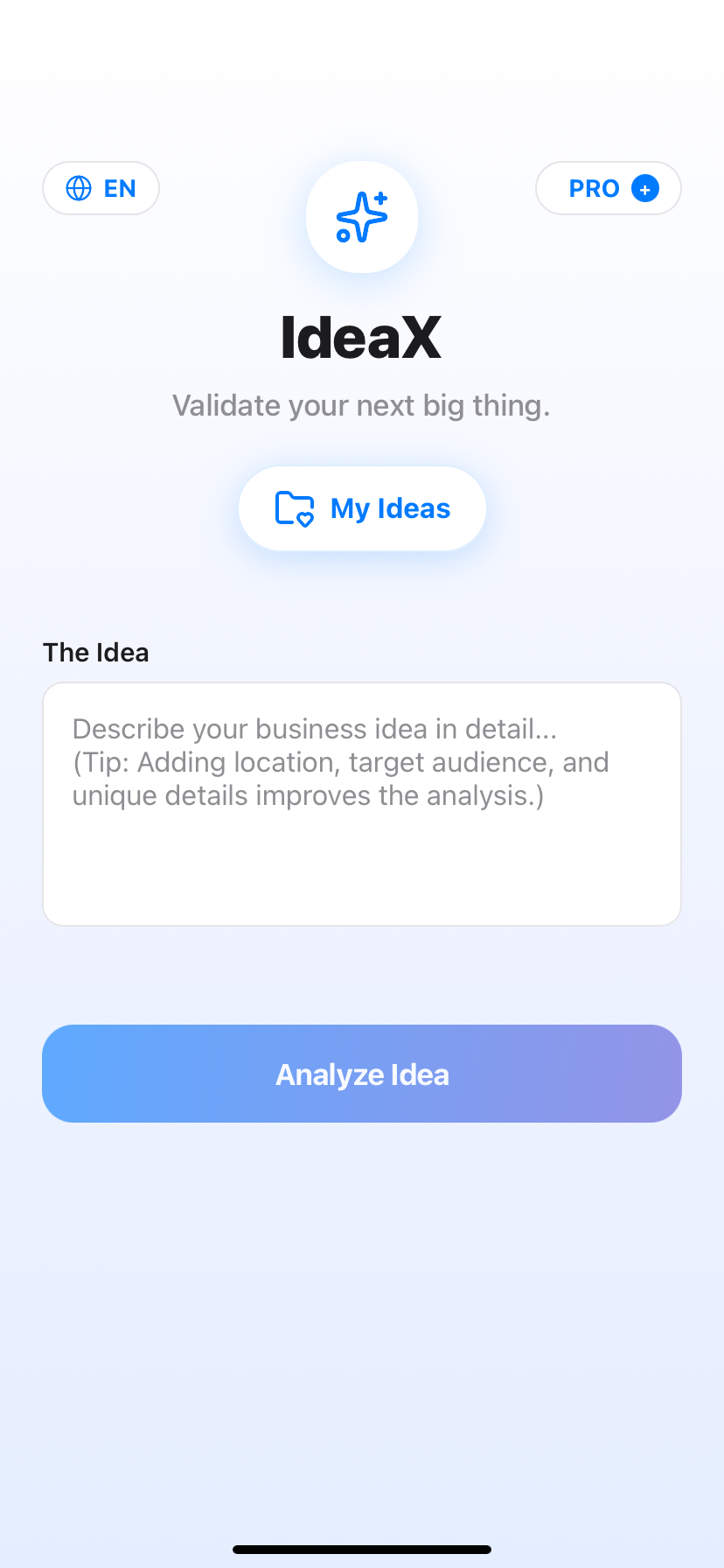
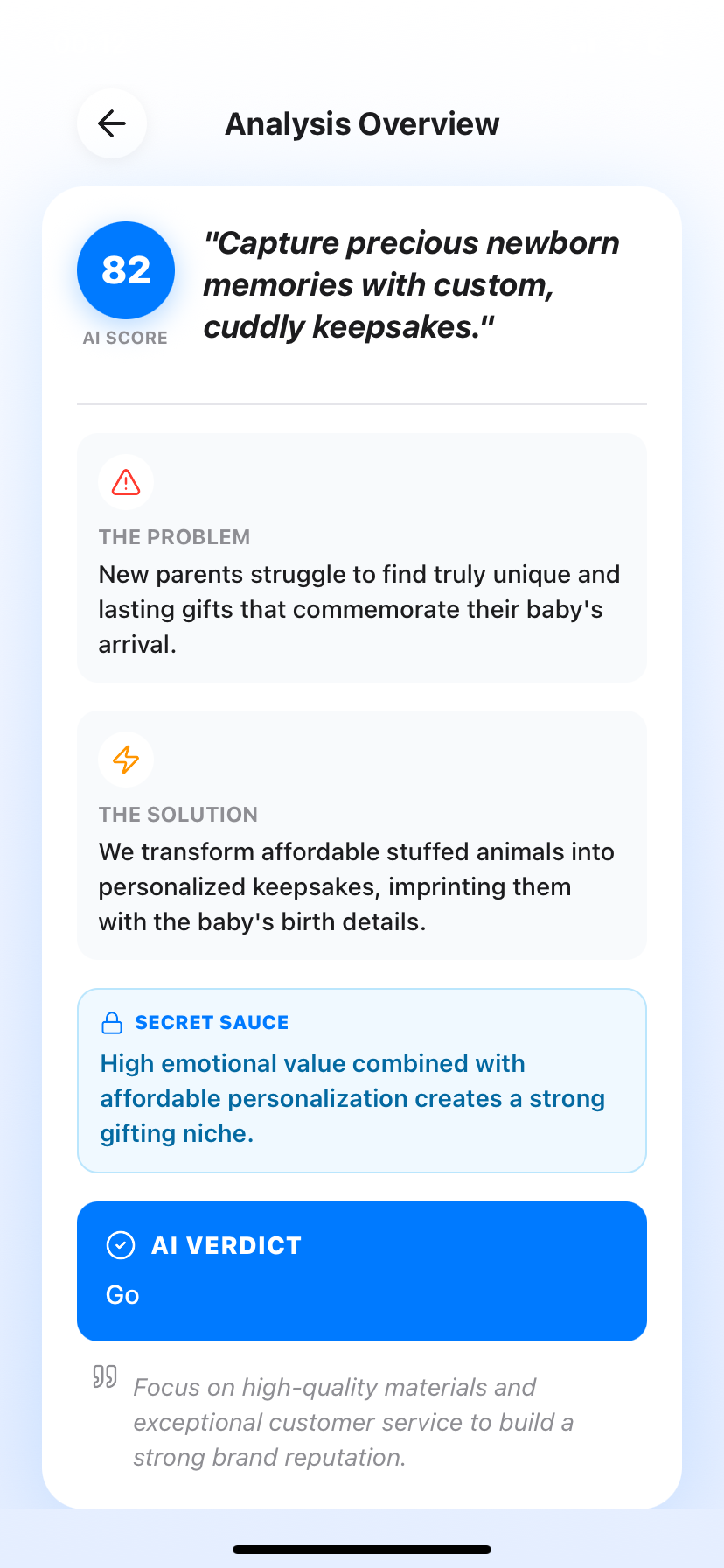
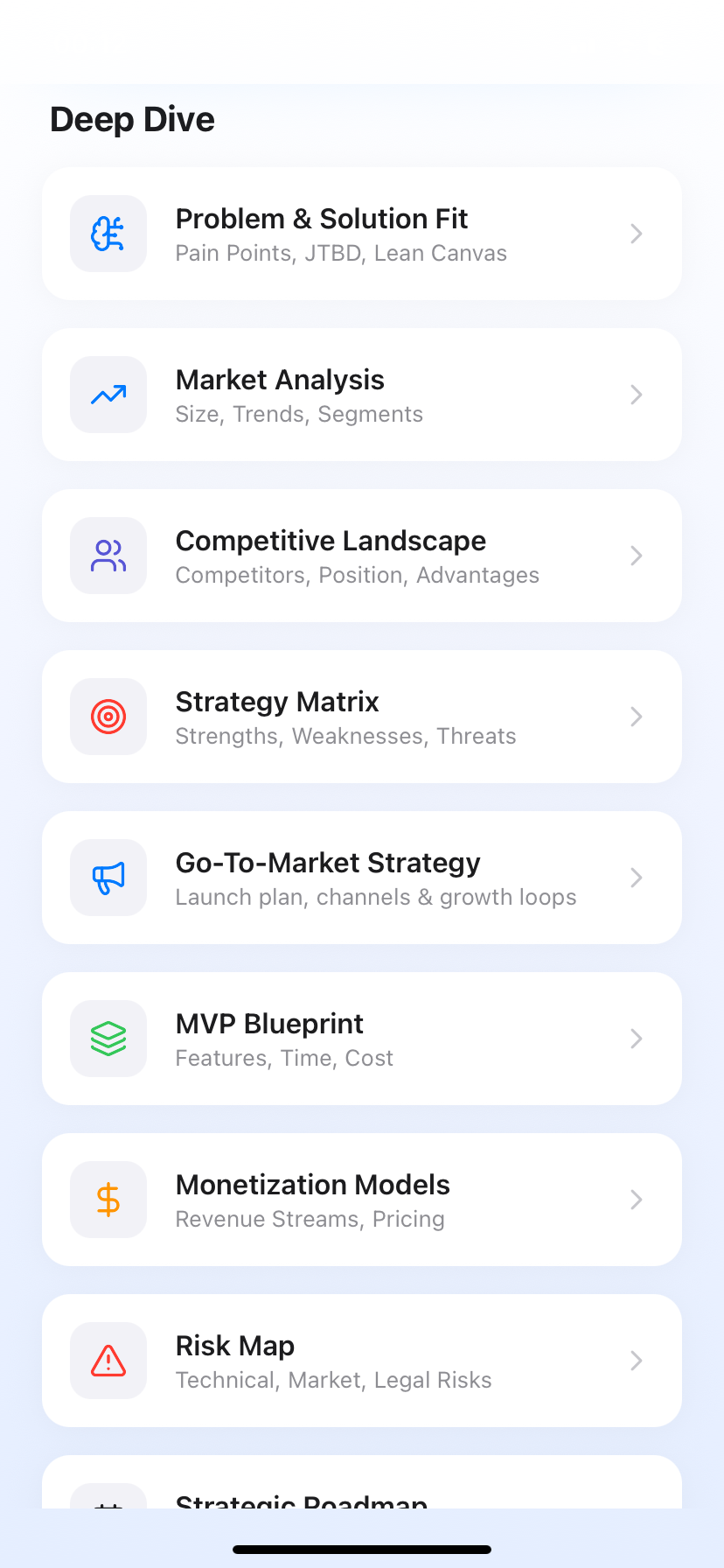
IdeaX: Business Idea Analysis
A structured way to evaluate what to build next.
Turn your scorecard into a full idea analysis.
IdeaX helps evaluate business ideas across problem clarity, target audience, market potential, competitor gaps, monetization, risk, and MVP planning so you can decide what deserves your build time.
Frequently Asked Questions
What is a startup idea scorecard?
A startup idea scorecard is a structured way to rate an idea across customer clarity, problem severity, demand evidence, pricing, competition, timing, founder fit, MVP scope, and risk before committing development time.
What score means a startup idea is worth building?
In this 24-point scorecard, 19-24 suggests a strong candidate for a focused MVP or paid pilot. A score of 13-18 needs more validation. A score below 13 is too weak for product development without more evidence.
Should I score based on opinions or evidence?
Score based on evidence. Customer behavior, existing workarounds, competitor complaints, paid intent, and reachable distribution channels matter more than personal excitement or friendly feedback.
Can a low-scoring idea still become good?
Yes. A low score often means the idea needs a narrower customer, clearer pain point, stronger wedge, or better validation test. The score is a diagnostic tool, not a permanent judgment.