The Danger of Founder Bias
Every entrepreneur operates inside a reality distortion field. When you conceive an idea, you are biologically hardwired to protect it. You unconsciously seek out data that validates your pricing model, you inflate the total addressable market, and you assume customer acquisition will be seamless. This is known as confirmation bias, and it is the leading underlying cause of startup death.
To survive, you cannot rely solely on the opinions of your friends or your co-founders—they are equally biased. You need an adversarial force. You need a process designed explicitly to break your business model. In military strategy, this is called the "Red Team." In the modern startup ecosystem, it is called AI Stress Testing.
What is a Red Team Analysis?
A Red Team is an independent group whose sole purpose is to ruthlessly attack your strategic defenses and expose vulnerabilities. By employing AI as your Red Team, you gain access to an entity that has zero emotional attachment to your idea. It does not care if your feelings get hurt; its only directive is to mathematically and structurally invalidate your hypothesis using terabytes of historical business data.
The 3 Pillars of AI Stress Testing
1. Unit Economics Stress Test
The most common delusion among first-time founders is assuming that if the product is good, the customers will come for free. AI strips away this delusion. By inputting your projected pricing and target demographic into an AI analysis tool, the system can cross-reference industry-average Customer Acquisition Costs (CAC) against your proposed Lifetime Value (LTV).
If the AI determines that your B2C app requires a $40 Facebook Ads CAC to acquire a user who will only generate $15 in ad revenue over a year, your startup is structurally bankrupt before it launches. The AI forces you to address this fatal math immediately.
2. The 'Why Now?' Failure Check
When a founder says, *"Nobody has thought of this before,"* they are almost always wrong. Someone has thought of it, and someone has failed at it. AI stress testing excels at historical pattern recognition. When you pitch an idea, the AI can search its vast database of failed startups to find companies that attempted the exact same model five years ago.
The AI will present you with the autopsy of those failures: *"Startup X attempted this in 2021 and failed because of prohibitive hardware distribution costs."* You must then answer the "Why Now?" question. What technological or cultural shift makes this possible today when it failed yesterday? If you don't have an answer, the stress test has successfully saved you years of wasted effort.
3. Go-to-Market (GTM) Vulnerability
Many founders have great products but catastrophic distribution strategies. A proper AI stress test will attack your GTM plan. If your plan is "SEO and word of mouth," the AI will calculate the domain authority required to rank for your critical keywords against massive incumbents. It will quickly show if your distribution channel is monopolized, forcing you to pivot to a niche, high-leverage channel instead of a broad, expensive one.

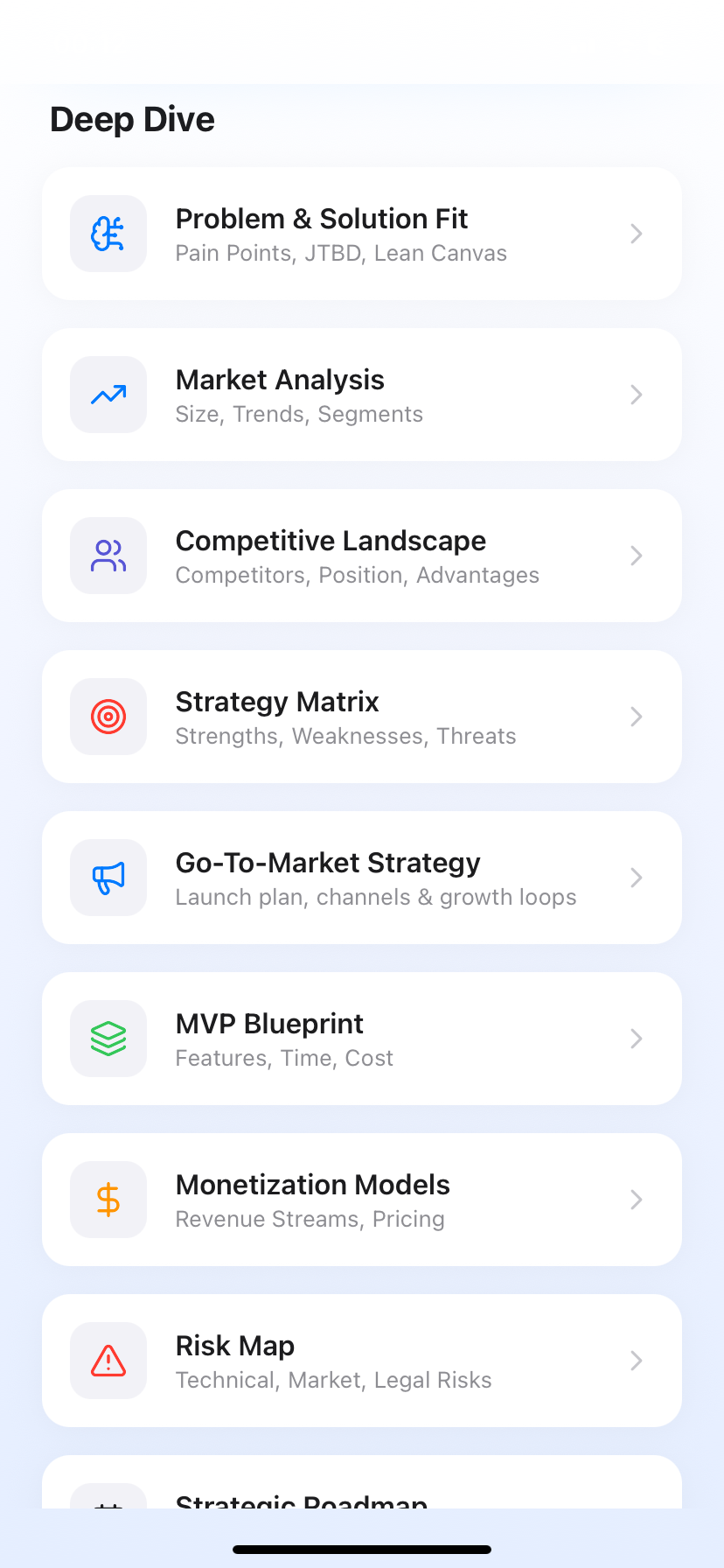
IdeaX: The Ultimate Red Team
Input your startup idea and let IdeaX mathematically benchmark your features against invisible market threats.
How to Mentally Survive the Stress Test
Receiving an automated report detailing exactly why your dream company is likely to fail is a painful experience. Many founders instinctively reject the AI's conclusions, declaring that the algorithm "just doesn't get the vision."
This is the final trap. The purpose of the stress test is not to discourage you; it is to fortify you. If the AI identifies a critical weakness in your supply chain reliability, that is not a reason to quit. It is a prioritized directive. Your very first task as a CEO is to fix that supply chain vulnerability before writing code.
Conclusion: Validation Velocity
Every structurally irredeemable idea that you quickly kill gives you back months of your life. Using AI for stress testing drastically increases your "validation velocity"—the speed at which you can cycle through bad ideas until you inevitably land on the one model that easily survives the Red Team.